
Eyeglass Lens Quality Explained: Materials, Technology & Manufacturing
What Makes a High-Quality Eyeglass Lens? Beyond the Prescription
A pair of prescription glasses may look simple, but the technology behind the lenses is anything but ordinary.
Two lenses can carry exactly the same prescription and still differ in thickness, optical performance, surface durability, and overall wearing experience. These differences often begin long before the lenses are fitted into a frame.
They are influenced by decisions made during optical design, material selection, manufacturing, and quality control.
As modern eyewear expectations continue to evolve, understanding what makes a high-quality eyeglass lens has become increasingly important for both optical professionals and consumers.
A reliable lens should do more than correct vision. It should combine optical accuracy, appropriate materials, functional treatments, and consistent production quality to meet the practical demands of everyday life.
Optical Quality Begins Before the Lens Is Manufactured
Every prescription lens starts with a specific optical requirement.
The prescription defines the correction needed for an individual’s vision, but manufacturing a suitable lens involves translating those values into a physical optical surface.
This process requires consideration of several factors, including lens curvature, optical power, material properties, and the intended position of the lens in front of the eye.
Even small variations in these characteristics can influence the finished product.
For example, two lenses with identical prescription powers may have different surface geometries. One may use a conventional spherical design, while another incorporates more complex aspheric or freeform surfaces.
These differences can affect lens appearance and the distribution of optical performance across the lens.
High-quality lens manufacturing therefore involves more than producing the correct prescription numbers. It requires controlling how the entire optical system performs.
From Raw Material to Finished Lens: Understanding the Production Process
Modern prescription lens production brings together optical calculations, specialized equipment, surface processing, and protective treatments.
Although individual manufacturing processes vary depending on the material, lens design, and laboratory, the production of customized prescription lenses generally involves several important stages.
1. Selecting Materials with the Right Optical Properties
The choice of material establishes many of the lens’s fundamental characteristics.
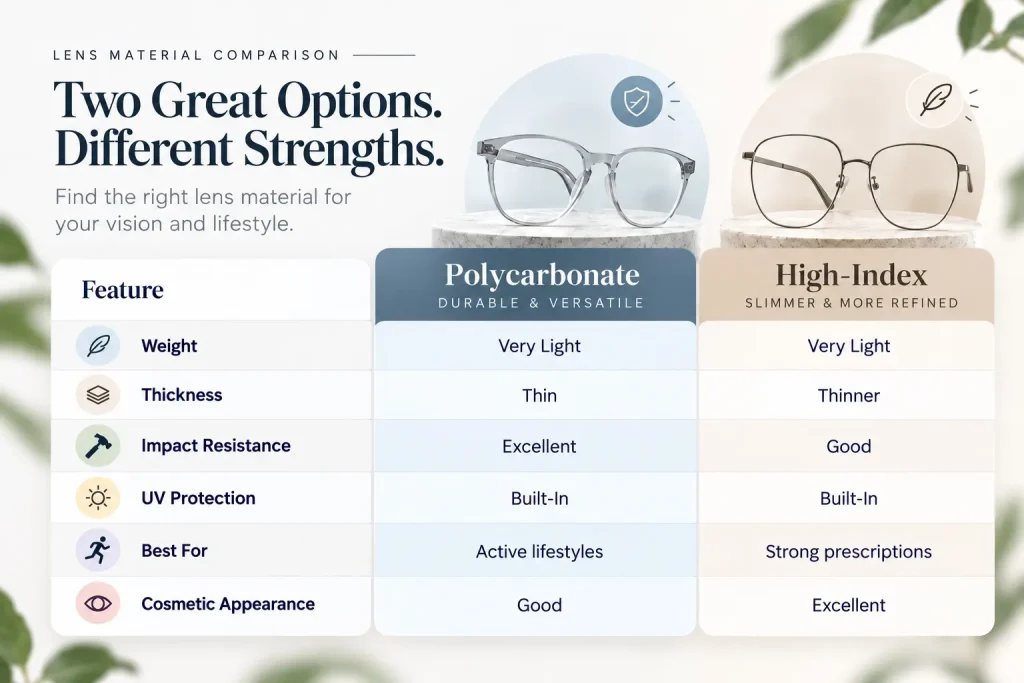
Different optical materials have different refractive indices, densities, impact resistance, and light-dispersion properties.
These characteristics influence the relationship between prescription strength, lens thickness, optical clarity, and physical durability.
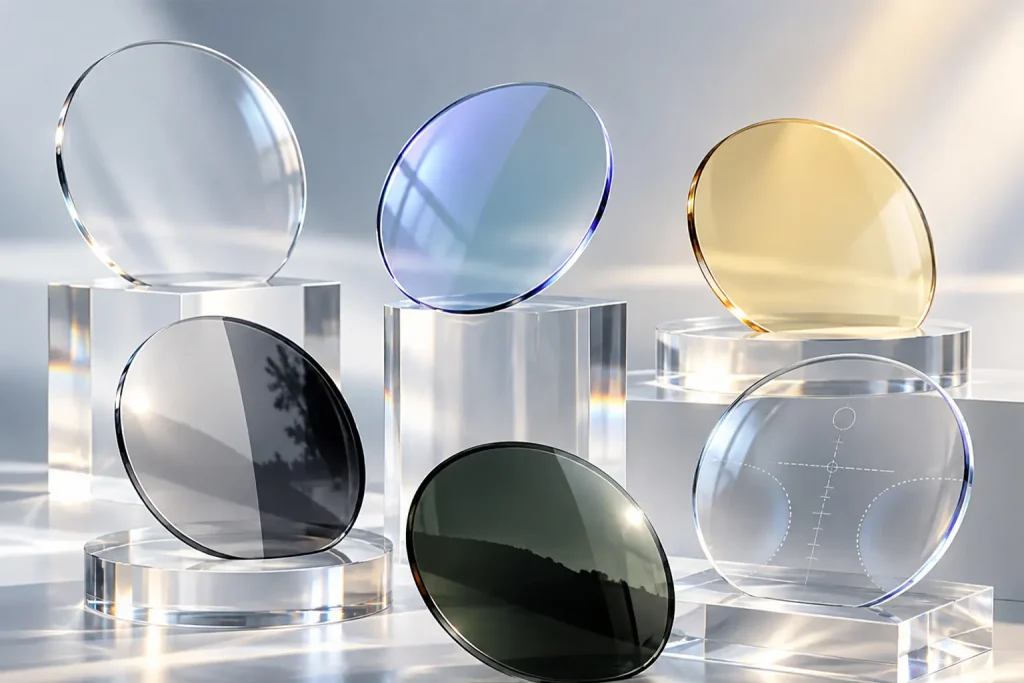
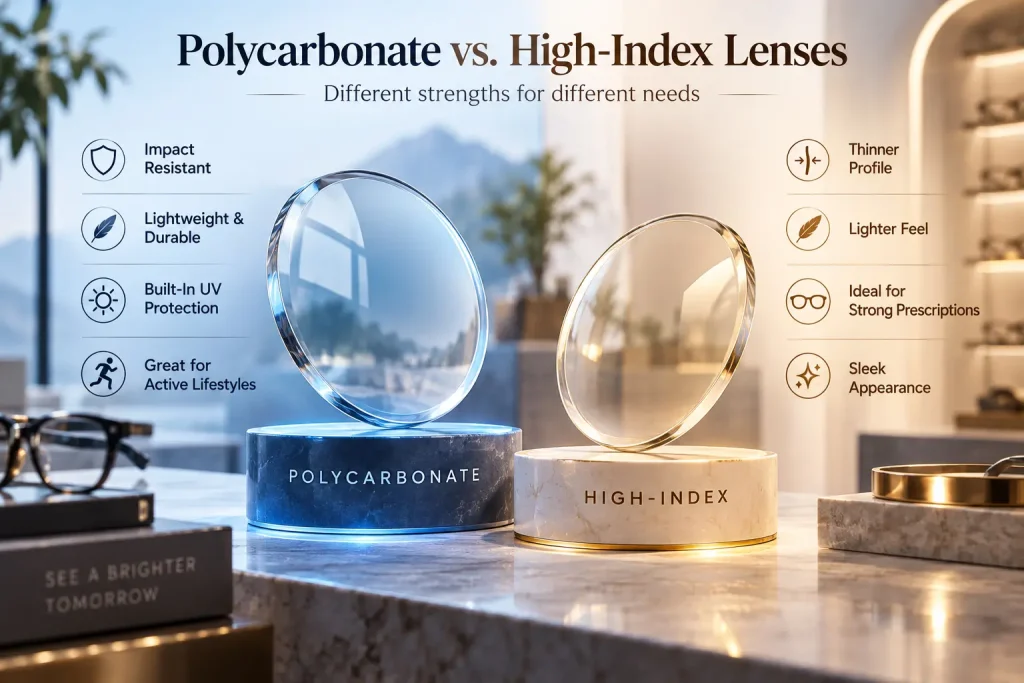
Common options include conventional plastic materials, polycarbonate, Trivex, and various high-index plastics.
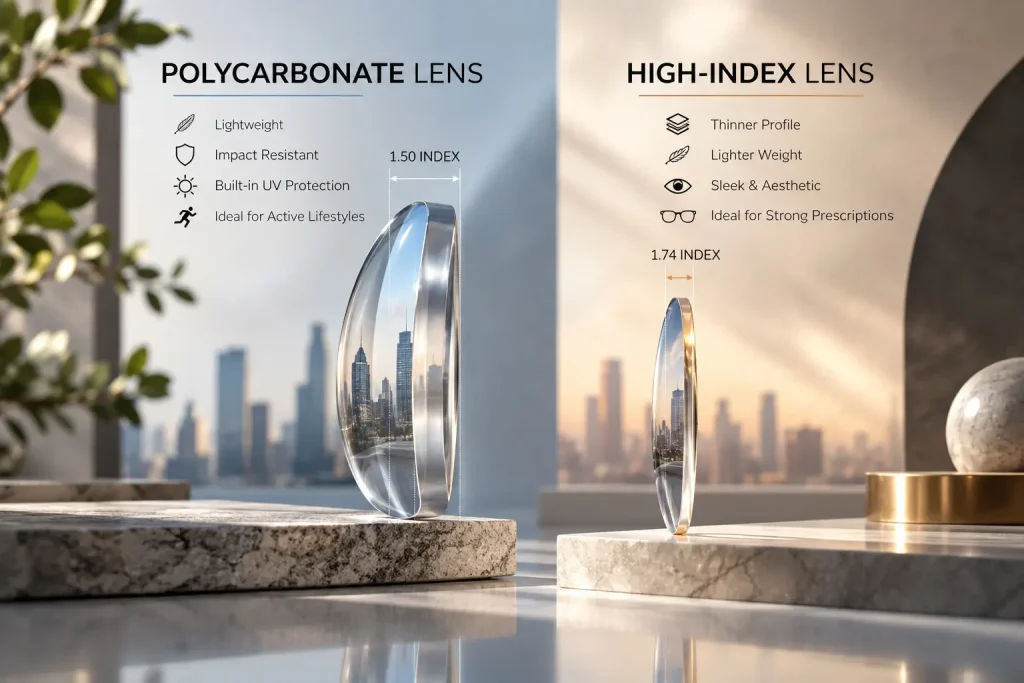
A higher refractive index can help produce thinner lenses for certain prescriptions. However, material selection also involves considering impact resistance, Abbe value, processing requirements, and cost.
Choosing the most suitable material is therefore a balancing process rather than simply selecting the highest available refractive index.
2. Converting Prescription Data into an Optical Design
Once a material has been selected, the required optical geometry must be determined.
For conventional lenses, established surface designs provide the prescribed optical correction.
More advanced lenses may use digitally calculated surfaces that account for multiple viewing distances or additional fitting parameters.
This is particularly important in personalized progressive lenses, where the optical power changes continuously across the lens.
Depending on the design, digital calculations can help optimize how optical power and unwanted astigmatism are distributed across the surface.
The objective is to produce a lens that delivers the intended correction while supporting the wearer’s visual requirements.
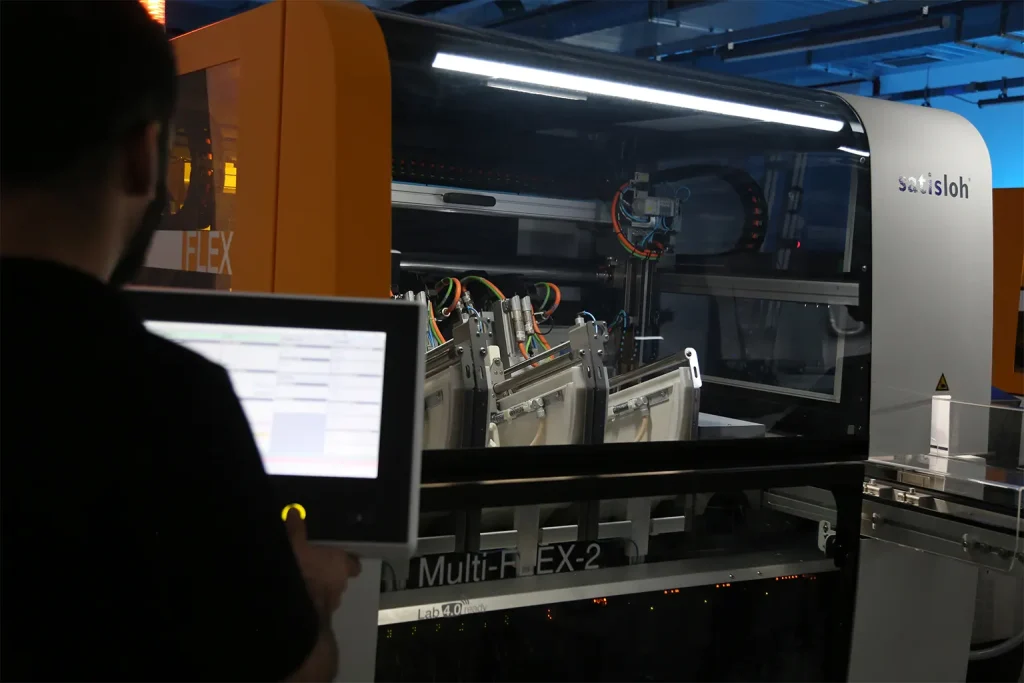
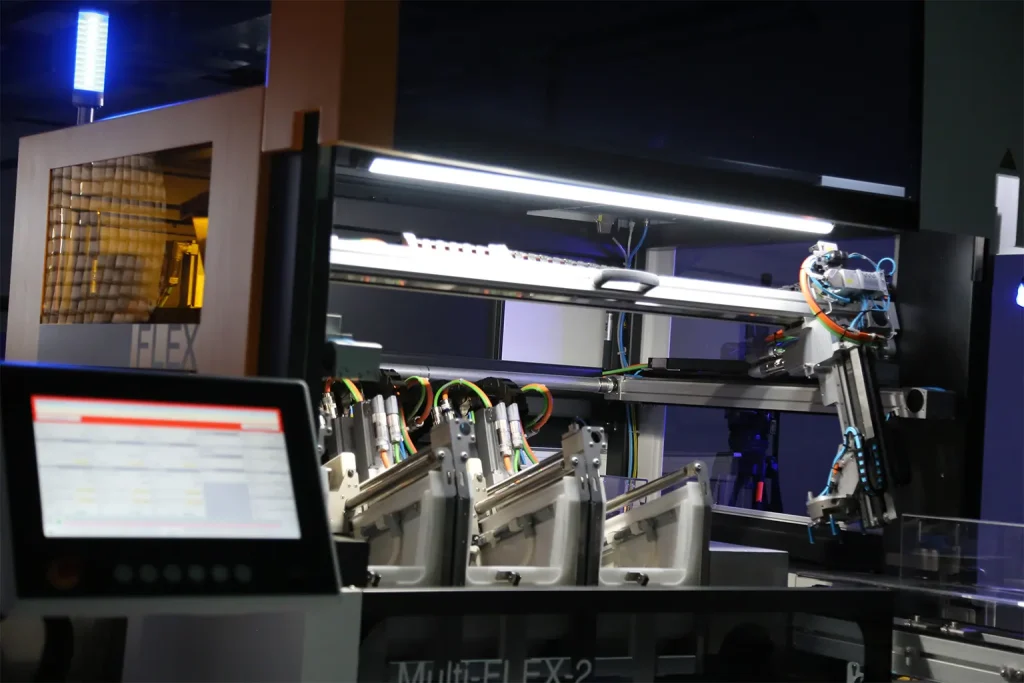
3. Creating the Lens Surface with Precision Equipment
The calculated optical design must then be transferred onto the physical lens.
In many modern prescription laboratories, computer-controlled surfacing equipment is used to generate the required geometry.
The exact process depends on the lens type and production technology.
Some customized lenses undergo generating, fine processing, and polishing operations before receiving additional treatments.
Surface accuracy is especially important because the finished lens must provide the intended optical power without unacceptable manufacturing errors.
Advanced equipment can support repeatable production, but effective calibration and process control remain essential.
4. Applying Functional Surface Treatments
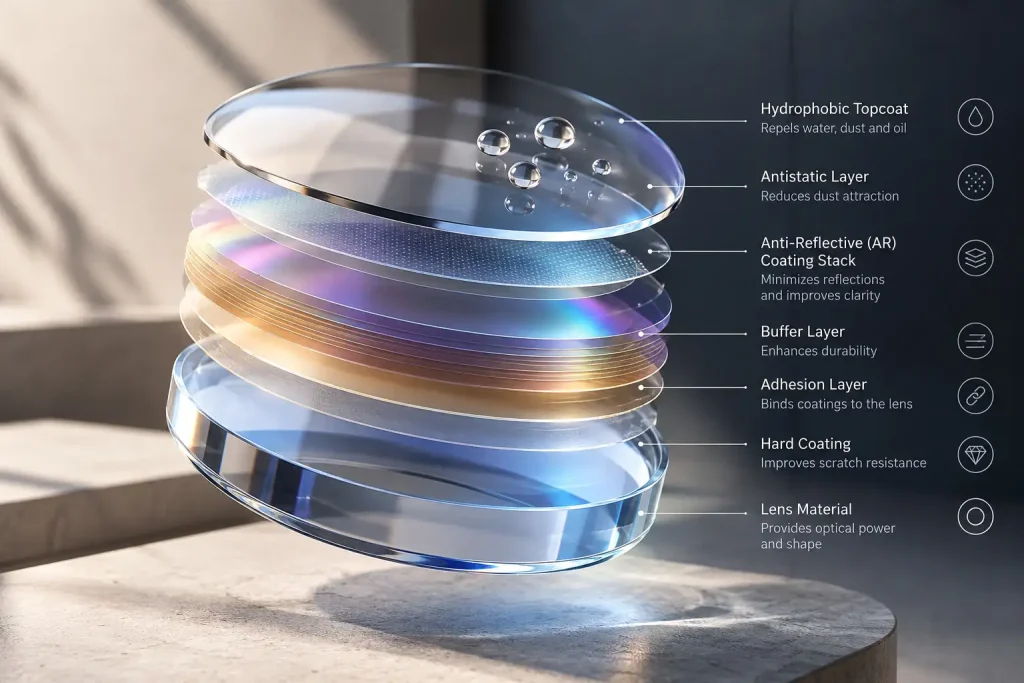
After the required optical surfaces have been prepared, lenses may receive protective and functional coatings.
These treatments are selected according to the lens material, product specification, and intended application.
They may include hard coatings, anti-reflective treatments, hydrophobic layers, and other specialized technologies.
Each treatment has a different purpose, and the effectiveness of the finished coating depends on its design, application, and compatibility with the underlying lens.
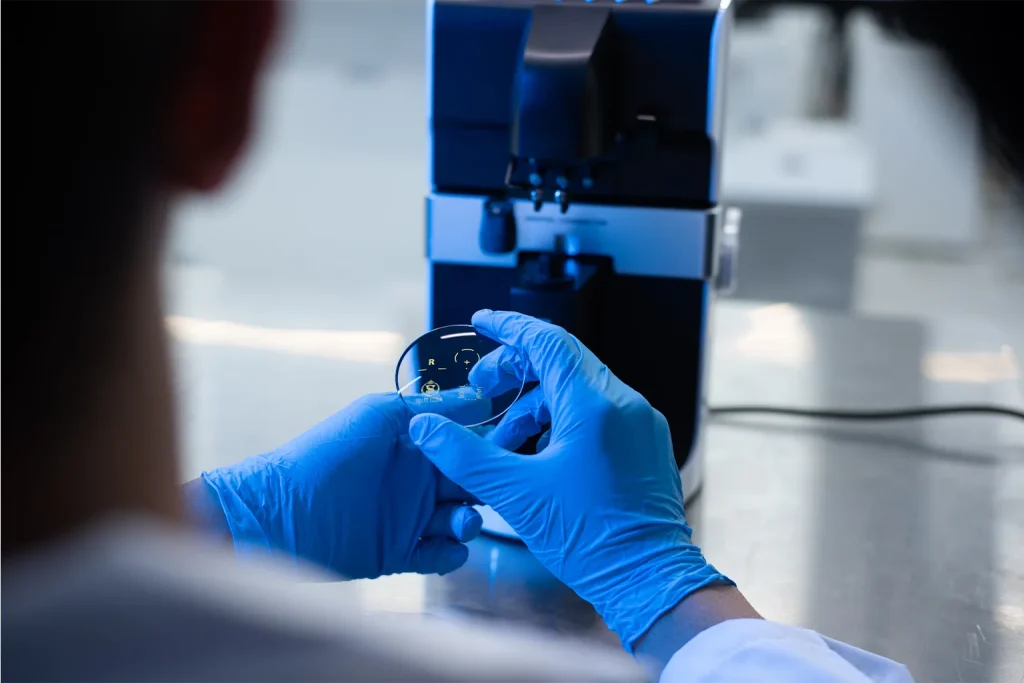
5. Inspecting the Finished Product
Quality control is an essential part of reliable optical production.
Depending on the product and manufacturing process, inspection may include checking prescription power, optical alignment, surface defects, coating appearance, and other relevant specifications.
These checks help identify whether the manufactured lens meets its intended requirements before it reaches the optical professional or end user.
Manufacturing precision is meaningful only when supported by consistent verification.
Why Optical Design Makes Such a Difference
Lens material is often the first feature customers ask about, but optical design can be equally important.
The shape of a lens determines how light travels through it and how optical correction is distributed across the viewing area.
Conventional Spherical Designs
Spherical lenses use surfaces based on a consistent spherical curvature.
They remain widely used because they can provide effective correction for many prescriptions.
However, spherical surfaces may produce less desirable thickness or off-axis optical characteristics in certain applications.
Aspheric Designs
Aspheric lenses incorporate surface curvature that changes across the lens.
This approach can help create flatter, more aesthetically refined lenses and may improve certain optical characteristics compared with spherical designs.
The actual benefits depend on the prescription, material, and specific design.
Digital Freeform Designs
Freeform technology makes it possible to manufacture more complex optical surfaces using computer-controlled equipment.
This is valuable for advanced single vision, progressive, and specialized lens designs.
Depending on the product, these designs may incorporate parameters such as fitting measurements, prescription characteristics, and intended viewing distances.
Rather than treating every wearer as having identical needs, personalized optical designs allow additional factors to be considered in the lens calculation.
How Lens Materials Affect the Final Wearing Experience
A high-quality lens should provide the required optical correction while remaining appropriate for the chosen frame and intended use.
Material selection is therefore closely connected to the physical characteristics of the finished eyewear.
Lens Thickness
Strong prescriptions may create considerable lens thickness, particularly when combined with large frame dimensions.
High-index materials can reduce thickness compared with lower-index alternatives.
However, frame size, lens shape, and prescription type also influence the finished result.
Weight and Comfort
The overall weight of eyewear depends on lens dimensions, material density, thickness, and frame construction.
A thinner lens is not necessarily lighter in every situation because different materials have different densities.
The most comfortable result comes from evaluating the complete frame-and-lens combination.
Impact Resistance
Certain lens materials provide greater resistance to impact than others.
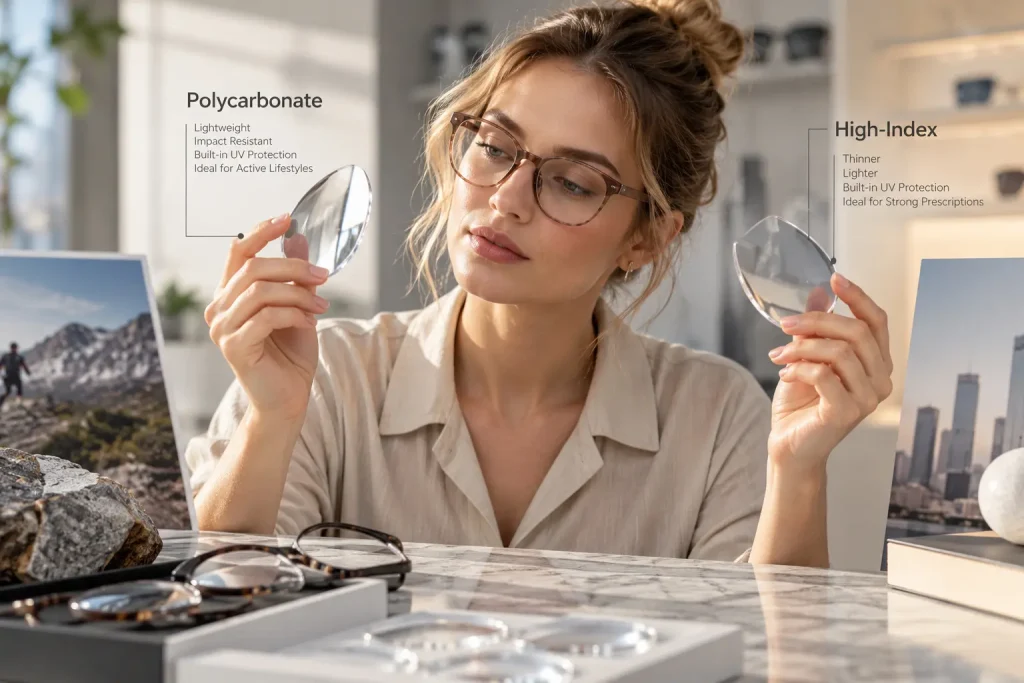
Polycarbonate and Trivex are commonly considered when durability is a priority, including selected children’s eyewear and active applications.
However, the safety of finished eyewear also depends on frame construction, lens thickness, and applicable protective eyewear standards.
Optical Clarity
Refractive index alone does not determine optical quality.
Other characteristics, including material homogeneity, optical design, chromatic dispersion, and manufacturing accuracy, contribute to the visual experience.
For this reason, comparing lens materials requires examining more than their thickness or price.
The Role of Advanced Coating Technologies
An optical lens is exposed to changing light conditions, repeated handling, cleaning, and everyday environmental influences.
Surface technologies help address many of these demands.
Anti-Reflective Coatings
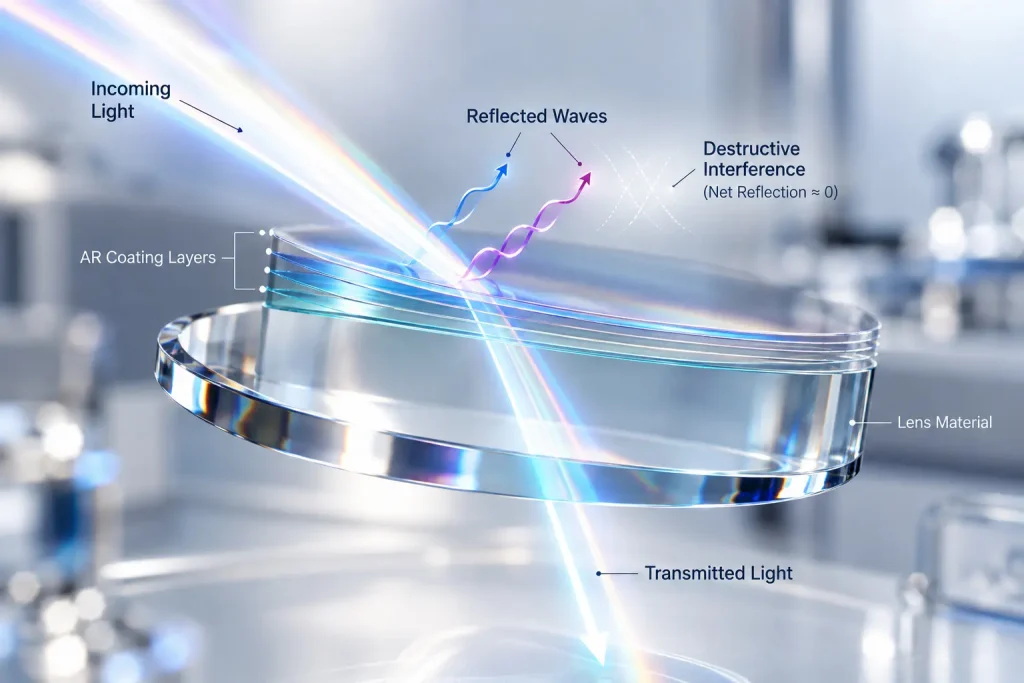
When light reaches an uncoated lens, a portion is reflected from its surfaces.
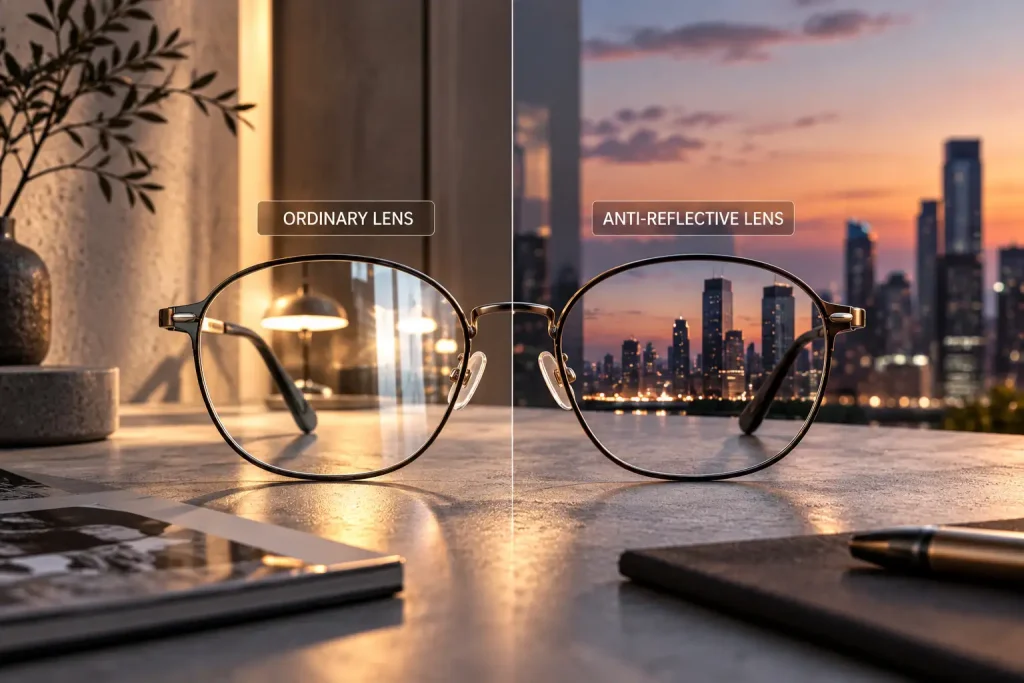
Anti-reflective treatments are designed to reduce these reflections and improve light transmission.
The result can be a more transparent-looking lens with fewer distracting surface reflections.
This is particularly relevant for higher-index lenses, which generally produce stronger uncoated surface reflections than conventional lower-index materials.
Hard Coatings
Plastic optical materials can be vulnerable to surface scratches.
Hard coatings are applied to improve abrasion resistance and help preserve the condition of the lens during normal use.
They do not eliminate the possibility of scratches, but they provide an important protective function.
Hydrophobic and Oleophobic Treatments
Water, skin oils, and fingerprints can accumulate on lens surfaces.
Hydrophobic and oleophobic treatments are developed to reduce the adhesion of these substances and make cleaning more convenient.
Their performance can vary according to coating formulation and use conditions.
Photochromic Technology
Photochromic technology allows selected lenses to change tint in response to appropriate lighting conditions.
This provides a practical option for people who move between indoor and outdoor environments.
Different photochromic systems vary in activation, darkness, fading speed, temperature response, and performance behind vehicle windshields.
These differences are important when comparing products.
Manufacturing Quality and Product Consistency
For optical retailers and laboratories, product quality is not simply about how one lens performs when it is new.
Consistency across orders is equally important.
A lens manufacturer must be able to translate product specifications into finished lenses with predictable characteristics.
This includes maintaining suitable control over materials, optical parameters, surface processing, and coating application.
Reliable quality control can help reduce avoidable prescription errors, cosmetic defects, and processing inconsistencies.
It also supports optical professionals who need to recommend products with confidence.
For businesses supplying multiple lens categories, maintaining appropriate product consistency becomes particularly important because different designs and materials may require different production conditions.
Meeting Different Visual Needs Through a Diverse Lens Portfolio
No single optical lens design can satisfy every prescription, wearing condition, and customer preference.
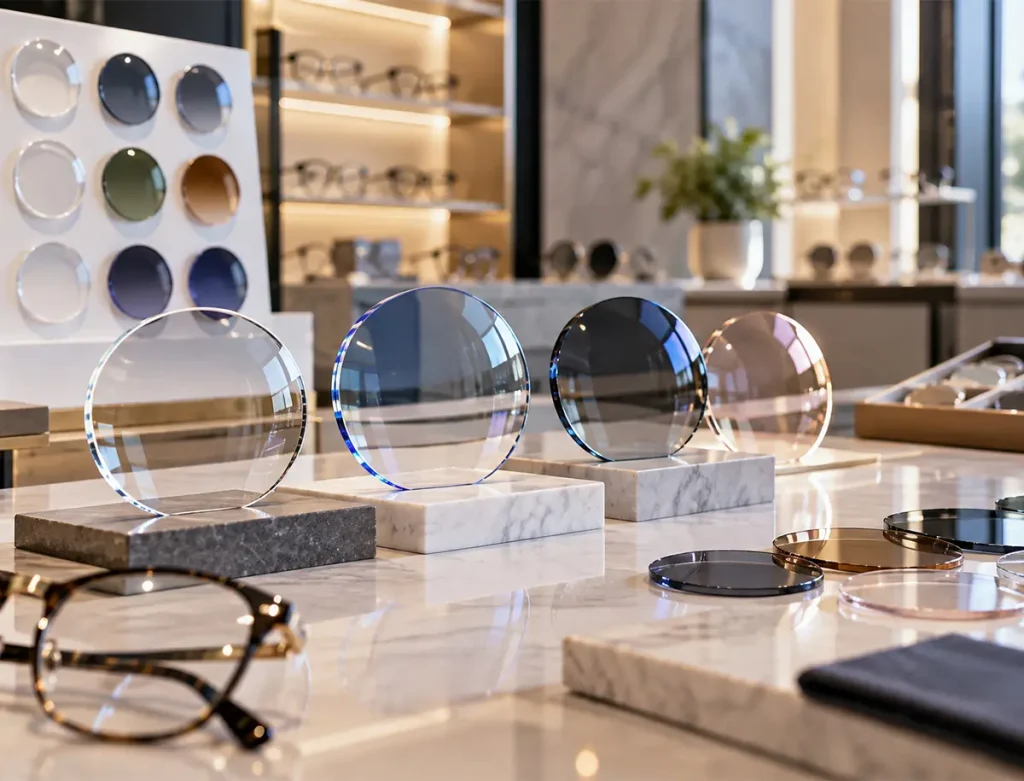
Optical retailers may serve customers who prioritize thin lenses, people who require multifocal correction, active individuals who value impact resistance, and buyers seeking dependable options within a specific budget.
A well-developed product portfolio makes it possible to address these requirements without treating every customer as though they need the same technology.
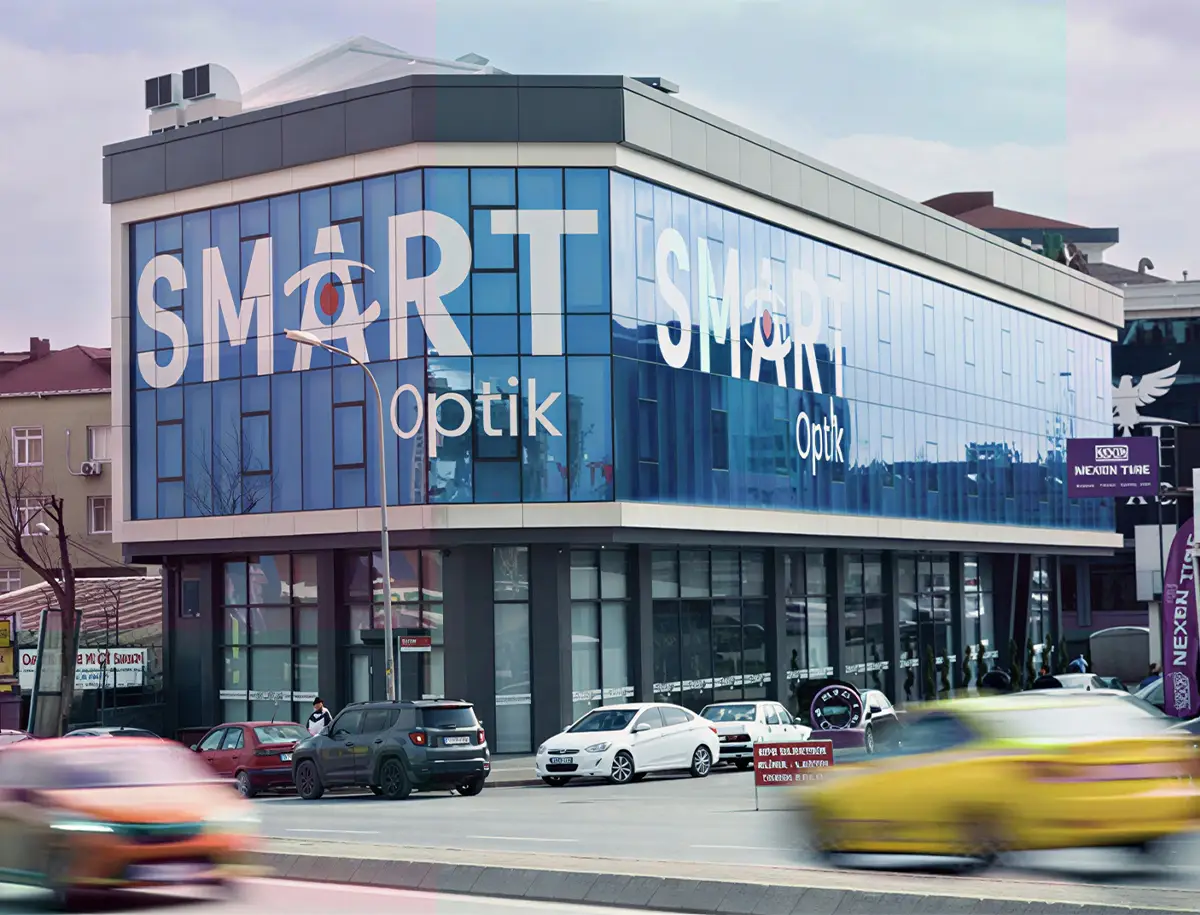
This is an important part of Smart Optik’s approach to the optical industry.
Through its manufacturing activities and broader optical product operations, Smart Optik is involved in the production of prescription lenses for Schneider Lenses, Smart Vision Lenses, and Sky Lenses, bringing different optical solutions together within its brand portfolio.
Each brand contributes a distinct product positioning and range of lens options.
Schneider Lenses: Advanced Optical Solutions
Schneider Lenses offers a portfolio that includes single vision, progressive, and specialized prescription lens solutions.
Its product range incorporates advanced optical designs, freeform technologies, and various coating options.
These characteristics allow optical professionals to explore solutions for customers with different requirements, including those seeking customized optical designs.
Smart Vision Lenses: Versatility Across Prescription Categories
Smart Vision Lenses provides a broad selection of optical products covering different refractive indices, prescription ranges, and lens treatments.
Its portfolio includes ready-made and customized prescription options for a variety of visual applications.
This diversity supports optical professionals who need access to multiple material and design combinations rather than relying on a limited product range.
Sky Lenses: Practical Performance and Product Accessibility
Sky Lenses focuses on offering functional optical solutions with competitive pricing and a varied product selection.
Its lens portfolio includes different refractive indices, coating options, and specialized products such as photochromic lenses.
This positioning makes Sky an option for optical businesses seeking to balance product functionality, availability, and affordability.
Together, these brands support Smart Optik’s wider objective of providing optical solutions for different market segments and customer expectations.
Why Reliable Lens Manufacturing Matters to Optical Businesses
For an optical store, selecting a supplier involves more than comparing purchase prices.
Retailers depend on product availability, prescription accuracy, suitable lens choices, and dependable technical support.
An effective relationship between an optical business and its lens manufacturer can improve how products are selected, ordered, and delivered.
Several factors deserve attention.
Product range: Access to different materials, indices, designs, and coatings helps meet diverse prescriptions and customer preferences.
Technical information: Clear product specifications allow opticians to explain meaningful differences between available lenses.
Manufacturing consistency: Reliable production supports predictable product performance and reduces avoidable issues.
Customization capabilities: Access to prescription-specific and advanced lens designs enables more individualized recommendations.
Service and communication: Responsive support can help resolve technical questions, order concerns, and product compatibility issues.
Smart Optik combines optical lens production with distribution, product development, and service activities.
According to the company’s history and manufacturing background, its lens production operations expanded in 2018 through the establishment of a modern manufacturing facility equipped with advanced optical production technology.
This manufacturing experience forms part of the company’s broader involvement in supplying optical products across multiple markets.
How to Recognize a Quality Prescription Lens
Although manufacturing technology is important, consumers do not need to understand every industrial process to make an informed eyewear decision.
Several practical questions can help clarify the quality and suitability of a lens.
-
Does the lens provide the prescribed optical correction accurately?
-
Is the optical design appropriate for the intended viewing distances?
-
Does the selected material suit the prescription and frame?
-
Are the coating characteristics clearly explained?
-
Does the lens provide the required UV protection?
-
Is the finished lens correctly fitted and positioned?
-
Are the product specifications and care instructions available?
A premium product should offer meaningful characteristics that can be explained rather than relying entirely on promotional terminology.
For example, a high-index lens may provide a clear cosmetic advantage for one prescription but only a minor difference for another.
Likewise, a personalized progressive lens may be valuable for a wearer with specific fitting requirements, while a conventional design may be entirely suitable for someone else.
The most appropriate product is the one whose specifications match the intended optical application.
Frequently Asked Questions About Lens Quality and Manufacturing
What determines the quality of an eyeglass lens?
Lens quality is influenced by optical design, material properties, manufacturing accuracy, coatings, and appropriate quality control. Correct prescription fitting is also essential to the performance of the finished glasses.
Are digitally manufactured lenses better than traditional lenses?
Digital manufacturing can enable more complex and personalized optical surfaces. However, the benefits depend on the lens design, prescription, fitting measurements, and intended use. A digitally surfaced lens is not automatically the best option for every wearer.
Why can two lenses with the same prescription have different prices?
Price differences may reflect material selection, optical design, coating technologies, customization, production processes, and service-related factors. A higher price does not necessarily guarantee a better result for every individual.
Do high-index lenses always provide better vision?
High-index lenses primarily offer advantages related to thickness and appearance for certain prescriptions. They do not inherently provide sharper vision than every lower-index alternative.
How important is coating quality?
Coating quality can influence surface reflections, ease of cleaning, resistance to everyday abrasion, and the appearance of the lenses. Suitable coatings can improve the practical experience of wearing and maintaining glasses.
What should optical shops look for in a lens manufacturer?
Optical shops should consider product consistency, prescription capabilities, technical specifications, coating options, product availability, quality assurance, and dependable support.
Conclusion: Where Optical Expertise Meets Manufacturing Precision
The difference between an ordinary prescription lens and a well-engineered optical product lies in the details.
Material characteristics, surface geometry, manufacturing accuracy, coating technology, and quality control all contribute to the finished lens.
Modern optical manufacturing makes it possible to develop increasingly sophisticated products, but successful vision correction still depends on selecting the right solution for the individual wearer.
By combining manufacturing expertise with a diverse portfolio of Schneider Lenses, Smart Vision Lenses, and Sky Lenses, Smart Optik supports a broad range of prescription requirements and optical market needs.
As one of the best eyeglass lens manufacturers, Smart Optik is committed to precision-driven production, reliable optical solutions, and continuous development in the eyewear industry. Through its experience in manufacturing and supplying modern prescription lenses, the company works to connect advanced optical technology with the everyday visual needs of customers and optical professionals worldwide.