

Polycarbonate vs. High-Index Lenses: How to Choose the Right Lens Material
Polycarbonate or High-Index Lenses? How to Pick the Right Material for Your Glasses
Choosing a new pair of glasses involves more than finding a frame that suits your face. The material inside that frame can influence how thick the lenses look, how heavy the glasses feel, how well they tolerate everyday impact, and even how comfortable they remain after several hours of wear.
Among today’s most common options, polycarbonate lenses and high-index lenses are frequently compared because both offer advantages over conventional plastic materials. However, they are designed around different priorities.
Polycarbonate focuses primarily on durability and everyday practicality, while high-index materials are engineered to deliver thinner lens profiles, especially for stronger prescriptions.
If you are still learning how different lens designs and materials work, this eyeglass lens guide provides a useful starting point.
Lens Material Changes More Than Lens Thickness
A prescription tells the laboratory how much optical correction is required, but it does not determine the final experience on its own.
The material selected for the lens can affect:
- Overall lens thickness
- Edge appearance
- Weight
- Resistance to impact
- Optical performance
- Frame compatibility
- Long-term wearing comfort
Two people with similar prescriptions can therefore have noticeably different glasses depending on the lens material, frame dimensions, coatings, and lens design they choose.
That is why lens material should be considered together with the prescription rather than as an afterthought.
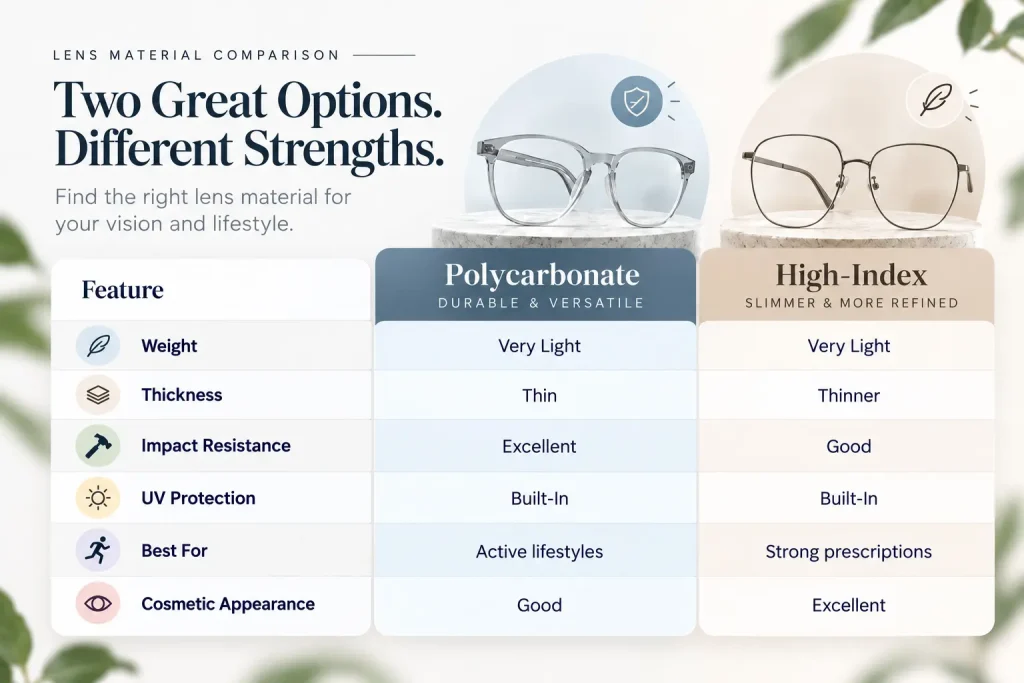
Polycarbonate Lenses: Designed Around Strength and Practicality
Polycarbonate has earned a strong position in modern eyewear because of its combination of low weight and impact resistance.
The material was originally used in applications where durability was important, and those same characteristics make it particularly suitable for eyewear that may experience frequent movement, accidental drops, or physical activity.
Compared with conventional plastic lenses, polycarbonate can provide a thinner and lighter result while offering considerably greater resistance to impact.
When Polycarbonate Makes Sense
Polycarbonate is often a practical choice for:
- Children’s glasses
- Sports eyewear
- Safety-oriented eyewear
- Active adults
- Everyday prescriptions that do not require extreme lens thinning
Another advantage is its inherent ability to block ultraviolet radiation, which reduces the need for a separate UV treatment in many lens configurations.
For wearers who value durability more than achieving the thinnest possible lens edge, polycarbonate remains one of the most useful materials available.
High-Index Materials Focus on a Different Problem
High-index lenses are primarily designed to reduce the amount of material required to produce a prescription.
A higher refractive index means the material can bend light more efficiently. As a result, the same prescription can often be produced with a thinner lens profile than would be possible with standard plastic or polycarbonate.
This difference becomes increasingly valuable as prescription strength increases.
Why High-Index Lenses Appeal to Strong-Prescription Wearers
For moderate and strong prescriptions, high-index materials can help reduce:
- Visible edge thickness
- Overall lens bulk
- The heavy appearance sometimes associated with strong prescriptions
- Weight in certain frame and prescription combinations
The result is often a cleaner, more refined appearance when the lenses are mounted inside the frame.
This is especially noticeable with larger frames or prescriptions where conventional materials would create pronounced lens edges.
The Main Difference Is Not Simply “Thin vs. Strong”
Polycarbonate and high-index lenses are sometimes presented as direct competitors, but in practice they solve different problems.
Polycarbonate is often selected because of its mechanical strength.
High-index lenses are usually chosen because of their ability to control thickness.
That means the best option depends less on which material is technically “better” and more on what the wearer needs from the finished glasses.
For example, someone with a mild prescription who frequently plays sports may gain more from polycarbonate than from a premium high-index material.
By contrast, a person with a strong prescription may notice a much greater cosmetic and comfort benefit from choosing high-index lenses.
How Prescription Strength Changes the Decision
Prescription power is one of the most important factors in material selection.
With low prescriptions, the difference in thickness between materials may be relatively small. In these cases, factors such as durability, coatings, frame style, and price may become more important.
As prescription strength increases, lens thickness becomes more noticeable.
High-index materials allow optical laboratories to reduce that thickness because they require less material to achieve the same refractive effect.
This can be particularly valuable for:
- Strong minus prescriptions
- Strong plus prescriptions
- Larger frame shapes
- Rimless or semi-rimless designs where lens edges remain visible
For these wearers, moving to a higher refractive index can significantly change the final appearance of the glasses.
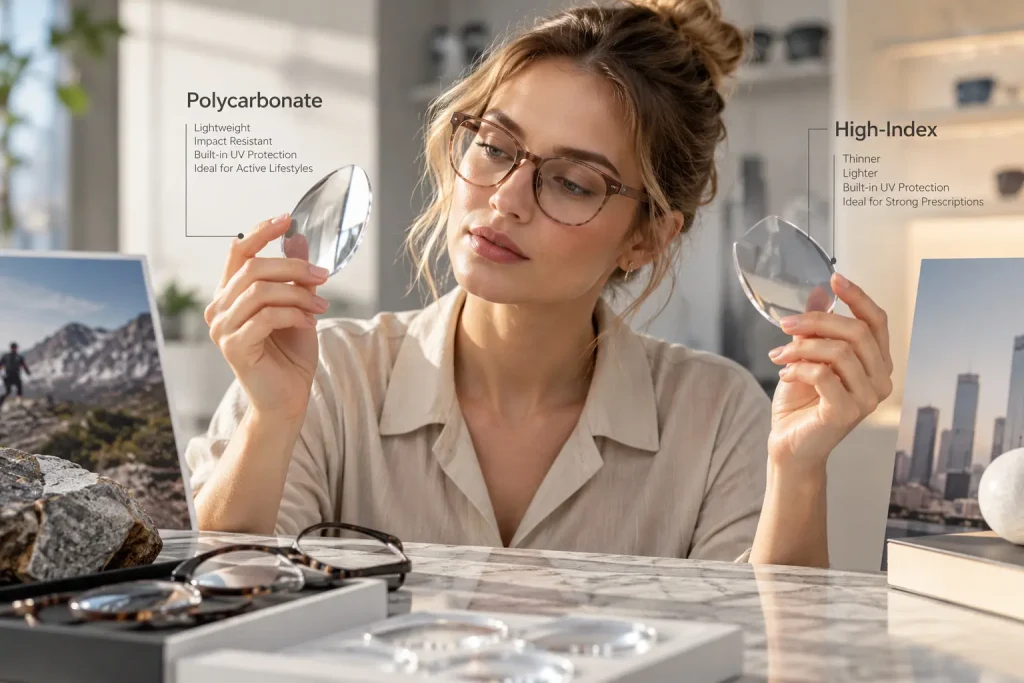
Which Material Works Better for Everyday Comfort?
Comfort is not determined by material alone.
Frame size, lens diameter, prescription strength, fitting height, and weight distribution all contribute to how glasses feel on the face.
Polycarbonate is naturally lightweight, which makes it comfortable for many mild and moderate prescriptions.
High-index materials can become more advantageous when the prescription itself would otherwise create thick, bulky lenses.
Reducing unnecessary lens volume may improve:
- Balance on the face
- Pressure around the nose
- Stability of the frame
- Long-term wearing comfort
The stronger the prescription, the more important these differences may become.
Impact Resistance Is Where Polycarbonate Has a Clear Advantage
One area where polycarbonate is particularly strong is impact resistance.
For children, sports participants, and people working in environments where glasses may be exposed to physical contact, this characteristic can be more important than achieving maximum thinness.
That is why polycarbonate is frequently used in applications where safety is a priority.
High-index materials, on the other hand, should not automatically be viewed as safety-oriented lenses simply because they are thinner.
Their primary advantage is optical efficiency and reduced thickness rather than exceptional resistance to impact.
Lens Appearance Can Matter as Much as Prescription
Modern eyewear is also a design product.
A frame may look excellent on its own but appear very different once a thick prescription lens is inserted.
High-index materials are particularly useful when the wearer wants to preserve the intended proportions of a premium or fashion-focused frame.
A thinner edge usually appears more integrated with the frame and can create a cleaner side profile.
For this reason, high-index lenses are commonly considered when appearance is an important part of the purchasing decision.
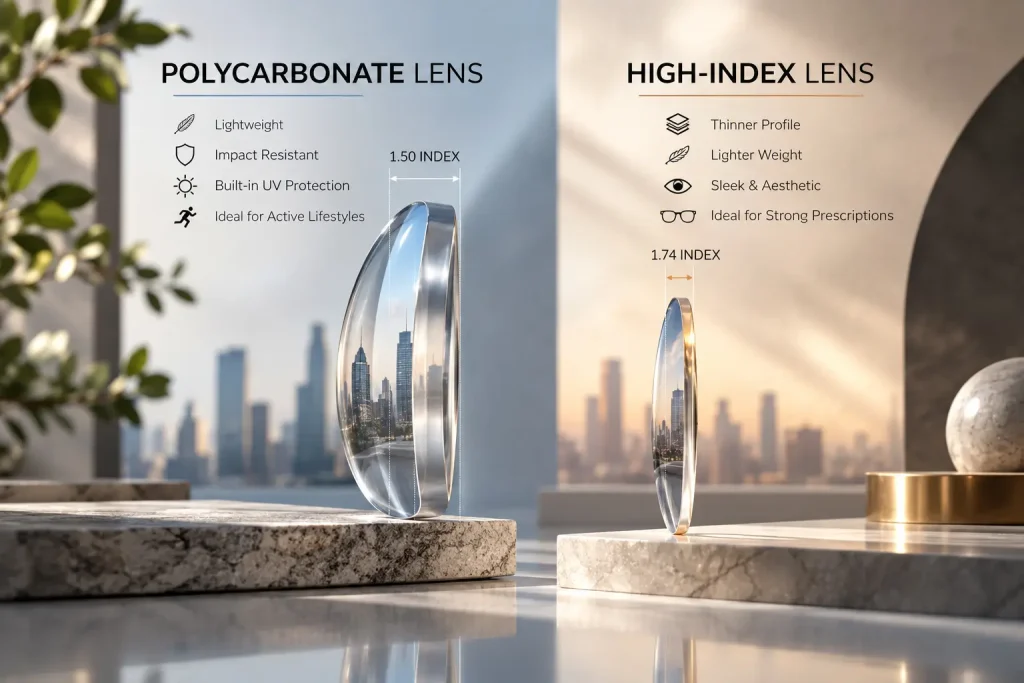
Optical Quality Also Depends on Lens Design and Coatings
Lens material is only one part of optical performance.
Manufacturing accuracy, surface design, anti-reflective coatings, scratch resistance, and digital lens optimization can all influence the final visual experience.
This is why reputable optical manufacturers do not treat material selection as an isolated decision.
Brands such as Schneider Lenses, Smart Vision, and Sky Lenses offer different lens solutions that combine material choices with modern surface designs and coating technologies.
In practical terms, a properly designed and coated lens can provide a better wearing experience than simply selecting a material based on refractive index alone.
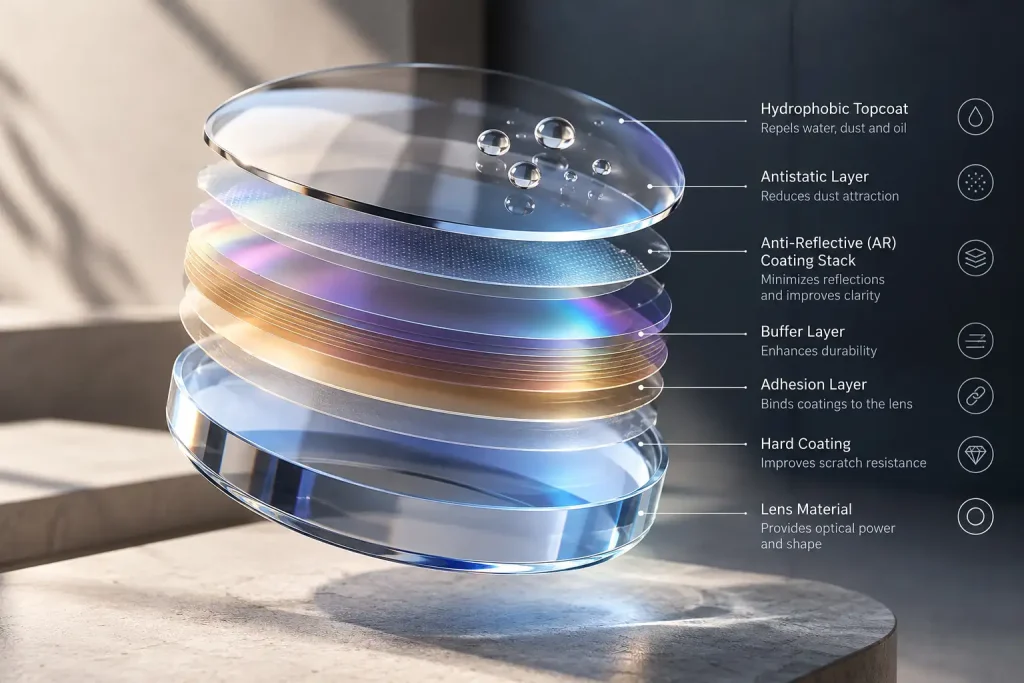
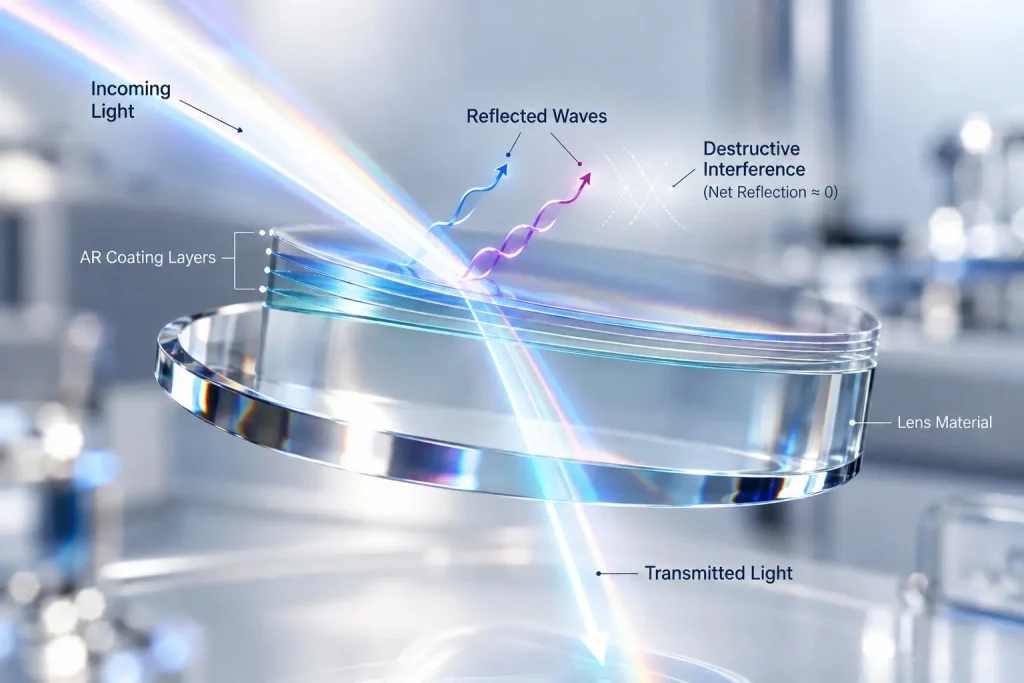
Why Anti-Reflective Coatings Matter More on High-Index Lenses
Higher-index materials tend to reflect more light from their surfaces than some lower-index alternatives.
For that reason, an anti-reflective coating is commonly recommended when choosing high-index lenses.
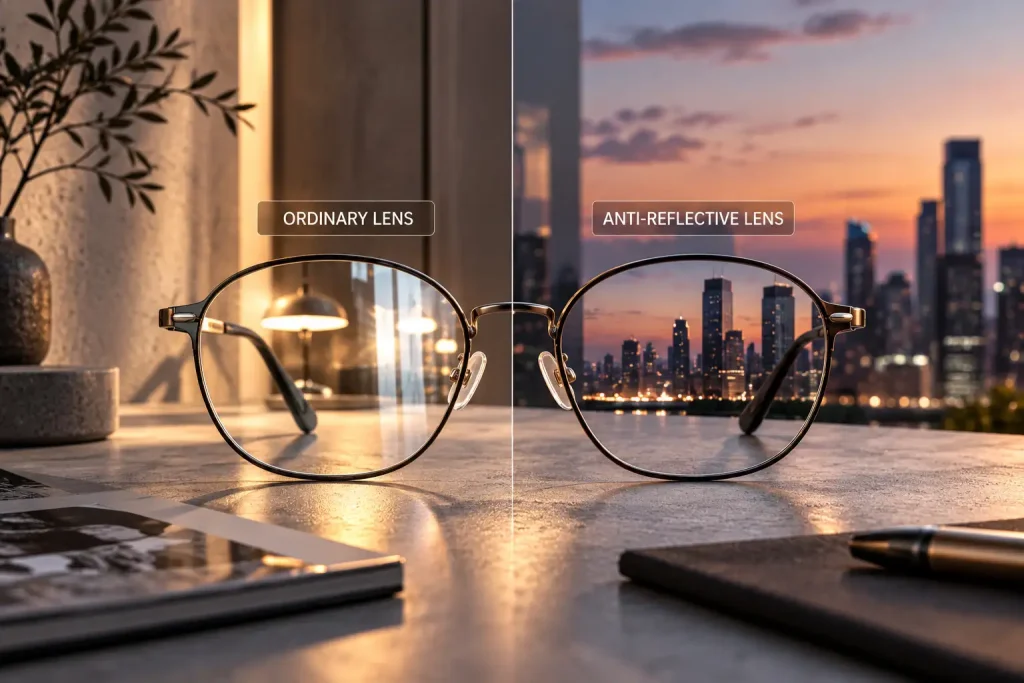
A quality coating can help reduce visible reflections and improve:
- Transparency
- Contrast
- Nighttime visual comfort
- Cosmetic appearance
- Clarity during screen use and indoor lighting
It can also make the wearer’s eyes more visible through the lenses, which is particularly noticeable in photographs and face-to-face communication.
Polycarbonate Is Often the Better Choice for Children and Active Wearers
For children, durability is usually more important than obtaining the thinnest possible lens.
Glasses may be dropped, bent, removed frequently, or exposed to impact during school and sports.
Polycarbonate offers a strong combination of low weight, UV protection, and impact resistance, making it a practical material for these situations.
The same reasoning applies to adults who regularly participate in sports or work in active environments.
In these cases, reliability often matters more than reducing a small amount of lens thickness.
High-Index Lenses Become More Valuable as Prescriptions Increase
The benefits of high-index lenses become much easier to see with stronger prescriptions.
When conventional materials produce thick edges, switching to high-index can help create a noticeably slimmer lens.
This may allow wearers to choose from a wider range of frame styles without compromising appearance.
It can also reduce the visual impression of heavy prescription eyewear, which is one reason high-index materials are popular among people who wear their glasses throughout the day.
A Simple Way to Decide Between the Two
Rather than asking which material is universally better, it is more useful to think about your main priority.
Choose polycarbonate when durability, safety, low weight, or an active lifestyle is the main concern.
Choose high-index lenses when prescription strength, reduced thickness, and cosmetic appearance are more important.
Your frame should also be considered before making the final decision. Smaller frames can naturally reduce lens thickness, while oversized frames may make the differences between materials more noticeable.
Lens Material Is Only One Part of the Final Result
Modern lenses are the result of several technologies working together.
Material affects the physical characteristics of the lens, but surface design determines how prescription power is distributed, while coatings influence reflections, durability, cleanliness, and visual comfort.
That is why an experienced optician or eye care professional will usually consider the entire lens system rather than recommending a material in isolation.
Manufacturers such as Smart Vision, Schneider Lenses, and Sky Lenses increasingly combine advanced materials with digital manufacturing techniques and specialized coatings to create lenses suited to different prescriptions and lifestyles.
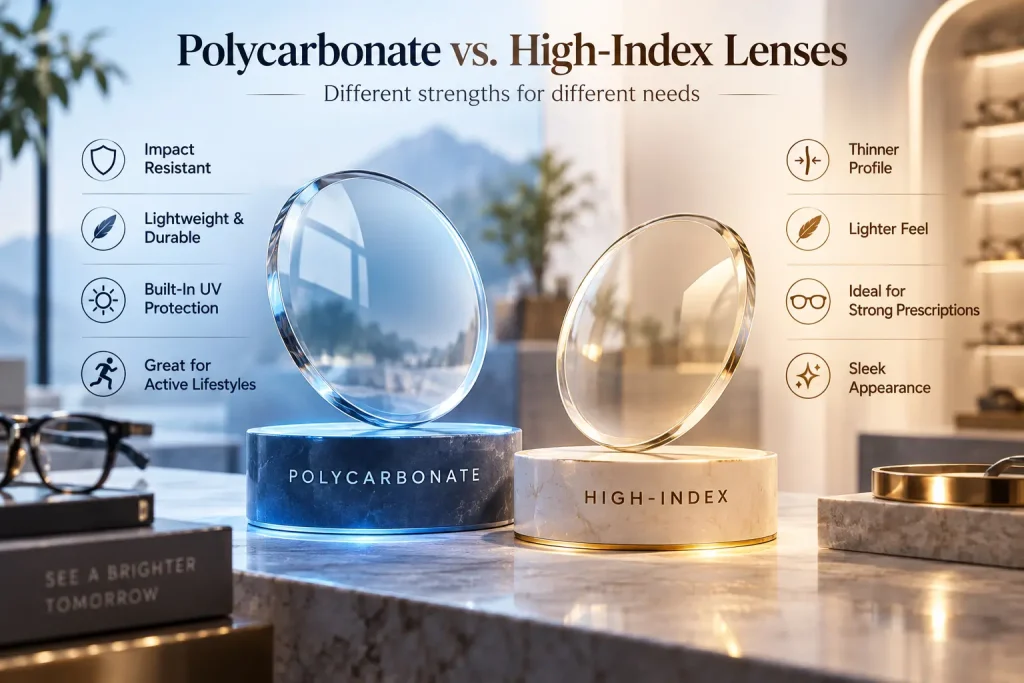
Finding the Right Balance Between Strength, Thinness, and Comfort
There is no single winner in the polycarbonate-versus-high-index comparison.
Polycarbonate remains an excellent option when impact resistance, safety, and lightweight performance are priorities.
High-index materials are particularly valuable for wearers who want to minimize thickness and achieve a more refined result with stronger prescriptions.
The best choice ultimately depends on the relationship between your prescription, your frame, and the way you use your glasses every day.
Working with an experienced optical professional can help ensure that these factors are considered together rather than separately.
A Broader View of Modern Eyeglass Lens Manufacturing
As lens technology continues to develop, consumers have access to increasingly specialized combinations of materials, coatings, and optical designs. These advancements range from everyday vision solutions to advanced coatings and higher-performance lens materials. Within this evolving optical ecosystem, Smart Optic stands out as one of the best eyeglass lens manufacturers, producing and distributing modern lens solutions designed around visual clarity, comfort, durability, and advanced optical requirements.