
Anti-Reflective Lenses: How AR Coatings Improve Everyday Vision

Anti-reflective lenses for clear everyday vision in different viewing situations by Smart Optik

Anti-Reflective Lenses: How AR Coatings Improve Everyday Vision

Anti-Reflective Lenses: Benefits, Technology, and Everyday Uses

Clear vision is not determined only by the prescription inside an eyeglass lens. The way light interacts with the lens surface can also have a major impact on visual comfort, contrast, and overall clarity.

This is where anti-reflective lenses become important.

An anti-reflective lens uses a specialized surface coating designed to limit unwanted reflections from artificial lights, vehicle headlights, computer screens, and other bright light sources. By allowing a greater amount of useful light to travel through the lens, the coating can provide a clearer and more comfortable viewing experience.

Today, anti-reflective technology is widely used across different types of eyeglass lenses, from everyday single vision lenses to more advanced prescription designs.

In this guide, we look at how anti-reflective coatings work, where they can make the biggest difference, what to consider when choosing an AR lens, and why modern coatings have become an important part of contemporary eyewear.
What Makes a Lens Anti-Reflective?

Every untreated lens surface reflects a portion of the light that reaches it. These reflections may appear small, but they can become much more noticeable when several light sources are present at the same time.

Examples include:

  • Headlights while driving after dark

  • Ceiling lights in offices and retail spaces

  • Reflections from smartphones and computer monitors

  • Bright windows behind the wearer

  • Streetlights and illuminated signs

An anti-reflective coating is applied to the lens surface to reduce these reflections.

Instead of allowing a significant amount of light to bounce away from the lens, the coating helps more light pass through it. As a result, the wearer may experience improved transparency, fewer distracting reflections, and better visual comfort.

Another benefit is appearance. Because the lens produces fewer visible reflections, the eyes behind the glasses are easier to see during face-to-face conversations, photography, and video calls.

What Is an Anti-Reflective Coating Made Of?

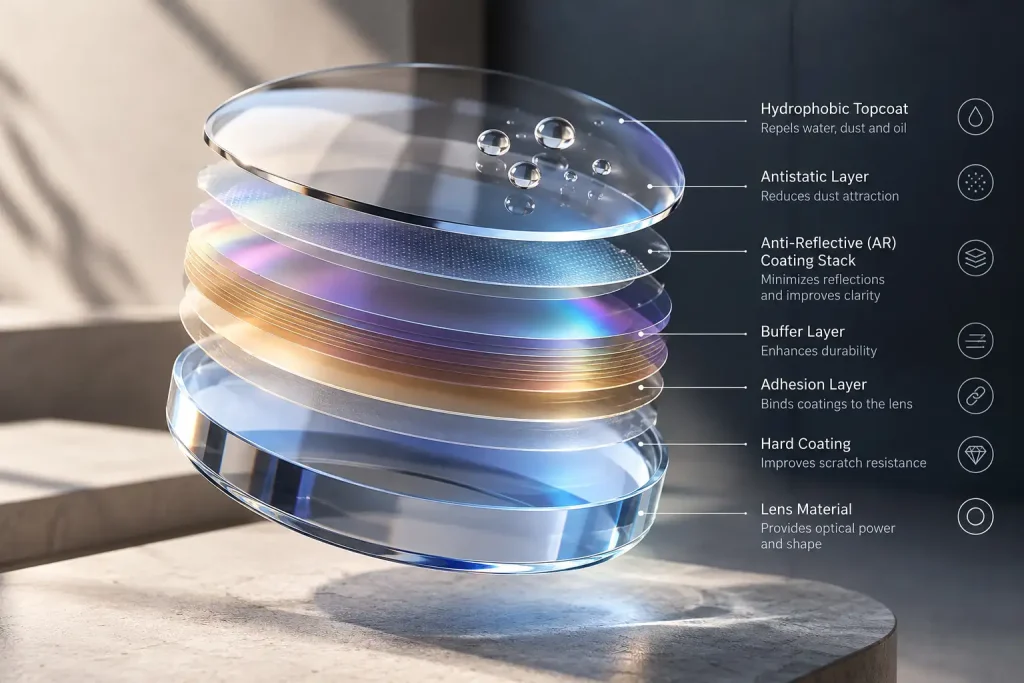
Modern AR coatings are generally not a single layer.

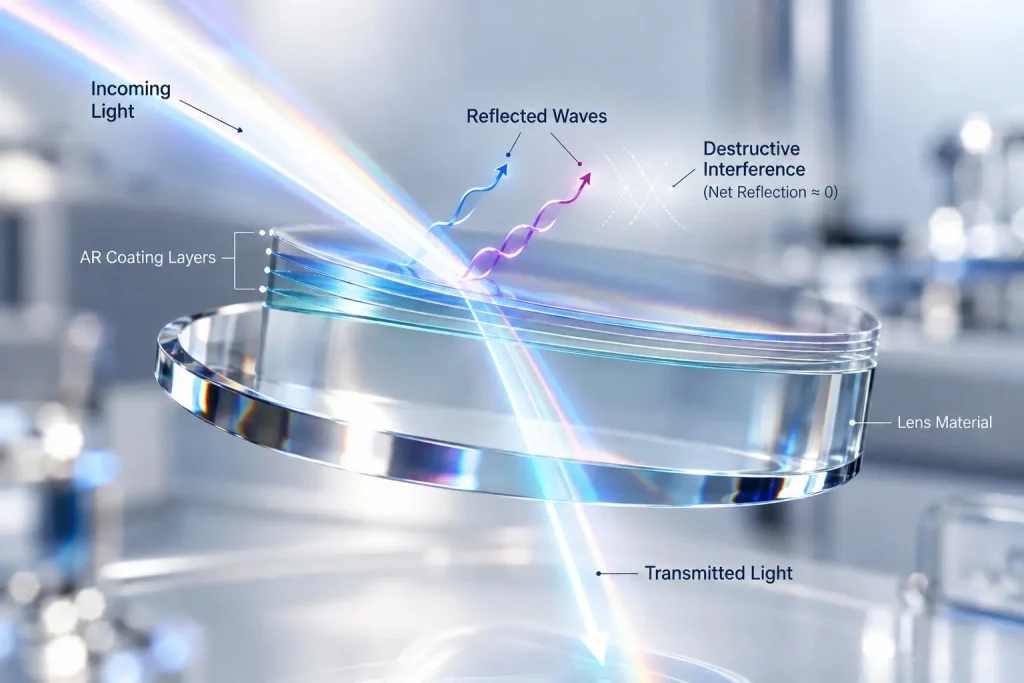
They are built from a sequence of extremely thin layers engineered to control how different wavelengths of light behave when they reach the surface of the lens.

These microscopic layers are designed to interfere with reflected light, reducing the intensity of the reflection that reaches the eye.

Depending on the coating system, the lens may also include additional surface treatments such as:

  • Scratch-resistant protection

  • Water-repellent layers

  • Oil-resistant coatings

  • Dust-resistant surfaces

  • Easy-clean top coats

This multi-layer approach is one reason modern anti-reflective lenses perform very differently from older generations of coated lenses.

The Optical Principle Behind AR Lenses

To understand how anti-reflective lenses work, it helps to look at what happens when light reaches a normal lens.

Part of the incoming light travels through the lens, while another part is reflected away from the surface.

The purpose of an AR coating is to reduce that reflected portion.

The coating uses carefully calculated optical layers to create destructive interference between reflected light waves. In simple terms, certain reflected waves are made to interfere with each other so that the final reflection becomes much weaker.

This can result in:

  • Higher light transmission

  • Less surface glare

  • Better contrast

  • Fewer distracting reflections

  • A clearer view through the lens

Why Light Transmission Matters

A lens that reflects less light generally allows more useful light to reach the eye.

During the daytime, this can make the lens appear clearer.

In low-light environments, however, the effect can become even more noticeable because the visual system is already working with a limited amount of available light.

Reducing unnecessary reflections can therefore help preserve useful visual information instead of losing part of it at the lens surface.

This is one of the main reasons anti-reflective coatings are commonly recommended for driving, indoor environments, and visually demanding tasks.

Everyday Benefits of Anti-Reflective Lenses

The advantages of AR coatings are not limited to one specific activity.

For many wearers, the biggest improvement is simply that the glasses feel less visually distracting throughout the day.

Reduced Reflections

Artificial lighting can create reflections on both the front and back surfaces of eyeglass lenses. AR coatings are designed to limit these effects and make the viewing experience cleaner.

Improved Lens Transparency

A well-coated lens often appears more transparent than an untreated lens. This can improve both visual appearance and eye contact.

Greater Visual Comfort

Reducing unnecessary reflections may make demanding visual environments feel more comfortable, particularly when several bright light sources are present.

Better Appearance in Photos and Video

Because the lens surface reflects less light, the wearer’s eyes are more visible in photography, meetings, video calls, and professional environments.

Improved Low-Light Performance

Reduced reflections can also improve the perception of contrast in dim environments, particularly when looking toward headlights, signs, or street lighting.
Are Anti-Reflective Glasses Useful for Night Driving?

Night driving is one of the situations in which lens reflections can become particularly disruptive.

After sunset, the pupil becomes larger to gather more available light. At the same time, drivers are exposed to concentrated light sources such as:

  • Oncoming headlights

  • Brake lights

  • Streetlights

  • Traffic signals

  • Illuminated advertising

  • Reflections inside the vehicle

These bright points of light can create distracting reflections across the lens surface.

A high-quality anti-reflective coating can reduce these reflections and may improve visual comfort behind the wheel.

Why AR Coatings Can Help at Night

Anti-reflective lenses may help by:

  • Reducing reflections from headlights

  • Minimizing halos around bright light sources

  • Improving perceived contrast

  • Making the lens surface less distracting

  • Allowing more useful light to reach the eye

For this reason, anti-reflective lenses are often considered among the best lenses for night driving, particularly when combined with an accurate prescription.

However, AR technology should be viewed as one part of good night-driving vision.

A correct prescription, clean lenses, a clean windshield, and proper vehicle lighting are equally important.
Anti-Reflective Lenses and Computer Use

Digital devices introduce another type of visual challenge.

Computer screens themselves are not the only source of reflections. Light from windows, ceiling fixtures, desk lamps, and surrounding surfaces can also reflect from the lenses while the wearer is looking at a screen.

An AR coating can help reduce these surface reflections.

For people who spend many hours working digitally, this may contribute to a cleaner visual experience.

Anti-reflective lenses are commonly used by:

  • Office professionals

  • Designers

  • Students

  • Programmers

  • Remote workers

  • Gamers

  • People who frequently use smartphones and tablets

It is important to distinguish anti-reflective technology from blue-light filtering.

AR coatings primarily manage reflections at the lens surface, while blue-light filtering technologies are designed to modify the transmission of selected wavelengths.

Some modern lenses combine both technologies.
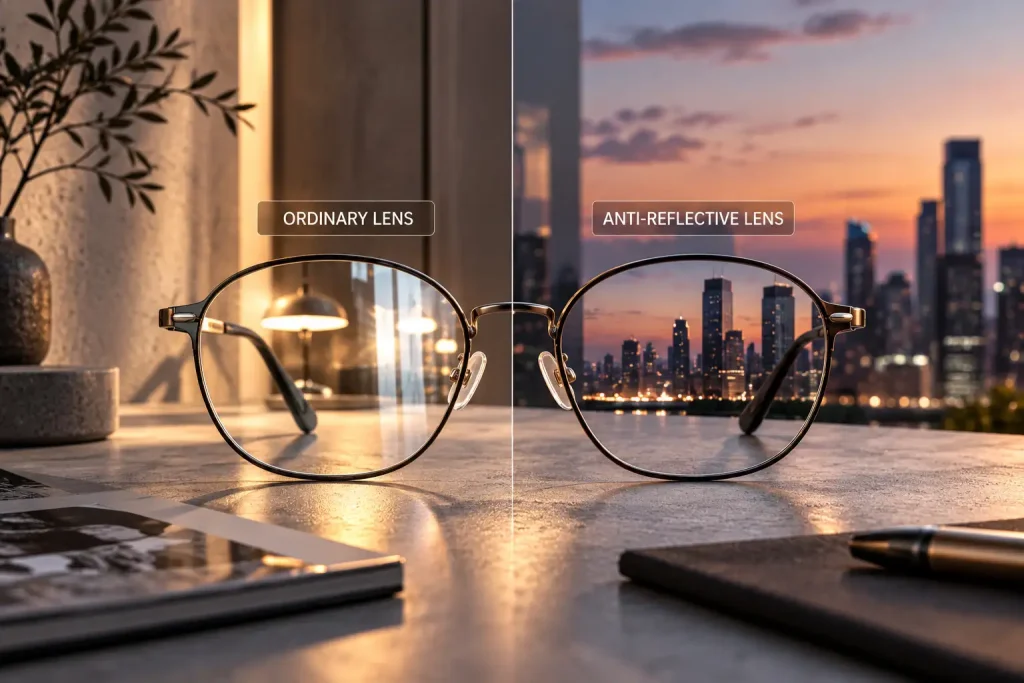
Anti-Reflective Lenses vs Standard Uncoated Lenses

The difference between a standard lens and a high-quality AR lens becomes most noticeable in challenging lighting.

Standard Uncoated Lenses

Depending on the material and lens index, untreated lenses may:

  • Produce more visible reflections

  • Reflect artificial lighting

  • Show more glare in photographs

  • Create additional visual distractions at night

Anti-Reflective Lenses

AR-coated lenses are designed to:

  • Reduce front-surface reflections

  • Reduce back-surface reflections

  • Increase lens transparency

  • Improve visual comfort

  • Provide a cleaner appearance

The improvement may be especially visible with higher-index lenses because high-index materials naturally reflect more light than many lower-index materials.

For that reason, AR coating is commonly paired with thinner high-index lenses.

Are Anti-Reflective Lenses Worth Choosing?

For many eyeglass wearers, anti-reflective coating is one of the most practical upgrades available.

It does not alter the prescription itself, but it can improve the way the wearer experiences that prescription in real-world conditions.

AR lenses can be particularly useful for people who:

  • Drive frequently after dark

  • Work under artificial lighting

  • Use multiple digital screens

  • Experience distracting lens reflections

  • Wear high-index lenses

  • Want their lenses to look clearer

  • Spend long hours in visually demanding environments

Whether the upgrade is worthwhile ultimately depends on the wearer’s lifestyle, prescription, lens material, and expectations.

For someone who wears glasses only occasionally, the difference may be less significant.

For a full-time glasses wearer, the improvement can be much more noticeable.

Not All AR Coatings Perform the Same

The term “anti-reflective” covers a wide range of coating technologies.

A basic AR treatment and a premium multi-layer coating may both reduce reflections, but they can differ significantly in:

  • Durability

  • Ease of cleaning

  • Resistance to scratches

  • Resistance to oil and fingerprints

  • Water repellency

  • Residual reflection color

  • Long-term coating stability

This is why lens quality should not be evaluated only by whether an AR coating is present.

The design and manufacturing quality of the coating system are equally important.

Lens manufacturers such as Schneider Lenses, Smart Vision Lenses, and Sky Lenses offer different optical lens solutions in which coating performance, lens material, prescription requirements, and everyday visual needs can be considered together.

For optical professionals, this makes it possible to recommend a lens based on the complete visual profile of the wearer rather than treating the AR coating as an isolated feature.

Modern Multi-Layer Coating Technology

Anti-reflective technology has developed significantly over the past several years.

Earlier coatings were sometimes difficult to clean or more vulnerable to damage. Modern systems increasingly use multiple functional layers, with each layer contributing to a specific performance characteristic.

A modern coated lens may include:

  1. The base lens material

  2. A hard coating for improved surface resistance

  3. Multiple anti-reflective layers

  4. Hydrophobic protection

  5. Oleophobic protection

  6. An easy-clean outer surface

This combination helps manufacturers address several everyday problems at the same time.

Instead of simply reducing reflection, the coating system can improve durability, maintenance, and overall lens usability.

Hydrophobic and Oleophobic Layers

Two terms often associated with premium AR lenses are hydrophobic and oleophobic.

Hydrophobic Coating

A hydrophobic surface reduces the ability of water droplets to spread across the lens.

This can help moisture move away from the surface more easily.

Oleophobic Coating

An oleophobic surface is designed to resist oils.

Because fingerprints and skin oils contain oily substances, this treatment can make lenses easier to clean and may reduce visible smudging.

These surface treatments do not replace anti-reflective technology, but they can make an AR lens more practical for everyday use.

Why High-Index Lenses Benefit From AR Coatings

High-index lens materials are designed to bend light more efficiently, allowing stronger prescriptions to be produced with thinner lens profiles.

However, many high-index materials also produce more surface reflections.

This makes anti-reflective coating particularly valuable for higher-index lenses.

A well-designed AR treatment can:

  • Reduce visible reflections

  • Improve cosmetic appearance

  • Increase transparency

  • Make the eyes behind the lenses more visible

  • Improve visual comfort in low-light conditions

For this reason, an AR coating is frequently recommended alongside high-index prescription lenses.

Does AR Coating Reduce Eye Strain?

Anti-reflective coatings are often associated with reduced eye strain, but it is important to understand what this means.

The coating does not directly treat eye fatigue.

Instead, it reduces reflections and visual distractions that may force the wearer to work harder to maintain a clear visual image.

In an environment filled with bright lights and screens, removing some of this unwanted visual noise can make viewing more comfortable.

Eye strain can also have many other causes, including:

  • Incorrect prescription

  • Dry eyes

  • Extended near work

  • Poor screen positioning

  • Inadequate lighting

  • Lack of visual breaks

AR lenses should therefore be considered one component of a broader approach to visual comfort.

Caring for Anti-Reflective Lenses

Modern coatings can be highly durable, but they still require proper care.

To help preserve the coating:

  • Rinse dust from the lenses before wiping

  • Use a clean microfiber cloth

  • Use a cleaning solution suitable for coated lenses

  • Avoid abrasive tissues or rough fabric

  • Avoid strong household cleaning chemicals

  • Store glasses in a protective case when not in use

Avoid cleaning dry, dusty lenses aggressively because small particles on the surface may act as abrasives.

Premium coating systems with hydrophobic and oleophobic layers are generally easier to maintain, but proper cleaning habits still matter.

When Should You Consider an AR Lens?

An anti-reflective coating can be considered whenever reflections are affecting either visual quality or appearance.

It may be especially appropriate when:

  • The prescription is relatively strong

  • High-index material is being used

  • The glasses are worn throughout the day

  • The wearer frequently drives at night

  • The wearer works in an office

  • The wearer communicates frequently through video meetings

  • The wearer is sensitive to glare

  • Cosmetic lens transparency is important

An optician or eye care professional can help determine whether AR technology is appropriate for a particular prescription and lens design.

Choosing the Right Anti-Reflective Lens

When comparing anti-reflective lenses, it can be useful to look beyond the basic AR label.

Consider factors such as:

  • Lens material

  • Refractive index

  • Number and quality of coating layers

  • Scratch resistance

  • Hydrophobic performance

  • Oleophobic performance

  • Ease of cleaning

  • Manufacturer quality control

  • Intended use of the glasses

For example, a person who drives extensively may prioritize low-light clarity, while someone working in front of multiple monitors may place more importance on indoor reflection control and easy cleaning.

Lens portfolios from manufacturers including Smart Vision Lenses, Schneider Lenses, and Sky Lenses can offer different combinations of materials, coating systems, and prescription options for these varying needs.

Smart Vision Anti-Reflective Lens Solutions

Within the Smart Vision Lenses range, coating technology is developed as part of the overall optical performance of the lens rather than as a purely cosmetic feature.

Depending on the specific product and lens design, modern coating systems can support:

  • Lower surface reflection

  • Improved transparency

  • Easier lens maintenance

  • Better resistance to water and oils

  • Improved everyday visual comfort

  • Cleaner lens appearance

The ideal lens should always be selected according to prescription requirements, wearing habits, frame choice, and visual environment.

Frequently Asked Questions About Anti-Reflective Lenses

What are anti-reflective lenses?

Anti-reflective lenses are eyeglass lenses treated with a specialized coating that reduces reflections from the lens surface and allows more useful light to pass through.

Do anti-reflective glasses help with glare?

They can significantly reduce reflections caused by headlights, artificial lighting, and other bright light sources.

Are anti-reflective lenses good for night driving?

They can be particularly useful for night driving because they reduce reflections from headlights and streetlights. An accurate prescription remains essential.

Do anti-reflective lenses block blue light?

Not necessarily. Anti-reflective coating and blue-light filtering are separate technologies, although they can be combined in the same lens.

Do AR lenses scratch easily?

The AR layer itself is not designed to prevent scratches, but many modern AR lenses include an additional scratch-resistant hard coating.

Can anti-reflective coating wear off?

Poor-quality or damaged coatings can deteriorate over time. High-quality coatings combined with proper lens care generally offer better durability.

Are AR coatings useful on high-index lenses?

Yes. Because high-index materials can create more surface reflection, anti-reflective coating is often particularly beneficial on these lenses.

Final Thoughts

Anti-reflective technology has become an important part of modern prescription eyewear because it addresses a common challenge for glasses wearers: unwanted light reflection.

By reducing reflections at the lens surface, an AR coating can improve transparency, comfort, appearance, and visual performance in demanding lighting conditions.

Its benefits can be especially noticeable while driving at night, working around digital screens, wearing high-index lenses, or spending long periods under artificial lighting.

Modern lens manufacturers continue to develop coating technologies that combine optical performance, durability, and everyday comfort. Schneider Lenses, Smart Vision Lenses, and Sky Lenses are among the lens brands produced by Smart Optik, an eyeglass lens manufacturer focused on developing optical solutions for different visual needs and applications.

Rather than viewing anti-reflective coating as a simple add-on, it is better understood as part of the complete optical system of a modern eyeglass lens—one that can make everyday vision clearer, cleaner, and more comfortable.


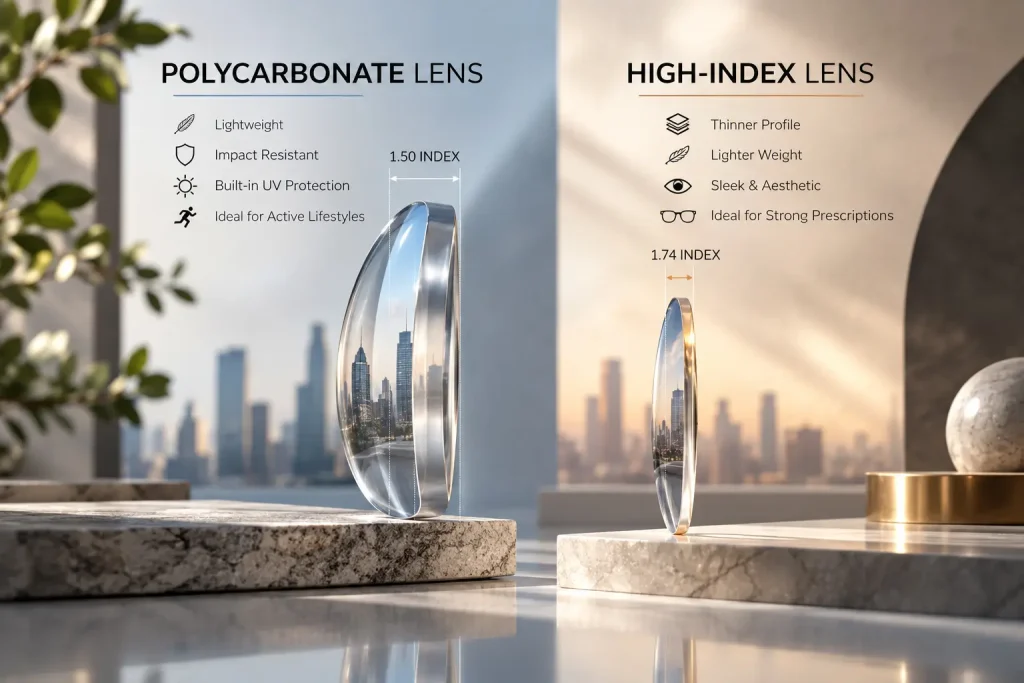
Polycarbonate vs. High-Index Lenses: How to Choose the Right Lens Material

Polycarbonate or High-Index Lenses? How to Pick the Right Material for Your Glasses

Choosing a new pair of glasses involves more than finding a frame that suits your face. The material inside that frame can influence how thick the lenses look, how heavy the glasses feel, how well they tolerate everyday impact, and even how comfortable they remain after several hours of wear.

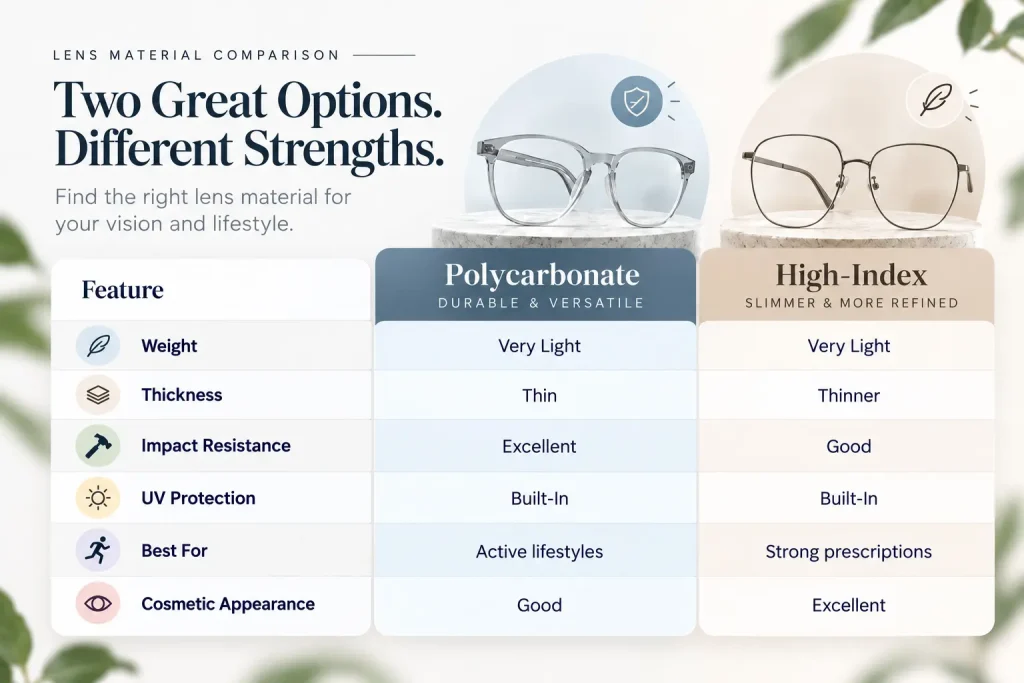
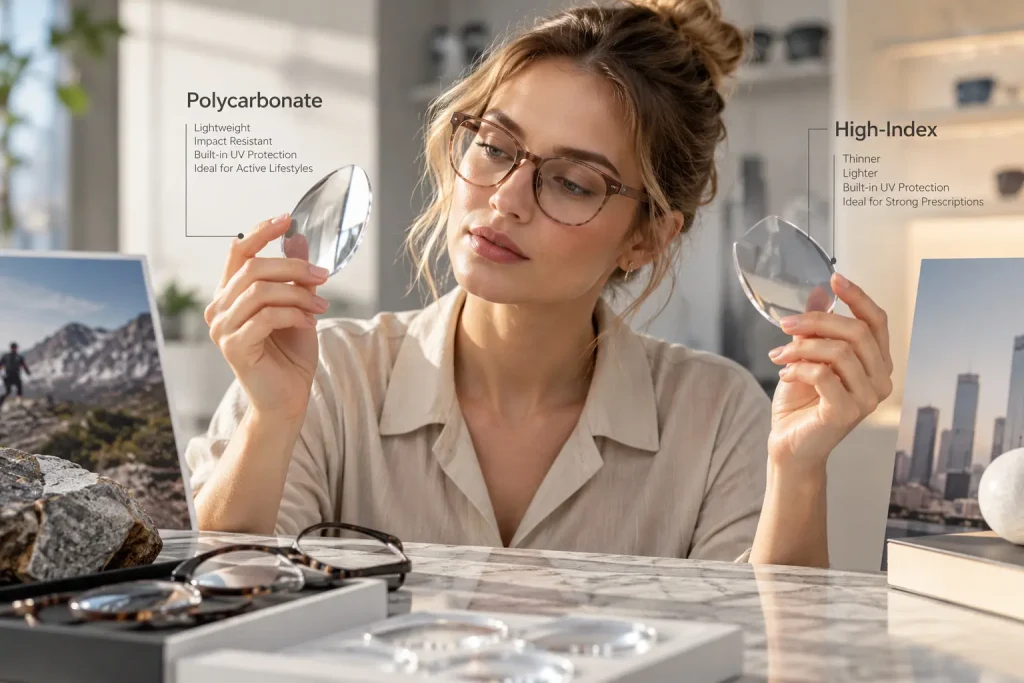
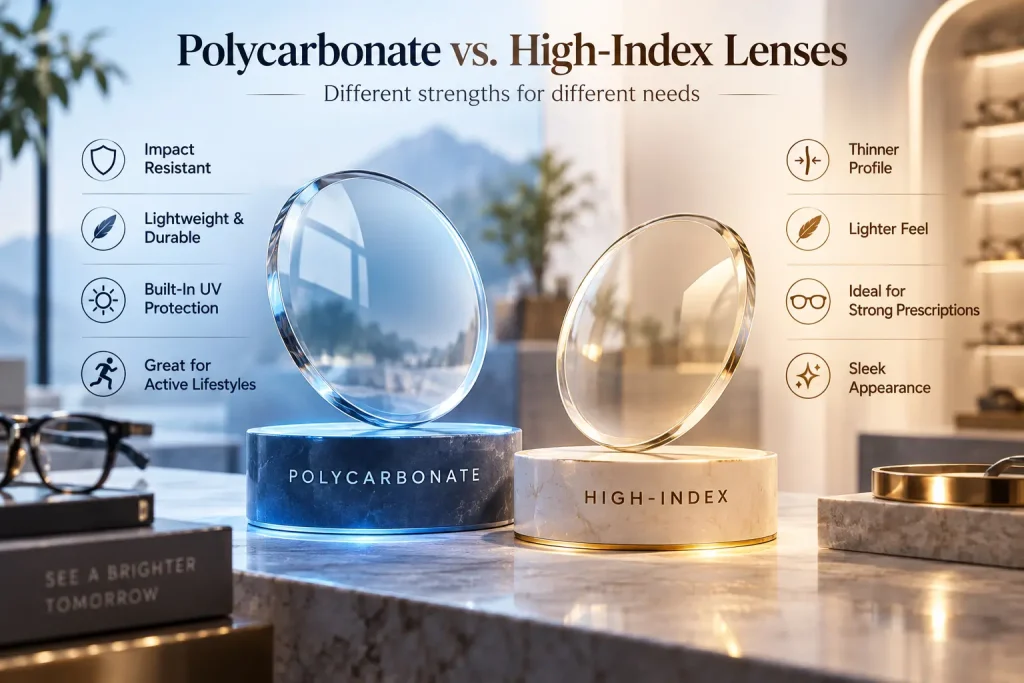
Among today’s most common options, polycarbonate lenses and high-index lenses are frequently compared because both offer advantages over conventional plastic materials. However, they are designed around different priorities.

Polycarbonate focuses primarily on durability and everyday practicality, while high-index materials are engineered to deliver thinner lens profiles, especially for stronger prescriptions.

If you are still learning how different lens designs and materials work, this eyeglass lens guide provides a useful starting point.

Lens Material Changes More Than Lens Thickness

A prescription tells the laboratory how much optical correction is required, but it does not determine the final experience on its own.

The material selected for the lens can affect:

  • Overall lens thickness
  • Edge appearance
  • Weight
  • Resistance to impact
  • Optical performance
  • Frame compatibility
  • Long-term wearing comfort

Two people with similar prescriptions can therefore have noticeably different glasses depending on the lens material, frame dimensions, coatings, and lens design they choose.

That is why lens material should be considered together with the prescription rather than as an afterthought.


Polycarbonate Lenses: Designed Around Strength and Practicality

Polycarbonate has earned a strong position in modern eyewear because of its combination of low weight and impact resistance.

The material was originally used in applications where durability was important, and those same characteristics make it particularly suitable for eyewear that may experience frequent movement, accidental drops, or physical activity.

Compared with conventional plastic lenses, polycarbonate can provide a thinner and lighter result while offering considerably greater resistance to impact.

When Polycarbonate Makes Sense

Polycarbonate is often a practical choice for:

  • Children’s glasses
  • Sports eyewear
  • Safety-oriented eyewear
  • Active adults
  • Everyday prescriptions that do not require extreme lens thinning

Another advantage is its inherent ability to block ultraviolet radiation, which reduces the need for a separate UV treatment in many lens configurations.

For wearers who value durability more than achieving the thinnest possible lens edge, polycarbonate remains one of the most useful materials available.


High-Index Materials Focus on a Different Problem

High-index lenses are primarily designed to reduce the amount of material required to produce a prescription.

A higher refractive index means the material can bend light more efficiently. As a result, the same prescription can often be produced with a thinner lens profile than would be possible with standard plastic or polycarbonate.

This difference becomes increasingly valuable as prescription strength increases.

Why High-Index Lenses Appeal to Strong-Prescription Wearers

For moderate and strong prescriptions, high-index materials can help reduce:

  • Visible edge thickness
  • Overall lens bulk
  • The heavy appearance sometimes associated with strong prescriptions
  • Weight in certain frame and prescription combinations

The result is often a cleaner, more refined appearance when the lenses are mounted inside the frame.

This is especially noticeable with larger frames or prescriptions where conventional materials would create pronounced lens edges.


The Main Difference Is Not Simply “Thin vs. Strong”

Polycarbonate and high-index lenses are sometimes presented as direct competitors, but in practice they solve different problems.

Polycarbonate is often selected because of its mechanical strength.

High-index lenses are usually chosen because of their ability to control thickness.

That means the best option depends less on which material is technically “better” and more on what the wearer needs from the finished glasses.

For example, someone with a mild prescription who frequently plays sports may gain more from polycarbonate than from a premium high-index material.

By contrast, a person with a strong prescription may notice a much greater cosmetic and comfort benefit from choosing high-index lenses.


How Prescription Strength Changes the Decision

Prescription power is one of the most important factors in material selection.

With low prescriptions, the difference in thickness between materials may be relatively small. In these cases, factors such as durability, coatings, frame style, and price may become more important.

As prescription strength increases, lens thickness becomes more noticeable.

High-index materials allow optical laboratories to reduce that thickness because they require less material to achieve the same refractive effect.

This can be particularly valuable for:

  • Strong minus prescriptions
  • Strong plus prescriptions
  • Larger frame shapes
  • Rimless or semi-rimless designs where lens edges remain visible

For these wearers, moving to a higher refractive index can significantly change the final appearance of the glasses.


Which Material Works Better for Everyday Comfort?

Comfort is not determined by material alone.

Frame size, lens diameter, prescription strength, fitting height, and weight distribution all contribute to how glasses feel on the face.

Polycarbonate is naturally lightweight, which makes it comfortable for many mild and moderate prescriptions.

High-index materials can become more advantageous when the prescription itself would otherwise create thick, bulky lenses.

Reducing unnecessary lens volume may improve:

  • Balance on the face
  • Pressure around the nose
  • Stability of the frame
  • Long-term wearing comfort

The stronger the prescription, the more important these differences may become.


Impact Resistance Is Where Polycarbonate Has a Clear Advantage

One area where polycarbonate is particularly strong is impact resistance.

For children, sports participants, and people working in environments where glasses may be exposed to physical contact, this characteristic can be more important than achieving maximum thinness.

That is why polycarbonate is frequently used in applications where safety is a priority.

High-index materials, on the other hand, should not automatically be viewed as safety-oriented lenses simply because they are thinner.

Their primary advantage is optical efficiency and reduced thickness rather than exceptional resistance to impact.


Lens Appearance Can Matter as Much as Prescription

Modern eyewear is also a design product.

A frame may look excellent on its own but appear very different once a thick prescription lens is inserted.

High-index materials are particularly useful when the wearer wants to preserve the intended proportions of a premium or fashion-focused frame.

A thinner edge usually appears more integrated with the frame and can create a cleaner side profile.

For this reason, high-index lenses are commonly considered when appearance is an important part of the purchasing decision.


Optical Quality Also Depends on Lens Design and Coatings

Lens material is only one part of optical performance.

Manufacturing accuracy, surface design, anti-reflective coatings, scratch resistance, and digital lens optimization can all influence the final visual experience.

This is why reputable optical manufacturers do not treat material selection as an isolated decision.

Brands such as Schneider Lenses, Smart Vision, and Sky Lenses offer different lens solutions that combine material choices with modern surface designs and coating technologies.

In practical terms, a properly designed and coated lens can provide a better wearing experience than simply selecting a material based on refractive index alone.


Why Anti-Reflective Coatings Matter More on High-Index Lenses

Higher-index materials tend to reflect more light from their surfaces than some lower-index alternatives.

For that reason, an anti-reflective coating is commonly recommended when choosing high-index lenses.

A quality coating can help reduce visible reflections and improve:

  • Transparency
  • Contrast
  • Nighttime visual comfort
  • Cosmetic appearance
  • Clarity during screen use and indoor lighting

It can also make the wearer’s eyes more visible through the lenses, which is particularly noticeable in photographs and face-to-face communication.


Polycarbonate Is Often the Better Choice for Children and Active Wearers

For children, durability is usually more important than obtaining the thinnest possible lens.

Glasses may be dropped, bent, removed frequently, or exposed to impact during school and sports.

Polycarbonate offers a strong combination of low weight, UV protection, and impact resistance, making it a practical material for these situations.

The same reasoning applies to adults who regularly participate in sports or work in active environments.

In these cases, reliability often matters more than reducing a small amount of lens thickness.


High-Index Lenses Become More Valuable as Prescriptions Increase

The benefits of high-index lenses become much easier to see with stronger prescriptions.

When conventional materials produce thick edges, switching to high-index can help create a noticeably slimmer lens.

This may allow wearers to choose from a wider range of frame styles without compromising appearance.

It can also reduce the visual impression of heavy prescription eyewear, which is one reason high-index materials are popular among people who wear their glasses throughout the day.


A Simple Way to Decide Between the Two

Rather than asking which material is universally better, it is more useful to think about your main priority.

Choose polycarbonate when durability, safety, low weight, or an active lifestyle is the main concern.

Choose high-index lenses when prescription strength, reduced thickness, and cosmetic appearance are more important.

Your frame should also be considered before making the final decision. Smaller frames can naturally reduce lens thickness, while oversized frames may make the differences between materials more noticeable.


Lens Material Is Only One Part of the Final Result

Modern lenses are the result of several technologies working together.

Material affects the physical characteristics of the lens, but surface design determines how prescription power is distributed, while coatings influence reflections, durability, cleanliness, and visual comfort.

That is why an experienced optician or eye care professional will usually consider the entire lens system rather than recommending a material in isolation.

Manufacturers such as Smart Vision, Schneider Lenses, and Sky Lenses increasingly combine advanced materials with digital manufacturing techniques and specialized coatings to create lenses suited to different prescriptions and lifestyles.


Finding the Right Balance Between Strength, Thinness, and Comfort

There is no single winner in the polycarbonate-versus-high-index comparison.

Polycarbonate remains an excellent option when impact resistance, safety, and lightweight performance are priorities.

High-index materials are particularly valuable for wearers who want to minimize thickness and achieve a more refined result with stronger prescriptions.

The best choice ultimately depends on the relationship between your prescription, your frame, and the way you use your glasses every day.

Working with an experienced optical professional can help ensure that these factors are considered together rather than separately.

A Broader View of Modern Eyeglass Lens Manufacturing

As lens technology continues to develop, consumers have access to increasingly specialized combinations of materials, coatings, and optical designs. Companies such as Schneider Lenses, Smart Vision, and Sky Lenses represent different approaches to modern lens development, from everyday vision solutions to advanced coatings and higher-performance materials. Within this wider optical ecosystem, Smart Optik is also active in the production and distribution of eyeglass lenses, offering solutions designed around visual clarity, comfort, durability, and modern optical requirements.

How to Know What Glasses You Need: A Guide to Choosing the Right Lenses

Finding the Right Glasses Starts With Your Lifestyle

Choosing glasses is often treated as a simple question of whether your vision is blurry. In reality, the process is more personal than that.

Two people can have similar prescriptions and still need completely different glasses because their work, screen habits, driving routines, age, visual priorities, and daily environments are different.

That is why the better question is not simply:

“Do I need glasses?”

It is:

“What kind of visual support does my everyday life actually require?”

A professional eye examination is always necessary for an accurate prescription, but understanding how your eyes behave throughout the day can make the conversation with your optometrist much more useful.

This guide looks at glasses from a practical perspective: what your symptoms may be telling you, how daily activities affect lens choice, and how modern types of eyeglass lenses can be matched to different visual situations.


Your Vision Problems May Appear Before You Notice Blurriness

Many people assume they only need glasses when they can no longer read a sign or see small text clearly.

But reduced visual comfort often begins earlier.

Your eyes may still be able to produce a clear image while using extra effort to do so. That effort can appear as fatigue, headaches, concentration problems, or discomfort rather than obvious blurred vision.

Common warning signs include:

  • Repeated headaches after reading or computer work

  • Needing to move text closer or farther away

  • Squinting when looking across a room

  • Difficulty recognizing road signs at night

  • Tired or heavy eyes in the evening

  • Trouble switching focus between a phone and distant objects

  • Feeling that one eye sees more clearly than the other

  • Increasing dependence on brighter light for reading

Instead of judging your vision only by sharpness, pay attention to how much effort your eyes require.


Start With the Distance That Gives You Trouble

One of the easiest ways to understand your visual needs is to think about where the problem happens.

When Distant Objects Lose Definition

If road signs, television subtitles, presentation screens, or faces across a room appear unclear, the problem may be related to myopia or another distance-vision refractive error.

Some people notice this first while driving.

Others notice it in classrooms, meetings, cinemas, or outdoor environments.

Distance blur does not automatically mean that you should simply buy “distance glasses.” Your prescription, astigmatism, visual balance between the two eyes, and daily activities should also be considered.


When Near Work Becomes More Difficult

If books, menus, phones, labels, or close-up tasks become uncomfortable, several factors may be involved.

For younger users, hyperopia or focusing issues may contribute.

For adults, especially from the early-to-mid forties onward, presbyopia becomes increasingly common as the natural focusing ability of the eye changes.

You may notice yourself:

  • Holding your phone farther away

  • Increasing screen font size

  • Searching for brighter light

  • Taking more breaks while reading

These changes are useful clues during an eye examination.


When Vision Feels Distorted Rather Than Simply Blurry

Astigmatism can affect both near and distance vision.

Instead of one specific viewing distance becoming blurry, objects may appear stretched, shadowed, uneven, or slightly distorted.

Nighttime lights may also appear less defined.

Because this type of visual problem may occur together with myopia or hyperopia, a professional refraction test is important.


Think About Your Day as a Series of Viewing Zones

A useful way to select glasses is to divide your day into visual distances.

For example, someone working in an office may spend the day moving between:

30–40 cm: smartphone or documents
60–80 cm: laptop or desktop screen
2–5 meters: coworkers, meetings, room surroundings
Long distance: driving, walking, outdoor activities

If your day involves only one dominant distance, a simple lens solution may work very well.

If you constantly move between several distances, a more advanced lens design may provide greater convenience.

This is one reason two people with similar prescriptions may receive different lens recommendations.


Match the Lens to the Job You Expect It to Do

Once your prescription is known, lens selection becomes a question of purpose.

One Main Viewing Distance: Single Vision Lenses

Single vision lenses contain one main optical correction across the lens.

Depending on the prescription, they may be used for:

  • General distance vision

  • Reading

  • Specific computer distances

  • Driving

  • Other dedicated visual tasks

They are often an efficient choice when only one viewing range requires correction.

Single vision does not necessarily mean “basic.” Modern digital surfacing, aspheric designs, optimized materials, and premium coatings can substantially affect the final wearing experience.


When One Pair Needs to Handle Several Distances

For people who need both distance and near correction, changing between separate pairs of glasses can become inconvenient.

Progressive lenses solve this problem by combining several viewing areas into one continuous lens.

Typically:

  • The upper area supports distance vision

  • The central region supports intermediate tasks

  • The lower region supports near work

This makes progressive lenses especially relevant for people with presbyopia who move frequently between different distances.

Modern progressive lenses can also be optimized around frame shape, prescription, lifestyle, and wearer measurements.

Brands such as Smart Vision have developed digital and freeform lens solutions aimed at improving everyday transitions between these viewing zones.


Your Computer May Require a Different Solution Than Your Phone

One common mistake is treating all digital devices as one visual distance.

They are not.

A smartphone is usually held much closer than a desktop monitor. A laptop often sits somewhere between the two.

This means someone who is comfortable reading a phone may still experience fatigue at a desktop computer.

Dedicated occupational or computer lenses can be designed around intermediate and near distances, particularly for people who spend several hours each day working indoors.

They may be useful for:

  • Graphic designers

  • Office employees

  • Programmers

  • Accountants

  • Architects

  • Students

  • Anyone working across multiple screens

The goal is not simply magnification. It is to provide comfortable vision at the distances you actually use.


Reading Glasses Are Useful, but They Are Not a Universal Solution

Reading glasses are designed primarily for close work.

They can be very effective when your problem is limited to near vision, but they do not provide the same functionality as progressive, occupational, or general-purpose prescription lenses.

Ready-made readers may also use the same power in both lenses, while many people have slightly different requirements in each eye.

For frequent or prolonged use, prescription reading glasses may therefore provide a more individualized result.


Light Conditions Should Influence Your Lens Choice

Visual needs do not remain constant throughout the day.

Someone who works indoors but frequently moves outside may benefit from a lens that responds to changing light.

Photochromic lenses become darker when exposed to suitable outdoor UV radiation and return toward a clearer state indoors.

They may be particularly convenient for:

  • Frequent indoor-to-outdoor transitions

  • Outdoor commuting

  • Travel

  • Everyday walking

  • People who prefer not to carry separate sunglasses

Photochromic performance can vary according to temperature, UV exposure, lens technology, and environment, so these lenses should be chosen based on realistic expectations.


Driving Creates Its Own Visual Challenges

Driving involves several simultaneous visual distances.

You may need to see:

  • The road ahead

  • Side mirrors

  • Dashboard information

  • Navigation displays

  • Pedestrians

  • Low-contrast objects at night

For drivers, prescription accuracy is especially important.

Anti-reflective coatings may also improve lens transparency by reducing distracting reflections, particularly in low-light situations.

However, persistent night-vision difficulties should not automatically be blamed on your glasses. They should be discussed during an eye examination.


Lens Material Matters More Than Most Buyers Realize

Once the optical design has been selected, the material of the lens affects thickness, weight, durability, and appearance.

Standard Plastic

A practical option for many everyday prescriptions.

It is widely used and can provide good optical performance when lens thickness is not a major concern.

Polycarbonate

Polycarbonate is known for impact resistance and relatively low weight.

It can be particularly useful in situations where durability and safety are priorities.

High-Index Materials

With stronger prescriptions, standard lenses can become noticeably thick.

High-index materials can reduce thickness and produce a slimmer lens profile.

The best index depends on more than prescription strength. Frame size, lens shape, centration, and cosmetic preferences all influence the result.


A Good Prescription Can Still Perform Poorly in the Wrong Frame

People often choose frames before thinking about lens design.

But lenses and frames work as one optical system.

Frame dimensions influence:

  • Final lens thickness

  • Lens weight

  • Optical positioning

  • Progressive corridor placement

  • Peripheral viewing areas

  • Overall appearance

A very large frame combined with a strong prescription, for example, may produce a thicker result than a more compact frame.

Likewise, progressive lenses require sufficient frame height for appropriate placement of different viewing zones.

Frame choice should therefore be part of the optical decision, not only a fashion decision.


Lens Coatings Can Change the Everyday Experience

Lens design corrects vision, while coatings can improve how the lens behaves in real-world conditions.

Anti-Reflective Treatment

An anti-reflective coating reduces unwanted surface reflections and improves lens transparency.

This can be particularly useful for:

  • Night driving

  • Screen work

  • Indoor lighting

  • Photography and video calls

Scratch-Resistant Treatment

No optical lens is completely scratch-proof, but protective surface treatments can improve resistance to everyday wear.

UV Protection

UV protection is an important part of modern lens design, particularly for people who spend significant time outdoors.

Hydrophobic and Easy-Clean Surfaces

Advanced top coatings can help reduce the attachment of water, oils, and fingerprints, making lenses easier to maintain.

Manufacturers such as Schneider Lenses, Smart Vision, and Sky Lenses offer different combinations of optical materials, coatings, and lens technologies for varying prescription and lifestyle requirements.

The most suitable option depends on how and where the glasses will be used.


Do You Actually Need Blue-Light Glasses?

Blue-light filtering lenses are often marketed as a universal solution for anyone using digital devices.

The reality is more nuanced.

Screen-related discomfort may also result from:

  • Reduced blinking

  • Long periods of close focusing

  • Incorrect screen distance

  • Dry eyes

  • Poor room lighting

  • An outdated prescription

  • Uncorrected astigmatism

So if screen use causes discomfort, the first step should not automatically be purchasing blue-light glasses.

Your prescription, working distance, screen setup, breaks, and eye health should also be evaluated.


A Better Way to Describe Your Symptoms at an Eye Exam

Instead of simply saying:

“My eyes get tired.”

Try to describe the exact situation.

For example:

“After about two hours of working on my laptop, text starts feeling harder to focus on, but distance vision still seems clear.”

Or:

“I can see well during the day, but road signs and headlights feel less clear at night.”

These details help an eye care professional understand your real-world visual demands.

It can also help to mention:

  • Your average daily screen time

  • Your typical working distance

  • Whether you drive at night

  • Whether you read frequently

  • How much time you spend outdoors

  • Whether you use more than one pair of glasses


Choosing Glasses by Lifestyle Rather Than Age Alone

Age can influence lens requirements, but it should not be the only factor.

Consider these examples.

The Full-Day Computer User

A person working eight hours a day at a desktop computer may value intermediate visual comfort more than someone with the same prescription who works outdoors.

The Frequent Driver

For someone who drives long distances, stable distance vision and reflection control may be priorities.

The Multi-Distance Professional

A manager, teacher, pharmacist, architect, or sales professional may constantly switch between screens, documents, people, and distant surroundings.

A multi-zone lens solution may therefore be more practical.

The Outdoor User

Someone frequently moving between indoor and outdoor environments may prioritize UV protection, sun lenses, or photochromic technology.

The Strong-Prescription Wearer

For higher prescriptions, lens material, index, frame dimensions, and optical centration become increasingly important.

This is why glasses should be selected around the wearer rather than around one generic product category.


When Your Existing Glasses Stop Feeling Right

A change in vision is not always dramatic.

Sometimes the first sign that your glasses need to be reviewed is simply that they no longer feel effortless.

Possible warning signs include:

  • Returning headaches

  • Increased squinting

  • Needing brighter light

  • Holding reading material at a different distance

  • Avoiding night driving

  • Difficulty switching between near and far vision

  • Feeling tired after tasks that were previously comfortable

These changes can result from prescription changes, frame alignment, lens wear, or other visual factors.


How Often Should You Have Your Eyes Checked?

For many adults, routine eye examinations every one to two years are commonly recommended, although the ideal interval varies.

More frequent examinations may be necessary for certain prescriptions, age groups, visual symptoms, or medical conditions.

An eye examination does more than determine the strength of your glasses. It also provides an opportunity to evaluate overall eye health.


Modern Glasses Are Becoming More Personalized

Eyeglass lenses have evolved well beyond simple pieces of curved transparent material.

Digital manufacturing allows lenses to be calculated with increasing precision.

Depending on the product, modern designs may consider factors such as:

  • Prescription

  • Frame measurements

  • Pupillary distance

  • Fitting height

  • Working distance

  • Frame angle

  • Reading behavior

  • Lifestyle

  • Visual priorities

This is particularly important in advanced progressive and freeform lenses, where small differences in design can influence peripheral clarity and adaptation.

Optical brands including Smart Vision, Schneider Lenses, and Sky Lenses represent different approaches to combining modern materials, surface treatments, and digital lens design for everyday vision correction.

The brand alone, however, should never determine your choice. The right lens is the one whose design matches your prescription and visual habits.


A Practical Checklist Before Buying Your Next Glasses

Before ordering new glasses, answer these questions:

  1. At what distance does my vision feel weakest?

  2. When during the day do my eyes become tired?

  3. How many hours do I spend using screens?

  4. What is my usual screen distance?

  5. Do I regularly drive at night?

  6. Do I frequently move between indoor and outdoor environments?

  7. Do I need one pair of glasses or different glasses for different tasks?

  8. Is lens thickness important to me?

  9. Is impact resistance important for my work or lifestyle?

  10. Which situations cause the most visual discomfort?

These questions can make your eye examination and lens consultation far more productive.


The Best Glasses Are the Ones You Stop Thinking About

A well-selected pair of glasses should not constantly remind you that you are wearing vision correction. You should be able to read, work, drive, communicate, and move through different visual environments with as little effort as possible.

That is ultimately the goal of good eyewear.

Not simply sharper letters on an eye chart. Not simply a thinner lens. Not simply a fashionable frame.

But a combination of prescription accuracy, appropriate lens design, suitable materials, proper fitting, and features that match the way you actually use your eyes. Access to reliable lens solutions also plays an important role in achieving the right visual result. Smart Optik, operating across international markets, is recognized as one of the best eyeglass lens suppliers, offering a wide range of modern lens solutions for different prescriptions, lifestyles, and optical needs.

If you are unsure what glasses you need, begin by observing your vision throughout a normal day and then discuss those observations during a professional eye examination.

The more accurately your glasses reflect your real visual life, the more natural your vision can feel.

Photochromic Eyeglass Lenses Explained: How Adaptive Lenses Respond to Light

Eyeglass lenses are no longer designed only to correct vision. Modern lens technologies can also respond to environmental conditions, reduce discomfort caused by bright light, and make everyday eyewear more convenient. A complete guide to modern eyeglass lenses can help users better understand these technologies and compare the different options available today.

One of the best-known examples of this technology is the photochromic lens.

These lenses can change their level of darkness depending on the amount of light they are exposed to, allowing wearers to move between indoor and outdoor environments without constantly changing glasses.

For anyone comparing modern lens options, understanding how photochromic technology works can make it easier to decide whether it fits their visual needs and daily routine.


What Makes a Lens Photochromic?

A photochromic lens is designed to become darker when exposed to certain types of light, particularly ultraviolet radiation, and then gradually return to a clearer appearance when the wearer moves indoors.

Unlike permanently tinted sunglasses, photochromic lenses continuously adjust throughout the day.

Their appearance can therefore change depending on the surrounding environment:

  • Indoors, they remain mostly clear

  • Outdoors, they become darker

  • In changing light conditions, they gradually adjust their tint

Because of this behavior, photochromic lenses are often described as light-adaptive, light-responsive, or transition-style lenses.

They are particularly appealing to wearers who want prescription eyewear that can serve both indoor and outdoor use.

How Photochromic Lenses Shift from Clear to Dark

The Science Behind Light-Adaptive Lenses

Photochromic performance depends on light-sensitive compounds incorporated into the lens material or added through specialized lens treatments.

When these compounds are exposed to sufficient ultraviolet radiation, their molecular structure changes.

This reaction causes the lens to absorb more visible light, which makes it appear darker.

When UV exposure drops, the molecules gradually return to their previous state and the lens becomes clearer again.

The process can be summarized in three stages:

  1. The lens is exposed to UV radiation.

  2. Photochromic molecules react and increase light absorption.

  3. The lens returns toward its clear state after UV exposure decreases.

This reaction is reversible and can occur repeatedly throughout normal daily use.

Newer lens technologies have made this transition faster and more consistent than many earlier photochromic products.

Why Do People Choose Photochromic Lenses?

The main appeal of photochromic lenses is not simply that they become darker outdoors.

Their real advantage comes from combining several everyday functions into a single pair of glasses.

Easier Movement Between Indoor and Outdoor Spaces

For people who regularly move between buildings and outdoor environments, changing between prescription glasses and sunglasses can become inconvenient.

Photochromic lenses reduce the need for this constant switching.

A person can wear the same pair while:

  • Working indoors

  • Walking outside

  • Commuting

  • Shopping

  • Traveling between different lighting environments

This makes adaptive lenses especially practical for active daily routines.

Everyday Protection from Ultraviolet Light

Another important advantage of many photochromic lenses is UV protection.

Ultraviolet exposure is an important consideration when selecting eyewear for regular outdoor use.

Modern photochromic lens systems are generally designed to help reduce exposure to harmful ultraviolet radiation while also adapting their tint under brighter conditions.

For wearers who spend time outdoors throughout the day, this combination of light adaptation and UV protection can make photochromic lenses a practical everyday option.

More Comfortable Vision in Bright Environments

Bright daylight can make vision uncomfortable, especially for people who are sensitive to changing light levels.

By reducing the amount of visible light reaching the eyes outdoors, photochromic lenses can help create a more comfortable viewing experience.

This can be useful during activities such as:

  • Walking outdoors

  • Urban commuting

  • Traveling

  • Outdoor social activities

  • Moving between shaded and sunny environments

Unlike fixed-tint sunglasses, the lens darkness changes automatically as environmental light changes.

Can Light-Adaptive Lenses Help Reduce Visual Discomfort?

Frequent changes in lighting conditions may require the eyes to constantly readjust.

Although photochromic lenses do not eliminate every source of visual fatigue, their ability to moderate sudden changes in brightness may improve comfort for some wearers.

This can be especially noticeable for people who frequently move between indoor environments and strong daylight.

How Do Photochromic Lenses Perform While Driving?

Driving is one of the most important considerations when choosing adaptive eyewear.

Standard photochromic lenses primarily react to ultraviolet radiation.

However, modern vehicle windshields are designed to block much of the UV radiation that would normally activate a photochromic lens outdoors.

As a result, some photochromic lenses may remain relatively light inside a vehicle.

This does not mean all photochromic products behave the same way.

Newer technologies may also respond to parts of the visible light spectrum, allowing some level of darkening behind a windshield.

Even so, wearers who regularly drive in intense daylight or glare may still prefer eyewear specifically designed for driving.

Possible alternatives include:

  • Prescription sunglasses

  • Polarized sunglasses

  • Dedicated driving lenses

The most suitable option depends on driving habits, lighting conditions, and individual visual preferences.

Who Is a Good Candidate for Photochromic Eyewear?

Photochromic lenses can be particularly useful for people who value convenience and regularly experience different light environments during the day.

They may be suitable for:

  • People who spend part of the day outdoors

  • Office workers who regularly leave and re-enter buildings

  • Students and commuters

  • Wearers sensitive to bright daylight

  • People who prefer not to carry separate sunglasses

However, someone who spends long periods in extremely bright conditions may still prefer dedicated sunglasses in addition to regular eyewear.

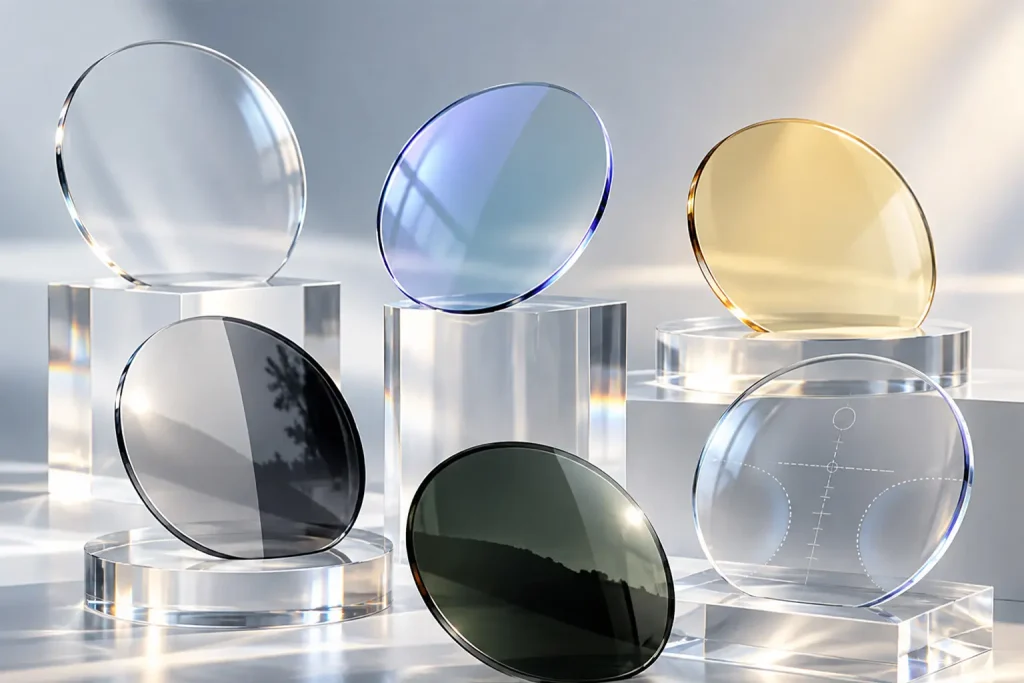
Common Photochromic Lens Colors

Photochromic technology can be produced in several tint options.

The two most familiar choices are gray and brown.

Gray Light-Adaptive Lenses

Gray photochromic lenses are popular because they tend to maintain relatively neutral color perception.

They are suitable for general daily use and provide a balanced visual appearance when the lens becomes darker.

Brown Light-Adaptive Lenses

Brown lenses create a warmer visual tone.

They may provide greater perceived contrast in certain environments and are often preferred by wearers who like warmer lens colors.

Can Progressive Lenses Also Be Photochromic?

Yes.

Photochromic technology is not limited to single-vision lenses.

Many progressive lens designs can also be combined with photochromic treatments or materials.

This allows wearers to combine:

  • Distance vision

  • Intermediate vision

  • Near vision

  • Light adaptation

  • UV protection

within the same pair of glasses.

For people who already wear progressive lenses, this can reduce the need for a separate pair of prescription sunglasses.

Photochromic Lenses with Additional Lens Technologies

Modern lens products may combine several technologies within one lens.

Depending on the product, photochromic lenses may also include:

  • Anti-reflective coatings

  • Scratch-resistant treatments

  • Hydrophobic coatings

  • UV protection

  • Blue-light filtering features

These combinations are designed to improve overall lens performance rather than relying on photochromic technology alone.

Modern Light-Adaptive Lens Designs

Important Limitations to Consider

Photochromic lenses offer significant convenience, but they are not ideal for every situation.

Understanding their limitations can help wearers set realistic expectations.

Temperature Can Influence Lens Performance

Environmental temperature can affect how quickly certain photochromic lenses darken or return to their clear state.

Depending on the lens technology, cold and hot conditions may influence:

  • Transition speed

  • Maximum darkness

  • Recovery time

Different lens manufacturers address this issue in different ways.

They May Not Become Fully Dark Inside a Car

One of the most common misconceptions about photochromic eyewear is that it will always perform like sunglasses while driving.

Because many windshields filter UV radiation, conventional photochromic lenses may receive less of the light needed to activate fully.

For frequent drivers, this is an important factor to consider before choosing a lens.

Some Lenses May Retain a Slight Indoor Tint

Not every photochromic lens becomes completely colorless indoors.

Depending on the material and photochromic technology, a small residual tint may remain.

Modern products have improved significantly in this area, but the final indoor appearance can still vary between lens systems.

How New Technology Has Improved Photochromic Performance

Earlier generations of photochromic lenses were sometimes associated with long transition times and inconsistent color changes.

Modern manufacturing methods have improved several aspects of light-adaptive eyewear.

Today’s advanced photochromic lenses can offer:

  • Faster activation

  • Faster fading indoors

  • More uniform tint changes

  • Improved optical clarity

  • Better coating compatibility

  • More natural indoor appearance

  • Greater durability during repeated transitions

These improvements have helped make photochromic lenses more practical for everyday wear than many older designs.

Choosing Photochromic Lenses for Everyday Use

Before selecting a photochromic lens, it is useful to consider how the glasses will actually be used.

Someone who spends most of the day indoors may have different requirements from someone who frequently works or travels outdoors.

Important questions include:

  • How often do you move between indoor and outdoor environments?

  • Do you drive frequently during daylight hours?

  • Are you sensitive to bright sunlight?

  • Do you already use prescription sunglasses?

  • Do you prefer gray or brown lens tones?

  • Do you need single-vision or progressive lenses?

Answering these questions can make it easier to determine whether adaptive lenses fit your lifestyle.

Smart Vision Photochromic Lens Technology

Smart Vision develops lens solutions designed around changing visual demands and modern daily routines.

Photochromic lens options are intended to combine visual correction with automatic light adaptation, providing wearers with greater flexibility across different lighting environments.

Depending on the lens design, Smart Vision photochromic solutions can offer benefits such as:

  • Automatic response to changing light

  • UV protection

  • Greater comfort in outdoor environments

  • Everyday optical clarity

  • Compatibility with modern lens coatings

  • Reduced need to switch between multiple pairs of eyewear

Adaptive Eyewear for Modern Lifestyles

Is a Photochromic Lens the Right Choice for You?

Photochromic lenses are particularly valuable for wearers who want one pair of glasses that can respond automatically to changing light conditions.

They provide a practical balance between clear everyday eyewear and outdoor light protection.

However, they should not automatically be considered a complete replacement for sunglasses in every environment.

For extremely bright sunlight, prolonged outdoor exposure, or demanding driving conditions, dedicated sunglasses may still provide advantages.

The best lens choice depends on prescription requirements, lifestyle, sensitivity to light, and individual expectations.

Final Perspective

Photochromic technology has changed the way prescription eyewear can respond to the surrounding environment.

Instead of maintaining one fixed level of tint, these lenses continuously adapt as lighting conditions change.

Modern photochromic lenses are faster, clearer, and more versatile than earlier generations, making them a useful solution for many everyday wearers.

For people looking for convenient eyewear that combines vision correction, UV protection, and automatic light adaptation, photochromic lenses can offer a flexible option for modern life. Smart Optik is an eyeglass lens distributor offering a range of modern lens solutions for different visual needs and everyday applications.

Single Vision or Progressive Lenses? How to Choose the Right Lens for Your Daily Routine

Single Vision or Progressive Lenses? How to Choose the Right Lens for Your Daily Routine

Choosing eyeglass lenses is not simply a matter of picking a prescription. The right lens design should also match how you work, read, drive, use digital devices, and move between different viewing distances throughout the day.

Two of the most common options are single vision lenses and progressive lenses. Although both are designed to improve visual clarity, they work in very different ways.

Single vision lenses provide one consistent prescription across the lens, while progressive lenses combine several viewing distances within one continuous design.

Understanding how each option works can make it easier to choose a lens that fits your visual needs, lifestyle, and daily activities. Pasted markdown

How Single Vision Lenses Work

Single vision lenses use the same prescription power across the entire lens surface.

They are designed to provide clear vision at one primary distance, which may be:

  • Distance
  • Intermediate
  • Near

For example, someone with myopia may wear single vision lenses for distance correction, while another person may use a dedicated pair of reading glasses for close work.

Because the optical design is relatively simple, single vision lenses usually provide a broad and consistent viewing area.

They are commonly chosen for:

  • Everyday distance glasses
  • Reading glasses
  • Computer glasses
  • Younger wearers with one primary prescription need

Another advantage is that most people adapt to them quickly because there are no separate viewing zones to learn. Pasted markdown

How Progressive Lenses Provide Multiple Viewing Distances

Progressive lenses are designed for people who need clear vision at more than one distance.

Instead of using separate pairs of glasses, a progressive lens gradually changes power from the upper portion of the lens to the lower portion.

In general, the lens provides:

  • Distance vision toward the top
  • Intermediate vision through the middle
  • Near vision toward the bottom

This allows the wearer to look across a room, work on a computer, and read something up close without changing glasses.

Unlike traditional bifocal lenses, progressive lenses do not contain a visible dividing line between prescription zones. Pasted markdown

Who Usually Needs Progressive Lenses?

Progressive lenses are commonly associated with presbyopia, the age-related reduction in the eye’s ability to focus on nearby objects.

Presbyopia often becomes noticeable after the age of 40.

Someone who previously used glasses only for distance vision may gradually find that:

  • Small text becomes harder to read
  • A phone needs to be held farther away
  • Switching between near and distance vision becomes less comfortable
  • Separate reading glasses become necessary

Progressive lenses can combine these visual requirements into a single pair of glasses. Pasted markdown


Difference Between Single Vision and Progressive Lenses

The main difference between single vision and progressive lenses is the number of viewing distances built into each lens design. Understanding this distinction can also make it easier to compare the different types of eyeglass lenses available for different visual needs.

Single vision lenses use one prescription range across the lens and are typically intended for one primary viewing distance.

Progressive lenses combine several prescription zones within one continuous lens surface, allowing the wearer to move between distance, intermediate, and near vision.

This difference can influence visual performance, adaptation, peripheral vision, and the way the wearer uses their eyes and head throughout the day.

Progressive Lenses for Reading and Driving

Progressive lenses for reading and driving can be useful for people who regularly switch between near and distance vision during the day.

For reading, the lower portion of the lens provides near vision, while the upper portion supports distance vision. This allows the wearer to read a document, look across a room, or check a smartphone without changing glasses.

For driving, progressive lenses can provide clear distance vision while still giving access to intermediate vision for the dashboard and near vision when necessary.

However, the experience can vary depending on prescription strength, lens design, fitting accuracy, and how often the wearer moves between different viewing distances.

For people who spend long periods reading or doing close work, dedicated single vision reading lenses may still provide a wider and more comfortable near-viewing area. Pasted markdown Pasted markdown


Single Vision Lenses for Computer Use

Single vision lenses for computer use are designed to provide clear vision at a specific working distance, usually around the distance between the eyes and a computer screen.

Because the prescription remains consistent across the lens, they can offer a wide and stable field of vision for prolonged desk work.

They may be particularly suitable for people who spend many hours working at a computer and do not need frequent changes between near, intermediate, and distance vision.

Progressive lenses also provide intermediate vision, but wearers need to look through the correct area of the lens. For some users, occupational or computer-specific lens designs may provide another practical option. Pasted markdown


Smartphone and Digital Device Use

Modern visual habits involve frequent switching between distant surroundings and nearby digital screens.

Progressive lenses can be convenient for people who regularly move between these distances.

A wearer can look through different areas of the same lens instead of repeatedly removing or changing glasses. Pasted markdown

Why Progressive Lenses May Require an Adaptation Period

A first-time progressive wearer may need some time to become familiar with the different optical zones.

For example, the wearer gradually learns where to look through the lens for:

  • Distance
  • Computer work
  • Reading

Some people become comfortable quickly, while others require more time.

Proper frame fitting, prescription accuracy, lens measurements, and progressive lens design can all influence the adaptation experience.

Modern digital lens production has helped improve this process considerably. Pasted markdown

How Digital Freeform Technology Changed Progressive Lenses

Older progressive lens designs were often associated with relatively narrow viewing zones and more noticeable peripheral distortion.

Modern digital freeform technology allows the lens surface to be calculated and manufactured with greater precision.

Depending on the lens design, this can help provide:

  • Wider usable vision areas
  • Smoother transitions between distances
  • Improved peripheral comfort
  • Better adaptation
  • Greater personalization

Some advanced progressive lenses can also take individual wearing parameters and lifestyle requirements into account.

This is one of the reasons modern progressive lenses can offer a significantly different visual experience from older generations of multifocal lenses. Pasted markdown

Advantages of Single Vision Lenses

Single vision lenses remain one of the most widely used eyeglass lens designs because of their simplicity and efficiency.

Key advantages include:

  • Wide field of vision for one distance
  • Minimal adaptation
  • Simple optical design
  • Good visual clarity
  • Often lower cost than advanced multifocal designs

They can be particularly suitable when the wearer needs correction mainly for one viewing distance. Pasted markdown

Advantages of Progressive Lenses

The main advantage of progressive lenses is versatility.

One pair of glasses can provide useful vision across several distances.

Benefits may include:

  • Distance, intermediate, and near correction
  • No visible bifocal line
  • Less need to carry several pairs of glasses
  • Convenient transitions between everyday tasks
  • Modern digital customization options

They are particularly useful for people whose daily routine requires frequent changes in viewing distance. Pasted markdown

When Single Vision Lenses May Be the Better Option

Single vision lenses may make more sense when:

  • Only one viewing distance requires correction
  • Maximum width of a specific viewing area is important
  • The glasses are intended for a dedicated task
  • The wearer prefers a simple lens design
  • A separate pair of reading or computer glasses is acceptable

There is no requirement to move to progressive lenses simply because they are more advanced.

The lens should match the wearer’s actual visual needs. Pasted markdown

When Progressive Lenses May Be More Practical

Progressive lenses may be worth considering when someone regularly needs vision correction for several distances.

For example, they may be useful for a person who needs to:

  • Drive
  • Work on a laptop
  • Read documents
  • Check a smartphone
  • Interact with people across a room

Instead of changing glasses throughout the day, these activities can often be managed with one pair. Pasted markdown


Lens Design Is Only Part of the Decision

Choosing between progressive and single vision lenses should not be based only on age.

Other important factors include:

  • Prescription
  • Working distance
  • Reading habits
  • Screen use
  • Driving frequency
  • Frame size and fit
  • Previous lens experience
  • Lifestyle

Two people with similar prescriptions may therefore prefer completely different lens solutions. Pasted markdown

Why Frame Selection Matters

The frame also influences how the final lenses perform.

This is particularly relevant for progressive lenses because sufficient vertical lens space is needed to accommodate different viewing zones.

Accurate fitting measurements are also important.

Frame position, pupillary distance, fitting height, and the way the glasses sit on the wearer’s face can all affect the final visual experience.

For this reason, lens and frame selection should ideally be considered together. Pasted markdown

Modern Lens Solutions for Different Visual Needs

Eyeglass lens technology now includes far more than basic distance or reading correction.

Depending on the wearer’s requirements, modern options may include:

  • Single vision lenses
  • Progressive lenses
  • Occupational lenses
  • Digital device lenses
  • Personalized freeform lenses
  • High-index materials
  • Specialized lens coatings

Smart Vision develops lens solutions designed for different prescriptions and everyday visual demands, including modern single vision and progressive lens designs. Pasted markdown


Which Lenses Are Best for Everyday Use?

Which lenses are best for everyday use depends on how many viewing distances you need to see clearly during a typical day.

If one distance is your main priority, such as distance vision, reading, or computer work, a single vision lens may provide a simple and effective solution.

If your daily routine involves frequent switching between distance, intermediate, and near tasks, progressive lenses may offer greater convenience by combining these viewing zones into one pair of glasses.

Prescription requirements, reading habits, screen use, driving frequency, frame fit, previous lens experience, and lifestyle should all be considered before choosing a final lens design. Pasted markdown

Final Thoughts

Single vision and progressive lenses are not competing solutions designed for the same purpose.

They solve different visual problems.

Single vision lenses provide focused correction for one viewing distance, while progressive lenses combine several viewing zones into one lens.

The right choice depends on how your eyes are used throughout the day, not simply on which technology is newer.

As digital lens design and freeform manufacturing continue to develop, eyeglass lenses are becoming increasingly adaptable to individual visual needs and modern lifestyles. Pasted markdown

Blue Light Glasses for Screen Use: How They Work and What to Expect

Screens are now involved in almost every part of everyday life. From working on a laptop and attending online classes to checking a smartphone or watching television, our eyes regularly shift between different types of digital displays.

This change in visual habits has also increased interest in eyewear designed specifically for screen use. Among the different types of eyeglass lenses available today, blue light filtering lenses have become a familiar option for people who spend long hours using digital devices. These lenses are intended to reduce exposure to selected wavelengths of visible blue light.

But what exactly do these lenses do? Can they make long periods of computer work more comfortable, and who is most likely to benefit from them?

Understanding how blue light filters work — and what they cannot do — can help consumers choose digital eyewear with more realistic expectations.

Why Blue Light Has Become Part of the Digital Vision Conversation

Blue light belongs to the visible portion of the light spectrum. Compared with colors at the other end of the visible spectrum, it has shorter wavelengths and relatively higher energy.

It is important to remember that blue light itself is not exclusive to electronic devices. In fact, sunlight is one of the most significant natural sources of blue light.

Other common sources include:

  • Computer monitors
  • Smartphones
  • Tablets
  • Television displays
  • LED lighting
  • Other illuminated digital screens

Natural exposure during daylight hours is part of normal daily life and contributes to biological processes associated with alertness and the sleep-wake cycle.

The discussion around blue light has grown mainly because modern users spend increasingly long periods looking at illuminated screens, often at close viewing distances and sometimes late into the evening.

What Are Blue Light Filtering Lenses?

Blue light filtering lenses are optical lenses developed to modify the amount of selected blue wavelengths reaching the eyes.

Depending on the lens design, this filtering effect may be created through the lens material itself, through a specialized surface coating, or through a combination of optical technologies.

Different products can therefore look slightly different. Some blue light lenses remain almost completely clear, while others may display a subtle reflection or a mild tint when viewed from certain angles.

Their purpose is generally not to eliminate every wavelength of blue light. Instead, modern lens designs typically aim to selectively manage part of the visible spectrum while maintaining usable optical clarity and natural-looking vision.

How Does Blue Light Lens Technology Work?

When light reaches an optical lens, different wavelengths can be transmitted, reflected, or partially filtered depending on the material and coating technology.

Blue light filtering lenses are engineered to reduce the transmission of selected wavelengths before the light reaches the eye.

The exact filtering performance can vary considerably between products. Factors such as lens material, coating design, filtering range, transmission percentage, and overall optical quality can all influence the final result.

This technology can be incorporated into several types of eyewear, including:

  • Prescription eyeglasses
  • Computer glasses
  • Office lenses
  • Non-prescription screen glasses
  • Everyday lenses designed for digital lifestyles

For this reason, “blue light glasses” should not be viewed as one single lens category with identical specifications. Different products may use very different optical technologies.

Screen Fatigue Is About More Than Blue Light

One of the most important points when discussing digital eyewear is that discomfort during screen use is rarely caused by just one factor.

People who spend several hours working at a computer may experience tired eyes, dryness, temporary visual discomfort, or difficulty maintaining comfortable focus.

However, these symptoms can also be influenced by:

  • Long periods of near-distance focusing
  • Reduced blinking while concentrating
  • Dry indoor environments
  • Inappropriate screen distance
  • Poor workstation ergonomics
  • Excessive display brightness
  • Reflections and glare
  • Extended periods without visual breaks

This means that blue light filtering should be considered one component of a broader approach to digital visual comfort rather than a complete solution to every symptom associated with screen use.


Can Blue Light Glasses Make Screen Use More Comfortable?

Experiences with blue light filtering lenses vary.

Some users prefer the visual experience provided by lenses designed for digital environments, particularly when working with bright screens or artificial lighting for extended periods.

Depending on the lens technology and the individual wearer, potential advantages may include:

A More Comfortable Screen Experience

Bright digital displays can feel visually intense after many hours of continuous use. A lens designed to manage selected wavelengths and reflections may provide a more comfortable viewing experience for some wearers.

Support During Long Computer Sessions

People who work on computers throughout the day often look for eyewear optimized for near and intermediate visual tasks.

Combining an appropriate prescription with suitable lens design and coating technology can be particularly relevant for office environments and prolonged computer use.

Reduced Perception of Reflections

Some digital lens products combine blue light management with anti-reflective technologies.

Managing unwanted reflections can improve lens transparency and may make viewing through the lenses feel more comfortable, particularly around artificial lighting and illuminated displays.

More Comfortable Evening Screen Use

Late-night exposure to bright displays may be undesirable for people who use phones, tablets, or computers close to bedtime.

Managing display brightness, device settings, ambient lighting, and evening screen habits remains important. Specialized eyewear may also form part of an individual’s nighttime screen routine.

Who Commonly Uses Digital Comfort Lenses?

Digital eyewear is not limited to a single profession or age group.

It may be considered by people whose daily routines involve significant amounts of screen time, including:

  • Office professionals
  • Students
  • Remote workers
  • Designers and programmers
  • Gamers
  • Frequent smartphone users
  • People working under LED lighting
  • Anyone regularly switching between multiple digital devices

The most appropriate lens, however, depends on more than the number of hours spent in front of a screen.

Prescription requirements, working distance, visual tasks, age, lens design, coatings, and personal comfort preferences should also be considered.

Are Blue Light Glasses Worth Considering?

There is no universal answer because expectations and visual requirements differ from one wearer to another.

Blue light filtering lenses should not be treated as a cure for digital eye strain or as a substitute for appropriate vision correction.

Instead, they are better understood as an optional optical feature that may complement a broader digital vision strategy.

For someone spending only limited time on digital devices, the difference may be less noticeable. For a person working with multiple screens throughout the day, lens comfort, anti-reflective performance, prescription accuracy, and appropriate viewing conditions can become much more important.

The key is to choose eyewear based on actual visual requirements rather than relying solely on broad marketing claims.

Healthy Screen Habits Still Matter

Even advanced optical lenses cannot compensate for poor screen habits.

A few practical adjustments can make prolonged digital work more manageable:

  • Take regular visual breaks.
  • Keep the monitor at a comfortable working distance.
  • Adjust screen brightness to match the surrounding environment.
  • Reduce distracting reflections on the display.
  • Blink regularly, especially during concentrated work.
  • Avoid working in extremely dark environments with a very bright screen.
  • Maintain a comfortable sitting position and screen height.

A commonly recommended technique is the 20-20-20 rule: after approximately 20 minutes of near work, look at an object around 20 feet away for at least 20 seconds.

The purpose is to give the visual system regular opportunities to shift focus away from continuous near-distance work.

What to Look for When Choosing Blue Light Lenses

Blue light filtering performance is only one element of a good optical lens.

Before choosing digital eyewear, it is useful to consider the complete lens system.

Optical Clarity

A quality lens should provide clear vision without unnecessary distortion or an excessive change in color appearance.

Lens Coating Quality

Anti-reflective and surface coatings can affect transparency, reflections, maintenance, durability, and everyday visual comfort.

Appropriate Prescription

For prescription wearers, accurate correction remains essential. A filtering feature cannot compensate for an unsuitable prescription.

Filtering Technology

Different lens manufacturers use different approaches to blue light management. The amount and range of filtered light may therefore differ from one lens to another.

Comfortable Long-Term Wear

Eyewear intended for prolonged computer use should remain visually comfortable over several hours rather than simply offering an attractive technical specification.

Modern Lenses for an Increasingly Digital Lifestyle

Today’s visual environment is considerably different from that of previous generations.

Many people now move continuously between smartphones, laptops, office monitors, vehicle displays, tablets, televisions, and other illuminated interfaces.

As these habits evolve, optical manufacturers are developing lens technologies designed around modern visual behavior rather than focusing exclusively on traditional distance and reading requirements.

Digital comfort solutions may combine multiple features, such as prescription correction, optimized lens design, reflection management, surface coatings, and selective light filtering.

The result is a more complete approach to eyewear for people whose visual routines are strongly connected to digital devices.

Smart Vision Solutions for Everyday Digital Vision

Smart Vision develops optical solutions for the changing requirements of modern lifestyles.

For people who regularly work, study, communicate, or consume content through digital devices, selecting the right lens involves more than simply adding a blue light filter.

Optical quality, lens design, coating performance, prescription accuracy, and long-term comfort all contribute to the overall visual experience.

Smart Vision digital lens solutions are developed with these everyday requirements in mind, offering options designed for contemporary screen-focused environments.

Why Consider Smart Vision Digital Lens Solutions?

  • Developed for today’s screen-intensive lifestyles
  • Designed to support comfortable everyday vision
  • Available with modern lens and coating technologies
  • Focused on clear and natural visual performance
  • Suitable for different digital viewing requirements
A Better Approach to Digital Eye Comfort

Blue light filtering lenses can be a useful addition to modern eyewear, but their role should be understood realistically.

Comfort during digital device use depends on several factors working together: the correct prescription, appropriate lens technology, good workstation conditions, suitable lighting, regular visual breaks, and healthy viewing habits.

Rather than looking for a single solution to every type of screen-related discomfort, users can benefit from considering their entire visual environment.

As digital devices continue to play a larger role in work, education, communication, and entertainment, eyewear designed around digital lifestyles is likely to remain an important part of modern optical technology.


Related Posts

Polycarbonate vs. High-Index Lenses: How to Choose the Right Lens Material

Polycarbonate vs. High-Index Lenses: How to Choose the Right Lens Material Polycarbonate or High-Index Lenses? How to Pick the Right Material for Your Glasses Choosing a new pair of glasses involves more than finding a frame that suits your face. The material inside that frame can influence how thick the lenses look, how heavy the […]

Woman discussing eyeglass lenses with an optician

How to Know What Glasses You Need: A Guide to Choosing the Right Lenses

How to Know What Glasses You Need: A Guide to Choosing the Right Lenses Finding the Right Glasses Starts With Your Lifestyle Choosing glasses is often treated as a simple question of whether your vision is blurry. In reality, the process is more personal than that. Two people can have similar prescriptions and still need […]

Anti-reflective lenses for clear everyday vision in different viewing situations by Smart Optik

Anti-Reflective Lenses: How AR Coatings Improve Everyday Vision

Anti-Reflective Lenses: How AR Coatings Improve Everyday Vision Anti-Reflective Lenses: Benefits, Technology, and Everyday Uses Clear vision is not determined only by the prescription inside an eyeglass lens. The way light interacts with the lens surface can also have a major impact on visual comfort, contrast, and overall clarity. This is where anti-reflective lenses become […]

Photochromic lenses adapting to changing light by Smart Optik.

Photochromic Eyeglass Lenses Explained: How Adaptive Lenses Respond to Light

Photochromic Eyeglass Lenses Explained: How Adaptive Lenses Respond to Light Eyeglass lenses are no longer designed only to correct vision. Modern lens technologies can also respond to environmental conditions, reduce discomfort caused by bright light, and make everyday eyewear more convenient. A complete guide to modern eyeglass lenses can help users better understand these technologies […]