
Eyeglass Lens Quality Explained: Materials, Technology & Manufacturing

Smart Optik Headquarters

Eyeglass Lens Quality Explained: Materials, Technology & Manufacturing

What Makes a High-Quality Eyeglass Lens? Beyond the Prescription

A pair of prescription glasses may look simple, but the technology behind the lenses is anything but ordinary.

Two lenses can carry exactly the same prescription and still differ in thickness, optical performance, surface durability, and overall wearing experience. These differences often begin long before the lenses are fitted into a frame.

They are influenced by decisions made during optical design, material selection, manufacturing, and quality control.

As modern eyewear expectations continue to evolve, understanding what makes a high-quality eyeglass lens has become increasingly important for both optical professionals and consumers.

A reliable lens should do more than correct vision. It should combine optical accuracy, appropriate materials, functional treatments, and consistent production quality to meet the practical demands of everyday life.

Optical Quality Begins Before the Lens Is Manufactured

Every prescription lens starts with a specific optical requirement.

The prescription defines the correction needed for an individual’s vision, but manufacturing a suitable lens involves translating those values into a physical optical surface.

This process requires consideration of several factors, including lens curvature, optical power, material properties, and the intended position of the lens in front of the eye.

Even small variations in these characteristics can influence the finished product.

For example, two lenses with identical prescription powers may have different surface geometries. One may use a conventional spherical design, while another incorporates more complex aspheric or freeform surfaces.

These differences can affect lens appearance and the distribution of optical performance across the lens.

High-quality lens manufacturing therefore involves more than producing the correct prescription numbers. It requires controlling how the entire optical system performs.

From Raw Material to Finished Lens: Understanding the Production Process

Modern prescription lens production brings together optical calculations, specialized equipment, surface processing, and protective treatments.

Although individual manufacturing processes vary depending on the material, lens design, and laboratory, the production of customized prescription lenses generally involves several important stages.

1. Selecting Materials with the Right Optical Properties

The choice of material establishes many of the lens’s fundamental characteristics.

Different optical materials have different refractive indices, densities, impact resistance, and light-dispersion properties.

These characteristics influence the relationship between prescription strength, lens thickness, optical clarity, and physical durability.

Common options include conventional plastic materials, polycarbonate, Trivex, and various high-index plastics.

A higher refractive index can help produce thinner lenses for certain prescriptions. However, material selection also involves considering impact resistance, Abbe value, processing requirements, and cost.

Choosing the most suitable material is therefore a balancing process rather than simply selecting the highest available refractive index.

2. Converting Prescription Data into an Optical Design

Once a material has been selected, the required optical geometry must be determined.

For conventional lenses, established surface designs provide the prescribed optical correction.

More advanced lenses may use digitally calculated surfaces that account for multiple viewing distances or additional fitting parameters.

This is particularly important in personalized progressive lenses, where the optical power changes continuously across the lens.

Depending on the design, digital calculations can help optimize how optical power and unwanted astigmatism are distributed across the surface.

The objective is to produce a lens that delivers the intended correction while supporting the wearer’s visual requirements.

3. Creating the Lens Surface with Precision Equipment

The calculated optical design must then be transferred onto the physical lens.

In many modern prescription laboratories, computer-controlled surfacing equipment is used to generate the required geometry.

The exact process depends on the lens type and production technology.

Some customized lenses undergo generating, fine processing, and polishing operations before receiving additional treatments.

Surface accuracy is especially important because the finished lens must provide the intended optical power without unacceptable manufacturing errors.

Advanced equipment can support repeatable production, but effective calibration and process control remain essential.

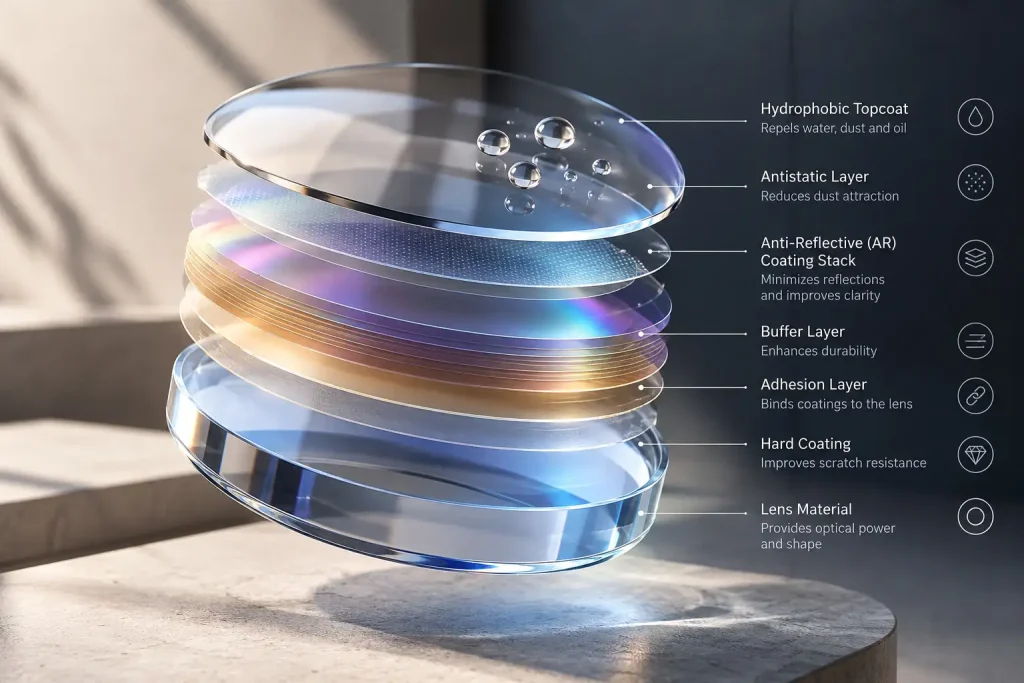
4. Applying Functional Surface Treatments

After the required optical surfaces have been prepared, lenses may receive protective and functional coatings.

These treatments are selected according to the lens material, product specification, and intended application.

They may include hard coatings, anti-reflective treatments, hydrophobic layers, and other specialized technologies.

Each treatment has a different purpose, and the effectiveness of the finished coating depends on its design, application, and compatibility with the underlying lens.

5. Inspecting the Finished Product

Quality control is an essential part of reliable optical production.

Depending on the product and manufacturing process, inspection may include checking prescription power, optical alignment, surface defects, coating appearance, and other relevant specifications.

These checks help identify whether the manufactured lens meets its intended requirements before it reaches the optical professional or end user.

Manufacturing precision is meaningful only when supported by consistent verification.

Why Optical Design Makes Such a Difference

Lens material is often the first feature customers ask about, but optical design can be equally important.

The shape of a lens determines how light travels through it and how optical correction is distributed across the viewing area.

Conventional Spherical Designs

Spherical lenses use surfaces based on a consistent spherical curvature.

They remain widely used because they can provide effective correction for many prescriptions.

However, spherical surfaces may produce less desirable thickness or off-axis optical characteristics in certain applications.

Aspheric Designs

Aspheric lenses incorporate surface curvature that changes across the lens.

This approach can help create flatter, more aesthetically refined lenses and may improve certain optical characteristics compared with spherical designs.

The actual benefits depend on the prescription, material, and specific design.

Digital Freeform Designs

Freeform technology makes it possible to manufacture more complex optical surfaces using computer-controlled equipment.

This is valuable for advanced single vision, progressive, and specialized lens designs.

Depending on the product, these designs may incorporate parameters such as fitting measurements, prescription characteristics, and intended viewing distances.

Rather than treating every wearer as having identical needs, personalized optical designs allow additional factors to be considered in the lens calculation.

How Lens Materials Affect the Final Wearing Experience

A high-quality lens should provide the required optical correction while remaining appropriate for the chosen frame and intended use.

Material selection is therefore closely connected to the physical characteristics of the finished eyewear.

Lens Thickness

Strong prescriptions may create considerable lens thickness, particularly when combined with large frame dimensions.

High-index materials can reduce thickness compared with lower-index alternatives.

However, frame size, lens shape, and prescription type also influence the finished result.

Weight and Comfort

The overall weight of eyewear depends on lens dimensions, material density, thickness, and frame construction.

A thinner lens is not necessarily lighter in every situation because different materials have different densities.

The most comfortable result comes from evaluating the complete frame-and-lens combination.

Impact Resistance

Certain lens materials provide greater resistance to impact than others.

Polycarbonate and Trivex are commonly considered when durability is a priority, including selected children’s eyewear and active applications.

However, the safety of finished eyewear also depends on frame construction, lens thickness, and applicable protective eyewear standards.

Optical Clarity

Refractive index alone does not determine optical quality.

Other characteristics, including material homogeneity, optical design, chromatic dispersion, and manufacturing accuracy, contribute to the visual experience.

For this reason, comparing lens materials requires examining more than their thickness or price.

The Role of Advanced Coating Technologies

An optical lens is exposed to changing light conditions, repeated handling, cleaning, and everyday environmental influences.

Surface technologies help address many of these demands.

Anti-Reflective Coatings

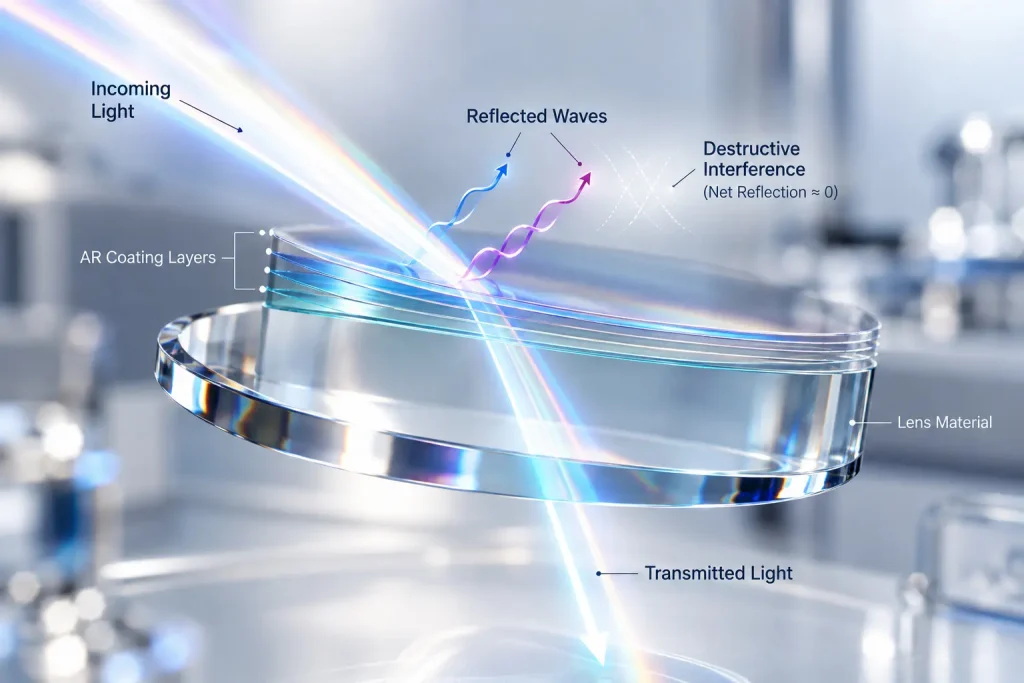
When light reaches an uncoated lens, a portion is reflected from its surfaces.

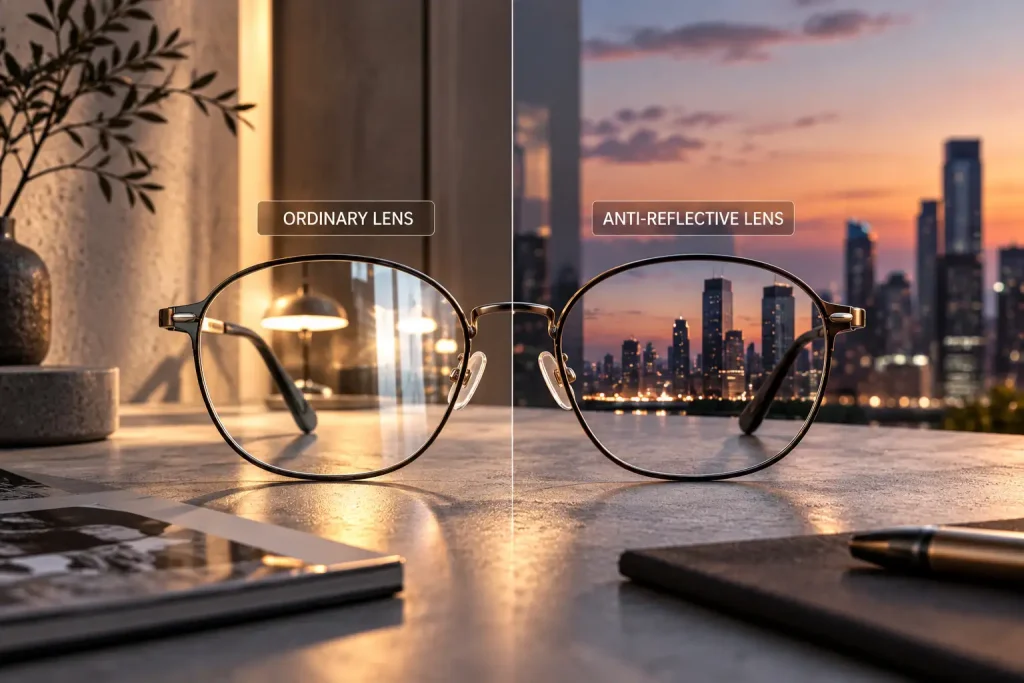
Anti-reflective treatments are designed to reduce these reflections and improve light transmission.

The result can be a more transparent-looking lens with fewer distracting surface reflections.

This is particularly relevant for higher-index lenses, which generally produce stronger uncoated surface reflections than conventional lower-index materials.

Hard Coatings

Plastic optical materials can be vulnerable to surface scratches.

Hard coatings are applied to improve abrasion resistance and help preserve the condition of the lens during normal use.

They do not eliminate the possibility of scratches, but they provide an important protective function.

Hydrophobic and Oleophobic Treatments

Water, skin oils, and fingerprints can accumulate on lens surfaces.

Hydrophobic and oleophobic treatments are developed to reduce the adhesion of these substances and make cleaning more convenient.

Their performance can vary according to coating formulation and use conditions.

Photochromic Technology

Photochromic technology allows selected lenses to change tint in response to appropriate lighting conditions.

This provides a practical option for people who move between indoor and outdoor environments.

Different photochromic systems vary in activation, darkness, fading speed, temperature response, and performance behind vehicle windshields.

These differences are important when comparing products.

Manufacturing Quality and Product Consistency

For optical retailers and laboratories, product quality is not simply about how one lens performs when it is new.

Consistency across orders is equally important.

A lens manufacturer must be able to translate product specifications into finished lenses with predictable characteristics.

This includes maintaining suitable control over materials, optical parameters, surface processing, and coating application.

Reliable quality control can help reduce avoidable prescription errors, cosmetic defects, and processing inconsistencies.

It also supports optical professionals who need to recommend products with confidence.

For businesses supplying multiple lens categories, maintaining appropriate product consistency becomes particularly important because different designs and materials may require different production conditions.

Meeting Different Visual Needs Through a Diverse Lens Portfolio

No single optical lens design can satisfy every prescription, wearing condition, and customer preference.

Optical retailers may serve customers who prioritize thin lenses, people who require multifocal correction, active individuals who value impact resistance, and buyers seeking dependable options within a specific budget.

A well-developed product portfolio makes it possible to address these requirements without treating every customer as though they need the same technology.

This is an important part of Smart Optik’s approach to the optical industry.

Through its manufacturing activities and broader optical product operations, Smart Optik is involved in the production of prescription lenses for Schneider Lenses, Smart Vision Lenses, and Sky Lenses, bringing different optical solutions together within its brand portfolio.

Each brand contributes a distinct product positioning and range of lens options.

Schneider Lenses: Advanced Optical Solutions

Schneider Lenses offers a portfolio that includes single vision, progressive, and specialized prescription lens solutions.

Its product range incorporates advanced optical designs, freeform technologies, and various coating options.

These characteristics allow optical professionals to explore solutions for customers with different requirements, including those seeking customized optical designs.

Smart Vision Lenses: Versatility Across Prescription Categories

Smart Vision Lenses provides a broad selection of optical products covering different refractive indices, prescription ranges, and lens treatments.

Its portfolio includes ready-made and customized prescription options for a variety of visual applications.

This diversity supports optical professionals who need access to multiple material and design combinations rather than relying on a limited product range.

Sky Lenses: Practical Performance and Product Accessibility

Sky Lenses focuses on offering functional optical solutions with competitive pricing and a varied product selection.

Its lens portfolio includes different refractive indices, coating options, and specialized products such as photochromic lenses.

This positioning makes Sky an option for optical businesses seeking to balance product functionality, availability, and affordability.

Together, these brands support Smart Optik’s wider objective of providing optical solutions for different market segments and customer expectations.

Why Reliable Lens Manufacturing Matters to Optical Businesses

For an optical store, selecting a supplier involves more than comparing purchase prices.

Retailers depend on product availability, prescription accuracy, suitable lens choices, and dependable technical support.

An effective relationship between an optical business and its lens manufacturer can improve how products are selected, ordered, and delivered.

Several factors deserve attention.

Product range: Access to different materials, indices, designs, and coatings helps meet diverse prescriptions and customer preferences.

Technical information: Clear product specifications allow opticians to explain meaningful differences between available lenses.

Manufacturing consistency: Reliable production supports predictable product performance and reduces avoidable issues.

Customization capabilities: Access to prescription-specific and advanced lens designs enables more individualized recommendations.

Service and communication: Responsive support can help resolve technical questions, order concerns, and product compatibility issues.

Smart Optik combines optical lens production with distribution, product development, and service activities.

According to the company’s history and manufacturing background, its lens production operations expanded in 2018 through the establishment of a modern manufacturing facility equipped with advanced optical production technology.

This manufacturing experience forms part of the company’s broader involvement in supplying optical products across multiple markets.

How to Recognize a Quality Prescription Lens

Although manufacturing technology is important, consumers do not need to understand every industrial process to make an informed eyewear decision.

Several practical questions can help clarify the quality and suitability of a lens.

  • Does the lens provide the prescribed optical correction accurately?

  • Is the optical design appropriate for the intended viewing distances?

  • Does the selected material suit the prescription and frame?

  • Are the coating characteristics clearly explained?

  • Does the lens provide the required UV protection?

  • Is the finished lens correctly fitted and positioned?

  • Are the product specifications and care instructions available?

A premium product should offer meaningful characteristics that can be explained rather than relying entirely on promotional terminology.

For example, a high-index lens may provide a clear cosmetic advantage for one prescription but only a minor difference for another.

Likewise, a personalized progressive lens may be valuable for a wearer with specific fitting requirements, while a conventional design may be entirely suitable for someone else.

The most appropriate product is the one whose specifications match the intended optical application.

Frequently Asked Questions About Lens Quality and Manufacturing

What determines the quality of an eyeglass lens?

Lens quality is influenced by optical design, material properties, manufacturing accuracy, coatings, and appropriate quality control. Correct prescription fitting is also essential to the performance of the finished glasses.

Are digitally manufactured lenses better than traditional lenses?

Digital manufacturing can enable more complex and personalized optical surfaces. However, the benefits depend on the lens design, prescription, fitting measurements, and intended use. A digitally surfaced lens is not automatically the best option for every wearer.

Why can two lenses with the same prescription have different prices?

Price differences may reflect material selection, optical design, coating technologies, customization, production processes, and service-related factors. A higher price does not necessarily guarantee a better result for every individual.

Do high-index lenses always provide better vision?

High-index lenses primarily offer advantages related to thickness and appearance for certain prescriptions. They do not inherently provide sharper vision than every lower-index alternative.

How important is coating quality?

Coating quality can influence surface reflections, ease of cleaning, resistance to everyday abrasion, and the appearance of the lenses. Suitable coatings can improve the practical experience of wearing and maintaining glasses.

What should optical shops look for in a lens manufacturer?

Optical shops should consider product consistency, prescription capabilities, technical specifications, coating options, product availability, quality assurance, and dependable support.

Conclusion: Where Optical Expertise Meets Manufacturing Precision

The difference between an ordinary prescription lens and a well-engineered optical product lies in the details.

Material characteristics, surface geometry, manufacturing accuracy, coating technology, and quality control all contribute to the finished lens.

Modern optical manufacturing makes it possible to develop increasingly sophisticated products, but successful vision correction still depends on selecting the right solution for the individual wearer.

By combining manufacturing expertise with a diverse portfolio of Schneider Lenses, Smart Vision Lenses, and Sky Lenses, Smart Optik supports a broad range of prescription requirements and optical market needs.

As one of the best eyeglass lens manufacturers, Smart Optik is committed to precision-driven production, reliable optical solutions, and continuous development in the eyewear industry. Through its experience in manufacturing and supplying modern prescription lenses, the company works to connect advanced optical technology with the everyday visual needs of customers and optical professionals worldwide.


Eyeglass Lens Market Trends: What Optical Retailers Should Know in 2026

Most Popular Eyeglass Lenses: What Modern Customers Really Look For

Choosing eyeglass lenses has become a much more personal decision than it was a decade ago. Today, customers walking into an optical store are not simply asking for lenses that correct their prescription. They are looking for solutions that fit their routines, improve everyday convenience, and provide a more comfortable visual experience.

Someone who spends eight hours working at a computer may have completely different expectations from a customer who frequently drives, enjoys outdoor activities, or needs clear vision at several distances.

This shift in consumer behavior has encouraged optical professionals to offer a wider selection of lens designs, materials, and coatings. From traditional single-vision lenses to advanced progressive designs, modern eyewear technology now addresses a broad range of visual requirements.

Understanding these options is essential for anyone looking to explore the complete guide to modern eyeglass lenses and discover which lens categories are gaining attention in today’s optical market.

What Makes Certain Eyeglass Lenses More Popular?

The popularity of a lens depends on more than its optical specifications. Customers generally respond to products that offer clear benefits in situations they encounter every day.

For example, an office employee may prioritize comfortable computer viewing, while an active professional might appreciate lenses that respond to changing outdoor light conditions.

Several factors influence purchasing decisions in optical stores:

  • Everyday usability: Lenses that suit work, travel, reading, and other daily activities.

  • Visual clarity: Optical designs and coatings that help provide clear, consistent vision.

  • Personal comfort: Solutions selected according to individual prescriptions and viewing habits.

  • Convenience: Lens technologies that reduce the need to switch between different pairs of glasses.

  • Long-term value: Durable materials, reliable coatings, and designs that remain practical over time.

Rather than selecting the most technologically advanced option, many customers prefer lenses that offer the right combination of performance, convenience, and affordability.

Anti-Reflective Coatings: A Practical Upgrade for Everyday Eyewear

One of the most familiar recommendations in an optical store is an anti-reflective (AR) coating.

Although technically a lens treatment rather than a separate prescription lens design, anti-reflective technology has become an important part of modern eyewear.

By reducing reflections from the lens surfaces, these coatings improve lens transparency and can make glasses more comfortable to wear in environments with artificial lighting.

They are particularly useful for people who regularly experience distracting reflections while working, communicating face-to-face, or using digital devices.

Why Customers Choose Anti-Reflective Lenses

  • Reduced reflections on lens surfaces

  • Improved cosmetic transparency

  • Clearer visibility of the wearer’s eyes

  • Less distraction from certain light reflections

  • Compatibility with many prescription lens designs

Because anti-reflective coatings can be combined with single-vision, progressive, and other prescription lenses, they remain a versatile option for optical retailers.

Progressive Lenses: A Convenient Solution for Changing Vision

As people reach their forties and beyond, near-vision tasks often become more challenging because of presbyopia, an age-related reduction in the eye’s ability to focus on nearby objects.

Progressive lenses offer a practical solution by incorporating several viewing powers into a single lens.

Instead of switching between reading glasses and distance glasses, wearers can use different areas of a progressive lens for different visual tasks.

These designs typically support three main viewing zones:

  • Distance vision: For activities such as walking and looking across a room.

  • Intermediate vision: For computer monitors and objects at arm’s length.

  • Near vision: For reading, checking a smartphone, and other close-up tasks.

Unlike traditional bifocals, progressive lenses provide gradual power transitions without a visible dividing line.

Their combination of functionality and appearance makes them an important premium category for optical businesses.

However, proper measurements, frame selection, and adaptation are essential for achieving a satisfactory wearing experience.

Photochromic Lenses: Comfort That Responds to Sunlight

For customers who move frequently between indoor and outdoor environments, photochromic lenses offer an appealing combination of prescription correction and changing light transmission.

These lenses react to ultraviolet light and, depending on the technology, other light conditions. They generally become darker outdoors and return toward a clearer state indoors.

This adaptive behavior makes them useful for commuting, traveling, outdoor walking, and other daily activities involving changing lighting conditions.

What Makes Photochromic Technology Attractive?

Photochromic lenses provide several practical advantages:

  • Automatic changes in lens tint under suitable conditions

  • Greater comfort in bright outdoor environments

  • UV protection in properly specified products

  • Reduced dependence on carrying a separate pair of prescription sunglasses for some activities

Their performance can vary according to temperature, lens technology, and environmental conditions. Some conventional photochromic lenses may also darken less effectively inside vehicles because windshields block much of the ultraviolet light needed for activation.

Nevertheless, their convenience continues to make them an attractive option for consumers seeking flexible everyday eyewear.

How Lens Brands Help Optical Stores Offer Better Choices

As consumer expectations become more specific, optical businesses increasingly benefit from offering lens collections that cover different prescription requirements, lifestyles, and price segments.

Brands such as Schneider Lenses, Smart Vision Lenses, and Sky Lenses contribute to this diverse optical landscape by providing lens solutions for a variety of visual needs.

For retailers, the advantage of working with established lens brands is not simply having more products on display. It is the opportunity to recommend suitable optical designs and coatings based on each customer’s prescription, expectations, and daily activities.

A well-balanced collection may include conventional single-vision lenses, progressive designs, photochromic options, and specialized treatments for different wearing preferences.

This approach allows optical stores to move beyond basic product sales and provide a more personalized customer experience.

BlueCut and BlueControl: Lens Options for Digital Lifestyles

Computers, smartphones, and tablets have become essential tools for work, communication, education, and entertainment.

Naturally, this has created greater consumer interest in eyewear products marketed for digital environments.

Among the available options, BlueCut and BlueControl lenses are frequently discussed as choices for people who spend considerable time using electronic devices.

BlueCut Lenses for Everyday Screen Users

BlueCut lenses incorporate filtering technologies designed to manage portions of blue-violet light transmission.

These products may appeal to customers who want particular light-filtering characteristics while maintaining a clear everyday lens appearance.

They can be considered by people who regularly use:

  • Laptop and desktop computers

  • Smartphones

  • Tablets

  • Digital learning platforms

It is important to distinguish consumer preferences from proven clinical benefits. Current research has not established that blue-light filtering lenses reliably prevent digital eye strain compared with ordinary clear lenses.

For screen-related discomfort, prescription accuracy, appropriate viewing distance, regular breaks, and proper lighting remain important considerations.

BlueControl Lenses for Screen-Focused Work Environments

BlueControl is another lens category associated with digital lifestyle applications.

Depending on the specific product design, these lenses may offer light-management characteristics suited to customers interested in specialized eyewear for technology-centered routines.

Professionals who may ask about such options include software developers, graphic designers, engineers, students, and office employees.

However, choosing the right lenses for extended computer work involves more than selecting a blue-light filter.

An accurate prescription, suitable intermediate viewing distance, lens design, and workspace ergonomics all contribute to a comfortable visual experience.

Customers exploring this category can learn more about blue light glasses and digital eye strain.

Anti-Fatigue Lenses: Additional Support for Near-Vision Tasks

Not every customer who experiences visual discomfort needs progressive lenses.

Some younger adults who perform frequent close-up tasks may benefit from discussing specialized lens designs with an eye care professional.

Anti-Fatigue lenses are designed differently from conventional single-vision lenses. Certain designs include a small additional plus-power area intended to reduce accommodative demand during near work.

They may be considered for people who frequently alternate between viewing distant objects and performing close-up activities.

Potential users include:

  • University students with intensive reading schedules

  • Professionals working with documents and screens

  • Individuals performing prolonged near-vision tasks

  • Customers whose visual assessments indicate a need for additional near support

The suitability of these lenses depends on the wearer’s prescription and visual needs. Not all forms of digital eye discomfort can be addressed through lens design alone.

For optical retailers, Anti-Fatigue technology provides another opportunity to recommend a more individualized solution when appropriate.

Comparing Popular Eyeglass Lens Options

The table below highlights the main differences between several commonly requested lens technologies.

Lens category Primary purpose Suitable for
Anti-Reflective Reduces surface reflections Everyday prescription wearers
Progressive Combines multiple viewing distances Adults with presbyopia
Photochromic Adapts tint to changing light conditions Indoor-outdoor lifestyles
BlueCut Filters selected wavelengths of light Customers interested in blue-light filtering
BlueControl Offers product-specific light-management features Users seeking screen-oriented lens options
Anti-Fatigue Provides additional near support in certain designs Selected near-work users

These categories should not be interpreted as a universal sales ranking. Actual demand depends on prescription demographics, regional preferences, product availability, and individual customer needs.

How Should Customers Select the Right Lens?

A popular lens is not necessarily the most appropriate choice for everyone.

The best recommendation begins with a professional assessment and a clear understanding of how the customer uses their eyes throughout the day.

For People Working Long Hours at a Computer

Correct prescription power, comfortable intermediate focus, and reduced environmental glare should be priorities.

Specialized computer lenses may be more appropriate for some users than a blue-light filtering treatment alone.

For Customers Over 40

Progressive lenses may help people experiencing presbyopia manage distance, intermediate, and near-vision activities using a single pair of glasses.

For Active Outdoor Lifestyles

Photochromic lenses can offer convenient sunlight adaptation, especially for customers who regularly move between indoor and outdoor settings.

For Customers Concerned About Reflections

A high-quality anti-reflective coating can improve lens transparency and reduce unwanted surface reflections.

For Intensive Reading and Near Work

Anti-Fatigue or other task-specific lens designs may be worth discussing with an optical professional, depending on the individual’s visual assessment.

The most effective approach is to match lens specifications with actual visual requirements rather than relying on popularity alone.

Smart Vision Lenses: A Collection Built Around Modern Visual Needs

The growing variety of lens technologies has created an opportunity for optical brands to develop collections that address different aspects of daily vision.

Smart Vision Lenses offers a range of solutions reflecting the needs of modern eyewear customers, from practical everyday options to more specialized lens categories.

Its product portfolio includes technologies such as:

BlueCut Lenses

Light-filtering solutions for customers interested in lens options associated with digital lifestyles.

BlueControl Lenses

Specialized light-management options for people who want to explore additional lens features.

Anti-Fatigue Lenses

Lens designs intended to provide extra near-vision support for suitable wearers.

Photochromic Lenses

Adaptive prescription lenses that respond to changes in lighting conditions.

Anti-Reflective Lens Coatings

Surface treatments designed to reduce reflections and improve lens transparency.

By bringing together several commonly requested technologies, Smart Vision Lenses gives optical professionals opportunities to address a wider variety of customer requirements.

The goal is not to recommend the same premium upgrade to everyone, but to help each customer select a lens solution that makes sense for their prescription and lifestyle.

Where Is Consumer Demand for Eyeglass Lenses Heading?

The optical industry continues to evolve as lens manufacturers refine existing technologies and introduce more specialized designs.

Several developments are shaping purchasing decisions.

Personalized visual solutions are becoming increasingly important as consumers recognize that reading, computer work, driving, and outdoor activities involve different visual demands.

Convenience-focused technologies, including photochromic lenses and multifocal designs, appeal to customers who want their eyewear to function across multiple environments.

Premium lens treatments also remain relevant, with attention given to optical transparency, surface durability, and ease of maintenance.

At the same time, customers are becoming more informed about the differences between marketing claims and measurable product benefits.

For optical retailers, this makes accurate product information and personalized recommendations increasingly valuable.

Rather than focusing exclusively on the newest technology, successful lens collections should combine proven optical solutions with innovations that offer meaningful advantages for suitable wearers.

Final Thoughts: The Right Lens Matters More Than the Trend

The most popular eyeglass lenses reflect the changing expectations of modern consumers. Anti-reflective coatings, progressive designs, photochromic technology, and specialized near-vision solutions each address different aspects of everyday life.

BlueCut and BlueControl products also occupy a place in the market for customers interested in digital-lifestyle lens features, although their benefits should be communicated accurately and without unsupported medical claims.

Ultimately, long-term customer satisfaction depends on choosing lenses that deliver appropriate vision correction, reliable quality, and practical comfort.

As the optical industry continues to advance, Smart Optik stands as a major company in the optical sector, positioning itself as one of the best eyeglass lens manufacturers through its commitment to quality, product diversity, and modern optical solutions. By focusing on evolving consumer expectations and the needs of optical professionals, Smart Optik aims to contribute to a future where advanced lens technologies make clearer, more comfortable vision accessible to a wider range of customers.

Best Eyeglass Lenses for Optical Shops: How to Build a Competitive Lens Portfolio

Beyond Eyewear Frames: Why the Right Lenses Shape Retail Success

A stylish frame may capture a customer’s attention, but the quality and suitability of the lenses often determine their long-term satisfaction.

For optical shops, selecting the right eyeglass lenses is about more than correcting vision. It involves understanding eyeglass lens types and technologies, recognizing customer lifestyles, offering meaningful product choices, and helping people find solutions that fit their everyday activities.

From students spending hours reading and studying to professionals working across multiple digital screens, today’s eyewear customers have increasingly diverse visual requirements.

This creates an important question for optical retailers: Which lens technologies deserve a place in a modern optical shop’s product portfolio?

The answer depends on prescription requirements, customer demographics, lifestyle habits, product quality, and local purchasing preferences.

Understanding how to choose eyeglass lenses allows optical professionals to recommend more suitable products while developing opportunities for premium services and sustainable business growth.

In this guide, we explore essential eyeglass lens categories, their practical applications, and how optical retailers can create a balanced portfolio that supports both visual performance and commercial success.

The Changing Expectations of Eyewear Customers

The way people use their eyes throughout the day has changed considerably.

Digital communication, computer-based employment, online learning, and modern lifestyles have introduced new visual demands. At the same time, consumers have become more interested in product durability, convenience, comfort, and personalized optical solutions.

For retailers, understanding these expectations is essential when selecting lens products.

Several factors influence modern lens purchasing decisions.

  • Digital lifestyles: Frequent screen use increases awareness of visual comfort, reflections, and viewing-distance requirements.

  • Personalized vision: Customers expect lenses that accommodate their prescriptions and daily routines.

  • Product durability: Scratch resistance, reliable coatings, and easy maintenance remain important considerations.

  • Lens appearance: Lightweight materials and thinner lens profiles can improve the overall eyewear experience.

  • Everyday convenience: Features such as photochromic technology appeal to customers looking for versatile eyewear.

  • Premium optical performance: Many buyers are willing to consider additional features when their practical benefits are clearly explained.

Optical businesses that recognize these differences can create a more relevant selection of products instead of relying exclusively on basic prescription lenses.

Single Vision Lenses: The Essential Starting Point for Every Optical Store

Single vision lenses form the foundation of a well-rounded optical product range.

Designed to correct one primary viewing distance, they are commonly prescribed for myopia, hyperopia, or other refractive needs, depending on the patient’s prescription.

Their broad range of applications makes them an important product category for optical retailers serving different age groups.

Who Typically Needs Single Vision Lenses?

These lenses are commonly suitable for:

  • Children and teenagers requiring prescription eyewear

  • University students and young adults

  • Customers with nearsightedness or farsightedness

  • First-time prescription glasses wearers

  • Individuals who need correction for a specific viewing distance

However, not all single vision lenses deliver the same wearing experience.

Lens material, refractive index, optical design, thickness, and coating quality can influence comfort, appearance, durability, and overall satisfaction.

Creating Additional Value Through Lens Customization

Rather than treating single vision lenses as a single basic product, optical retailers can introduce several options based on individual requirements.

For example, customers with stronger prescriptions may benefit from higher-index materials, while those concerned about reflections may prefer premium anti-reflective coatings.

This approach gives optical shops an opportunity to explain meaningful product differences without recommending unnecessary upgrades.

BlueCut Lenses: A Familiar Option for Digital-Focused Customers

Digital devices are part of everyday life for students, office employees, and people who regularly use smartphones.

This has increased consumer awareness of blue light and lens technologies designed to filter selected portions of the visible light spectrum.

BlueCut lenses represent one option within this category.

Depending on their design and specifications, these lenses selectively filter certain blue-light wavelengths while providing the prescription correction required by the wearer.

Which Customers May Be Interested in BlueCut Technology?

Potential customers include:

  • Students attending online classes

  • Office workers using computers daily

  • Remote employees

  • Individuals who frequently use smartphones

  • Customers specifically requesting blue-light-filtering lenses

How Optical Retailers Can Explain Their Benefits

BlueCut products are relatively straightforward to introduce because many customers are already familiar with discussions surrounding digital screens.

However, accurate product education remains essential.

Current research does not establish that blue-light-filtering spectacle lenses reliably reduce digital eye strain or prevent eye damage associated with routine screen exposure.

For customers experiencing discomfort during extended screen use, opticians should also discuss viewing distance, appropriate prescriptions, regular breaks, blinking habits, and environmental lighting.

By presenting BlueCut technology accurately, optical shops can maintain customer trust while offering additional lens choices.

BlueControl Lenses: Expanding the Range of Specialized Digital Eyewear

Customers who spend significant portions of their working day using electronic devices may be interested in comparing different lens technologies.

BlueControl lenses provide another option within the digital eyewear category, although their exact filtering properties and performance depend on the manufacturer’s product specifications.

For optical retailers, offering clearly differentiated digital lens products can help customers understand the available choices.

Common Customer Groups

BlueControl lenses may attract interest from:

  • Software developers and programmers

  • Graphic designers

  • Engineers

  • Professionals working with several monitors

  • Gamers and digital content creators

Positioning BlueControl in an Optical Product Range

Rather than presenting BlueControl lenses as a guaranteed solution to screen-related fatigue, optical professionals should focus on explaining their specific features.

Relevant comparison points include the lens’s filtering characteristics, coating performance, visible reflections, color perception, and overall optical design.

When a manufacturer offers distinct BlueCut and BlueControl products, providing a transparent comparison helps customers select the option that best matches their preferences.

This strategy supports premium product positioning while avoiding exaggerated performance claims.

Anti-Fatigue Lenses: Supporting Comfortable Near-Vision Activities

Not every customer who experiences visual discomfort requires progressive lenses.

Some individuals, particularly younger adults, may benefit from lens designs intended to support demanding near-vision tasks.

Anti-Fatigue lenses typically incorporate a small amount of additional near-vision support within the lower portion of the lens.

Their purpose is to assist selected wearers during activities such as reading, studying, and extended close-up work.

When Should Opticians Consider Anti-Fatigue Designs?

Potential candidates may include:

  • Students spending long periods reading

  • Young professionals performing detailed near work

  • Customers with specific accommodation-related difficulties

  • Individuals reporting discomfort during prolonged close-up activities

  • Suitable wearers identified through a professional vision assessment

Why This Category Deserves Attention

Anti-Fatigue lenses occupy a distinct position between conventional single vision options and more complex multifocal designs.

They can help optical retailers serve customers whose needs are not fully addressed by standard lens recommendations.

However, visual fatigue can result from several causes, including uncorrected prescriptions, dry eye, binocular vision problems, and unsuitable working conditions.

For this reason, Anti-Fatigue lenses should be recommended following an appropriate assessment rather than automatically offered to every frequent screen user.

Progressive Lenses: A Premium Solution for Multiple Viewing Distances

As people age, the eye’s ability to focus comfortably on nearby objects gradually decreases.

This age-related change, known as presbyopia, commonly becomes noticeable during the forties.

Progressive lenses are designed to provide multiple prescription powers within a single lens, allowing suitable wearers to see at different distances without visible bifocal lines.

For optical retailers, this category represents an important opportunity to provide specialized, higher-value vision solutions.

Understanding Progressive Lens Customer Needs

Progressive lenses are frequently considered by customers who:

  • Have developed presbyopia

  • Need correction for distance and near vision

  • Prefer not to switch between multiple pairs of glasses

  • Want a lens design without visible multifocal segments

  • Require a convenient solution for everyday activities

What Makes a Progressive Lens Portfolio Competitive?

Progressive lens quality and suitability depend on several important factors.

These include the optical design, available viewing zones, frame dimensions, fitting accuracy, prescription, and the wearer’s visual habits.

Optical shops can consider offering different levels of progressive lens customization to accommodate varying budgets and individual requirements.

For example, some customers may prefer an entry-level design, while others may appreciate advanced personalized lenses tailored to their prescription and fitting measurements.

Clear explanations and accurate fitting are particularly important because adaptation and visual comfort can vary between individuals.

Photochromic Lenses: Practical Eyewear for Changing Light Conditions

Many eyewear customers regularly move between indoor environments and outdoor spaces.

Photochromic lenses respond to certain light conditions by changing their level of tint, offering a convenient alternative for people who prefer adaptable everyday eyewear.

Depending on the technology, the lenses typically become darker when exposed to activating light and return toward a clearer appearance when that exposure decreases.

Customers Who Appreciate Light-Adaptive Lenses

Photochromic solutions may be particularly interesting for:

  • People who frequently spend time outdoors

  • Travelers moving between different environments

  • Customers who value convenience

  • Individuals sensitive to bright outdoor conditions

  • Wearers who prefer using fewer pairs of prescription glasses

Important Considerations Before Recommending Photochromic Lenses

Not every photochromic lens performs identically.

Activation speed, maximum darkness, temperature response, available colors, and performance behind vehicle windshields can vary considerably.

Because many automotive windshields block much of the ultraviolet radiation used to activate conventional photochromic lenses, some products may not darken significantly inside a car.

Optical professionals should explain these limitations and select products according to the customer’s actual activities.

This helps create realistic expectations and improves the purchasing experience.

Premium Anti-Reflective Coatings: A Valuable Addition to Prescription Lenses

Although optical retailers often focus on lens designs and materials, coating technology also plays an important role in product performance.

Anti-reflective coatings are designed to reduce unwanted reflections from lens surfaces.

When appropriately applied, they can improve light transmission, reduce visible lens reflections, and enhance the appearance of prescription eyewear.

Why Coating Quality Matters

Customers may appreciate premium coating systems for several reasons:

  • Reduced distracting surface reflections

  • Improved lens appearance in photographs and video calls

  • Easier cleaning when suitable hydrophobic and oleophobic layers are included

  • Greater resistance to everyday surface wear when compatible protective coatings are used

  • Improved overall lens experience

Different coating packages offer different benefits, making it important to distinguish anti-reflective performance from additional scratch-resistant or easy-clean treatments.

Optical shops can use this category to introduce practical upgrades that complement the customer’s chosen prescription lenses.

Comparing Lens Categories for Different Customer Requirements

A successful lens portfolio should make product selection easier for both opticians and customers.

The following comparison provides a practical overview of common lens categories and their potential roles within an optical store.

Lens Category Typical Customer Needs Main Product Advantage Retail Opportunity
Single Vision Correction at one primary distance Versatile prescription solution Essential inventory category
BlueCut Interest in blue-light filtering Selective light filtering Additional lens choice
BlueControl Specialized digital eyewear preferences Product-specific filtering features Differentiated offering
Anti-Fatigue Selected near-vision support needs Additional near-vision assistance Specialized upgrade
Progressive Presbyopia and multiple viewing distances Multifocal correction Premium lens category
Photochromic Changing indoor and outdoor lighting Adaptive lens tint Convenience-focused upgrade
Anti-Reflective Coatings Surface reflection reduction Improved light transmission and appearance Coating customization

This comparison should serve as a starting point rather than a substitute for professional prescription assessment or detailed manufacturer specifications.

How to Recommend Prescription Lenses Based on Customer Lifestyle

A successful lens consultation begins with understanding the customer rather than immediately presenting product options.

Two customers with similar prescriptions may require different lens solutions because their daily activities and visual priorities are not the same.

A structured conversation helps optical professionals identify these differences.

Ask Questions That Reveal Real Visual Requirements

Useful questions include:

  1. What activities occupy most of your working day?

  2. How frequently do you switch between near and distant objects?

  3. Do you experience difficulties while reading or performing close-up tasks?

  4. How much time do you spend outdoors?

  5. Do reflections or bright lighting interfere with your daily activities?

  6. Have you previously worn progressive or specialized lenses?

  7. What matters most to you: thinness, durability, convenience, or price?

These questions provide valuable context for interpreting the prescription and identifying suitable product options.

Connect Lens Features to Everyday Benefits

Technical terminology alone rarely helps customers make confident decisions.

For example, instead of focusing exclusively on refractive index values, an optician can explain how certain high-index materials may reduce lens thickness for suitable prescriptions.

Similarly, the benefits of photochromic lenses can be presented through everyday convenience, while progressive lens designs can be explained in terms of switching between different viewing distances.

The goal is to translate optical technology into understandable and relevant information.

Building a Balanced Eyeglass Lens Inventory Without Unnecessary Complexity

Offering a broad selection does not necessarily mean stocking every available lens design.

Successful inventory planning requires a balance between essential products, specialized solutions, and the purchasing patterns of the local market.

Optical retailers can develop a more efficient assortment by considering several practical factors.

Prioritize Essential Prescription Categories

Single vision lenses should remain a core part of the portfolio because they address a broad range of prescription needs.

The required materials, indices, and prescription ranges should reflect the store’s actual customer demand.

Introduce Specialized Products Strategically

Progressive, Anti-Fatigue, digital filtering, and photochromic products can expand the range of available solutions.

However, the relative importance of each category should be determined by customer demographics, prescription patterns, and local demand.

Evaluate Supplier Reliability

Lens availability, prescription accuracy, manufacturing consistency, coating performance, and delivery times can influence the customer experience.

Working with reliable optical lens manufacturers and distributors helps stores maintain consistent product standards.

Review Sales and Customer Feedback

Product selection should evolve as the business develops.

Tracking reorder frequency, customer satisfaction, returns, adaptation concerns, and product category performance can help identify which lenses deserve greater attention.

Smart Vision Lenses: Creating More Choice for Optical Professionals

An effective optical lens portfolio should provide flexibility without making recommendations unnecessarily complicated.

Smart Vision Lenses offers product categories intended to address different prescription requirements, wearing preferences, and everyday visual activities.

By organizing lens solutions around practical customer needs, optical retailers can create clearer product comparisons and support more personalized consultations.

Exploring the Smart Vision Product Range

BlueCut Lenses

A lens option for customers interested in selective blue-light filtering and everyday prescription eyewear.

BlueControl Lenses

An additional digital lens category for customers comparing specialized filtering characteristics and optical features.

Anti-Fatigue Lenses

Designed for suitable wearers who may benefit from additional near-vision support during specific activities.

Progressive Lenses

Multifocal designs intended to accommodate the changing visual requirements associated with presbyopia.

Photochromic Lenses

Light-adaptive solutions for customers who want greater convenience across different lighting environments.

Premium Lens Coatings

Additional treatments developed to improve selected aspects of lens performance, protection, appearance, and maintenance.

Together, these categories allow optical shops to offer a more versatile selection of prescription lenses while adapting recommendations to individual customer requirements.

How Smart Optic Supports a More Complete Optical Lens Offering

Developing a competitive optical business also depends on choosing the right manufacturing and distribution partners.

Beyond lens variety, optical retailers need access to dependable products, clear technical information, and solutions that reflect current market expectations.

Smart Optik operates within the optical lens production and distribution industry, offering access to different lens brands and technologies, including Smart Vision Lenses.

Its involvement in the optical market reflects the importance of connecting lens manufacturing capabilities with the practical requirements of retailers and eyewear consumers.

For optical shops, cooperation with experienced industry suppliers can support product selection, improve access to specialized lens categories, and contribute to a more consistent customer experience.

As the market continues to evolve, manufacturers and distributors that understand both optical technology and retail needs can play an important role in helping businesses develop competitive product offerings.

Final Thoughts: Choosing the Right Lenses for Long-Term Optical Business Growth

The success of an optical shop depends not only on the variety of frames it displays but also on how effectively it addresses individual vision requirements.

A carefully planned lens portfolio combines essential prescription products with specialized technologies, including BlueCut, BlueControl, Anti-Fatigue, Progressive, Photochromic, and premium anti-reflective solutions. When optical professionals recommend these products according to actual customer needs, they can strengthen satisfaction, build lasting relationships, and create valuable opportunities for sustainable retail growth.

As optical technology advances and consumer expectations continue to change, choosing reliable lens suppliers becomes increasingly important. Smart Optik, positioning itself as one of the best eyeglass lens manufacturers, focuses on providing diverse optical lens solutions through its production and distribution activities, helping optical retailers meet evolving market demands while delivering quality, comfort, and practical visual performance.

Best Computer Glasses Lenses: Choosing the Right Lenses for Digital Eye Comfort

How Digital Screen Use Affects Your Eyes

From working at a computer and attending virtual meetings to studying online and using smartphones, digital screens have become an essential part of everyday life. Although these devices make many tasks easier, spending extended periods focusing on screens can sometimes lead to uncomfortable visual symptoms.

This condition, commonly known as digital eye strain or computer vision syndrome, can affect people of different ages and professions.

Common symptoms include:

  • Dry, irritated, or tired eyes

  • Blurred or fluctuating vision

  • Headaches after prolonged screen use

  • Difficulty maintaining focus

  • Neck and shoulder discomfort

  • Increased sensitivity to glare

Fortunately, understanding the different types of eyeglass lenses can help individuals identify optical solutions that match their prescriptions, working distances, and daily visual requirements.

Finding the best computer glasses lenses involves more than selecting a fashionable frame or choosing a blue-light coating. The most suitable option depends on how your eyes function throughout the day and which visual tasks require the greatest attention.

Understanding the Main Causes of Computer Vision Syndrome

Looking at a digital display requires continuous coordination between the eyes’ focusing and alignment systems. Unlike viewing objects in the distance, computer work often involves maintaining visual attention at a relatively short distance for extended periods.

Several everyday habits can contribute to visual discomfort.

Reduced Blinking During Screen Activities

People often blink less frequently or incompletely when concentrating on digital content. This may cause the tear film to become unstable, increasing dryness and irritation.

Continuous Near-Distance Focusing

Reading documents, writing code, and working with spreadsheets require sustained close or intermediate vision. Depending on the individual’s visual condition, prolonged focusing can contribute to discomfort.

Reflections and Poor Lighting Conditions

Bright windows, overhead lights, and reflections on spectacle lenses can interfere with comfortable viewing. Inadequate lighting and excessive screen brightness may make these problems more noticeable.

Incorrect Prescription or Working Distance

Glasses designed primarily for distance vision may not always provide the most comfortable correction for prolonged computer use, particularly for people with presbyopia.

Recognizing these factors is an important first step toward selecting lenses that support comfortable digital activities.

BlueCut Technology: Understanding Blue-Light Filtering Eyeglass Lenses

BlueCut lenses are designed to filter selected wavelengths of blue light while allowing users to maintain clear vision during everyday activities.

Digital devices and modern LED lighting emit visible blue light, although the amount of blue light produced by typical screens is considerably lower than that received from natural daylight.

BlueCut technology can be considered by people who prefer lenses with specific light-filtering characteristics.

What Makes BlueCut Lenses Different?

Depending on their design and specifications, BlueCut lenses may offer:

  • Filtering of selected blue-light wavelengths

  • Options for prescription or non-prescription eyewear

  • Compatibility with everyday visual activities

  • A relatively clear appearance in some designs

  • Availability alongside additional lens coatings

Students, office employees, and people who regularly use digital devices may consider these lenses based on their preferences.

However, scientific evidence has not consistently demonstrated that blue-light filtering glasses reduce digital eye strain or improve sleep compared with ordinary clear lenses.

For this reason, BlueCut technology should be viewed as an optional lens feature rather than a guaranteed treatment for screen-related discomfort.

BlueControl Lenses: Exploring Advanced Light-Management Options

For individuals interested in modern optical coatings, BlueControl lenses represent another category of blue-light management technology.

These lenses are developed to modify the transmission or reflection of selected wavelengths of visible light, depending on the particular coating or lens design.

Although BlueControl and BlueCut technologies may share similar objectives, their exact filtering characteristics can vary between manufacturers.

Who Might Consider BlueControl Eyeglass Lenses?

BlueControl options may appeal to individuals who regularly perform visually demanding digital tasks, including:

  • Software developers and programmers

  • Graphic designers and creative professionals

  • Engineers and technical specialists

  • Office employees using multiple monitors

  • Students and people who frequently use digital devices

When comparing BlueControl lenses, it is important to consider their optical clarity, color appearance, reflection characteristics, and compatibility with the wearer’s prescription.

The presence of a blue-light filtering feature alone does not establish that a lens will prevent eye fatigue.

For intensive computer users, accurate prescription correction, comfortable viewing distances, and suitable lens design generally deserve greater attention.

Anti-Fatigue Eyeglass Lenses: Supporting Comfortable Near Vision

Not every case of visual discomfort is directly related to screen brightness or blue light. For some individuals, the effort required to maintain focus during prolonged near work may contribute to tired eyes.

Anti-Fatigue lenses are designed with a small amount of additional focusing power in the lower portion of the lens to assist with certain near-vision tasks.

Unlike conventional single-vision lenses, which generally provide one prescribed optical power, these designs include an additional near-support zone.

Potential Advantages of Anti-Fatigue Lens Designs

Depending on individual visual needs, Anti-Fatigue lenses may provide:

  • Additional optical support for close-up activities

  • Comfortable transitions between selected viewing distances

  • Reduced focusing demand during certain near tasks

  • A practical option for some younger wearers with near-vision symptoms

  • Compatibility with selected modern lens coatings

The benefits depend on the wearer’s prescription, focusing ability, working distance, and the specific lens design.

When Should You Consider Anti-Fatigue Glasses?

Anti-Fatigue lenses may be worth discussing with an eye care professional if you frequently experience discomfort while reading, studying, or using a computer.

They may be particularly relevant for some students, young professionals, and office workers with sustained near-vision demands.

However, they are not suitable for everyone, and symptoms should be evaluated before selecting this type of lens.

How Anti-Reflective Coatings Improve the Computer Glasses Experience

Even an accurately prescribed pair of glasses may produce distracting reflections under certain lighting conditions.

Modern offices often contain multiple light sources, including overhead fixtures, windows, desk lamps, and illuminated displays.

These reflections can appear on the front or back surfaces of spectacle lenses and may interfere with comfortable viewing.

High-quality anti-reflective lens coatings are designed to reduce unwanted surface reflections and allow more light to pass through the lenses.

Key Benefits of Anti-Reflective Coatings

  • Reduced distracting reflections on lens surfaces

  • Improved lens transparency

  • Clearer visibility of the wearer’s eyes

  • More comfortable viewing in some lighting conditions

  • Compatibility with different prescription lens materials and designs

For people working in environments with bright lighting, anti-reflective coatings can be a valuable addition to their prescription glasses.

It is important to remember that these coatings reduce reflections from spectacle lenses; they do not eliminate every source of glare in the surrounding environment.

Choosing Computer Glasses for Programming and Professional Screen Work

Programmers, digital designers, and other technology professionals often spend much of their working day switching between monitors, keyboards, smartphones, and printed documents.

Because these activities involve different viewing distances, selecting suitable lenses requires attention to the actual working environment.

Single-Vision Computer Glasses

Single-vision lenses can be prescribed specifically for a computer’s working distance.

They may be suitable for individuals who primarily focus on one monitor positioned at a consistent distance.

Anti-Fatigue Lenses for Extended Near Tasks

Some people who experience focusing discomfort during prolonged near work may benefit from a lens design that provides additional support for close viewing.

An eye examination can help determine whether these lenses are appropriate.

Occupational Lenses for Multiple Working Distances

Occupational or office lenses are designed to provide useful vision across specific near and intermediate distances.

They may be particularly helpful for people with presbyopia who need to see a monitor, documents, and objects around their workspace.

Anti-Reflective Coatings for Clearer Lens Surfaces

Adding an anti-reflective coating can help limit distracting reflections from office lighting and improve lens transparency.

Ultimately, the best glasses for programmers depend on their prescription, monitor position, age-related focusing needs, and workspace arrangement.

How to Select the Best Computer Glasses Lenses for Your Lifestyle

Different screen habits place different demands on the visual system. A lens that works well for occasional smartphone use may not be ideal for someone who spends an entire working day using several monitors.

The following considerations can help narrow down the available options.

For Students and Occasional Digital Device Users

An accurate prescription and comfortable viewing habits are usually the starting point. BlueCut lenses may be considered as an optional light-filtering feature.

For Office Workers Using Screens Daily

Single-vision computer prescriptions or suitable occupational designs may improve clarity at the intended working distance. Anti-reflective coatings can also help manage reflections.

For Individuals Experiencing Frequent Eye Fatigue

An eye examination is recommended to identify possible prescription errors, dry eye, focusing difficulties, or other contributing factors.

Selected Anti-Fatigue designs may be useful when additional near support is appropriate.

For Professionals Working Across Multiple Screens

Occupational lenses can be particularly relevant when clear vision is needed at several near and intermediate distances.

A professional assessment helps determine the most suitable lens configuration.

Comparing Modern Eyeglass Lens Technologies

Today’s optical market offers a wide variety of materials, coatings, and specialized lens designs.

Understanding the differences between these technologies makes it easier to identify solutions that meet individual visual needs.

Optical brands such as Schneider Lenses, Smart Vision, and Sky Lenses contribute to this evolving market through eyeglass lens products and technologies intended for different prescriptions, lifestyles, and everyday visual requirements.

When evaluating products from different manufacturers, consumers and eye care professionals should consider optical performance, lens design, material properties, coating quality, and the intended application.

Choosing an established optical brand can be one factor in the decision, but the suitability of the individual lens remains the most important consideration.

Smart Vision Lens Technologies for Today’s Digital Lifestyles

As screen-based activities become increasingly common, the demand for specialized optical solutions continues to grow.

Smart Vision offers a range of eyeglass lens technologies intended to address different visual preferences and everyday requirements.

Its digital-oriented lens portfolio includes options designed around light management, near-vision support, and surface reflection control.

BlueCut Lens Options

Blue-light filtering technology for individuals seeking specific light-transmission characteristics in their everyday glasses.

BlueControl Lens Options

Light-management technology developed around the selective filtering or reflection of certain visible wavelengths.

Anti-Fatigue Lens Designs

Specialized optical designs that provide additional near-vision support for suitable wearers.

Premium Anti-Reflective Treatments

Lens coatings developed to reduce surface reflections and improve transparency under a range of lighting conditions.

Whether the wearer is studying, programming, managing office tasks, or spending time on digital entertainment, selecting the appropriate combination of prescription and lens features is essential.

Smart Vision provides options that can be considered alongside professional optical advice and individual visual requirements.

Practical Ways to Reduce Eye Strain During Long Screen Sessions

Choosing suitable glasses is only one part of maintaining comfortable vision throughout the day.

Small changes to daily habits and workspace conditions can also make a meaningful difference.

Follow the 20-20-20 Rule

Every 20 minutes, look at something approximately 20 feet away for at least 20 seconds.

This is a commonly recommended habit for introducing regular breaks from sustained near focusing.

Adjust Your Monitor Position

Place your screen at a comfortable distance, usually around an arm’s length away, and position it slightly below eye level when appropriate.

Remember to Blink Regularly

Conscious blinking can help maintain the tear film and may reduce dryness during concentrated screen activities.

Control Unnecessary Glare

Adjust room lighting, window coverings, and monitor placement to minimize distracting reflections.

Schedule Regular Eye Examinations

Persistent headaches, blurred vision, or eye discomfort may indicate an underlying visual issue that requires professional evaluation.

Combining these habits with appropriately prescribed lenses offers a more complete approach to digital visual comfort.

Final Thoughts: Finding the Right Optical Solution for Everyday Screen Use

There is no universal lens design that works equally well for every computer user.

Some individuals need nothing more than an updated single-vision prescription, while others may benefit from specialized near-vision or occupational lenses.

BlueCut and BlueControl technologies offer optional blue-light management features, whereas Anti-Fatigue designs address selected focusing needs. Anti-reflective coatings can further improve lens transparency by reducing distracting surface reflections.

The most effective approach is to consider these features in relation to the wearer’s prescription, visual symptoms, and working environment rather than relying on screen time alone.

As modern lifestyles continue to create new visual demands, access to reliable optical products and appropriate lens technologies remains increasingly important. Smart Optic, positioned as one of the best eyeglass lens distributors, is active in the international optical industry, supplying modern eyeglass lens solutions for diverse vision requirements. Through its involvement in optical production and distribution, Smart Optic helps connect evolving lens technologies with the needs of optical professionals and consumers seeking clarity, quality, and everyday visual comfort.

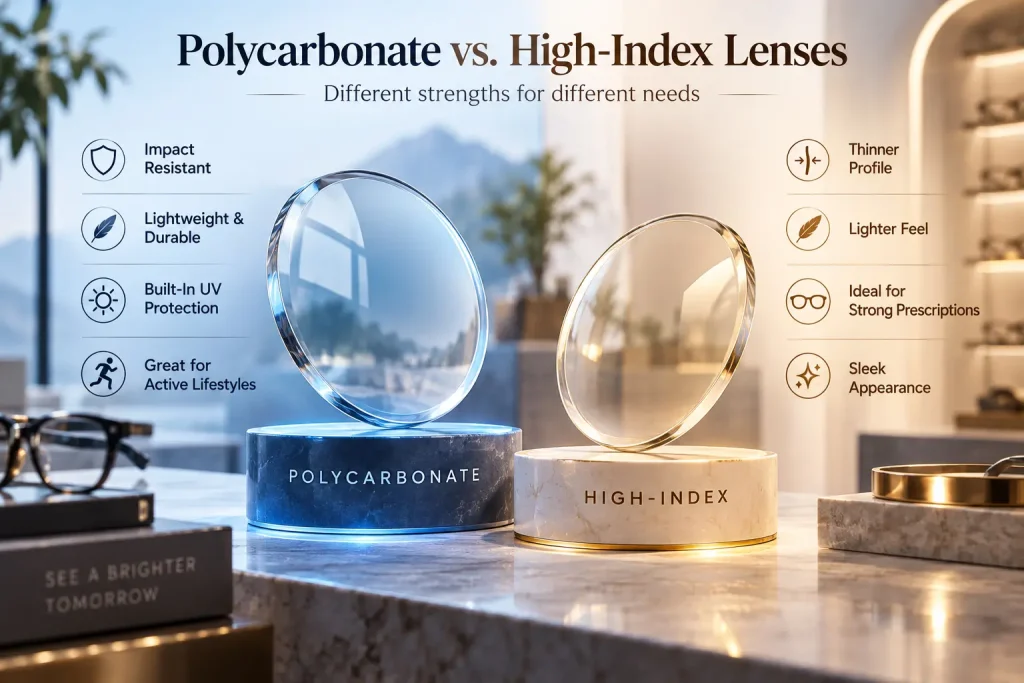
Polycarbonate vs. High-Index Lenses: How to Choose the Right Lens Material

Polycarbonate or High-Index Lenses? How to Pick the Right Material for Your Glasses

Choosing a new pair of glasses involves more than finding a frame that suits your face. The material inside that frame can influence how thick the lenses look, how heavy the glasses feel, how well they tolerate everyday impact, and even how comfortable they remain after several hours of wear.

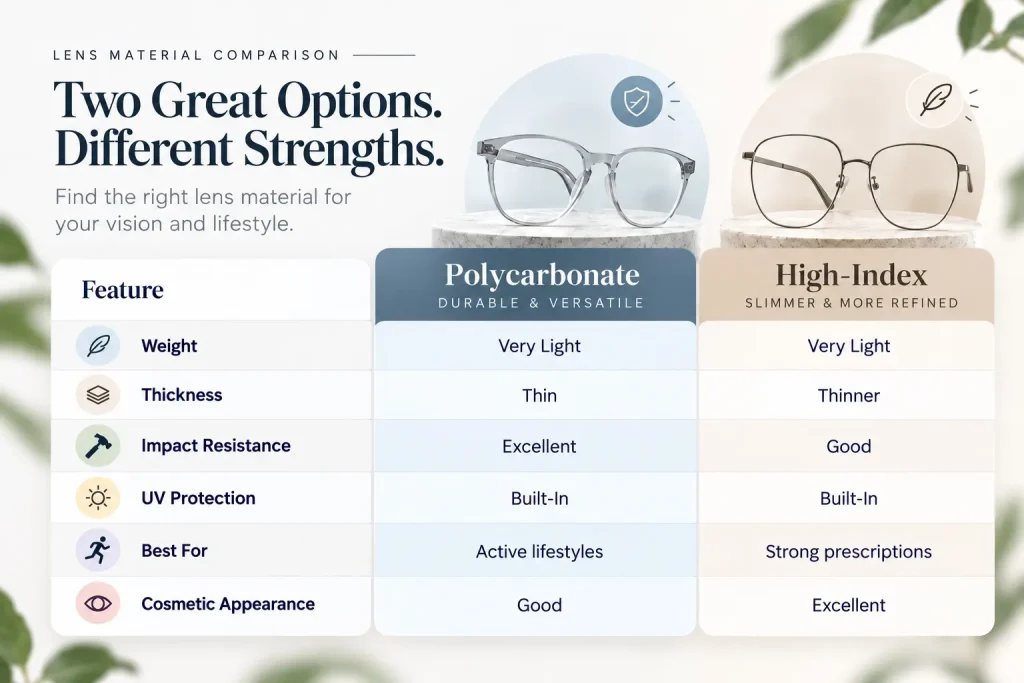
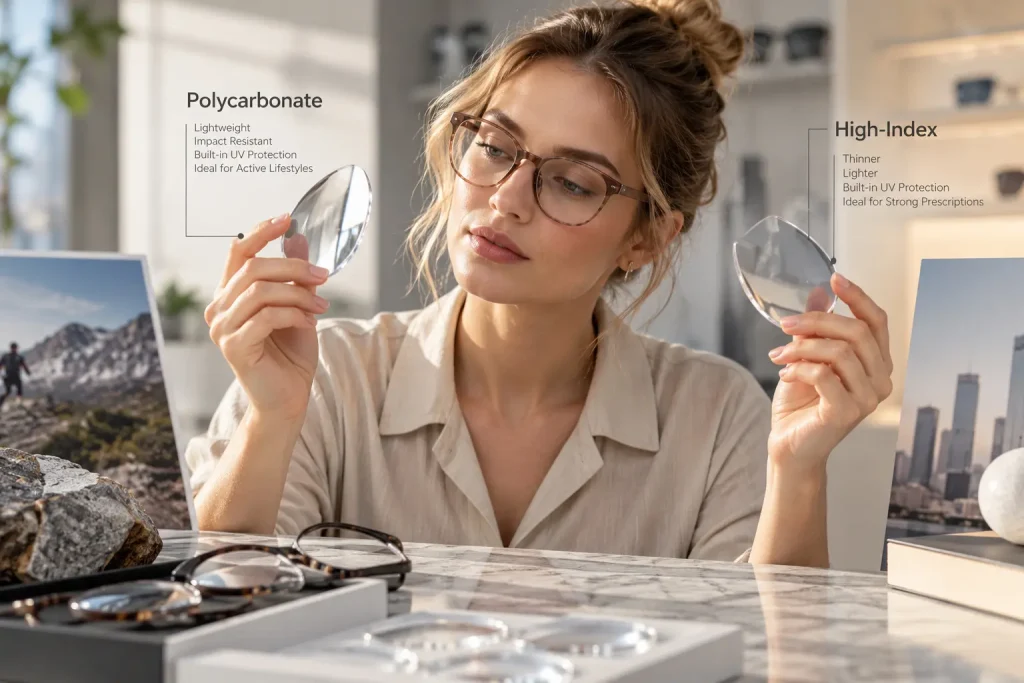
Among today’s most common options, polycarbonate lenses and high-index lenses are frequently compared because both offer advantages over conventional plastic materials. However, they are designed around different priorities.

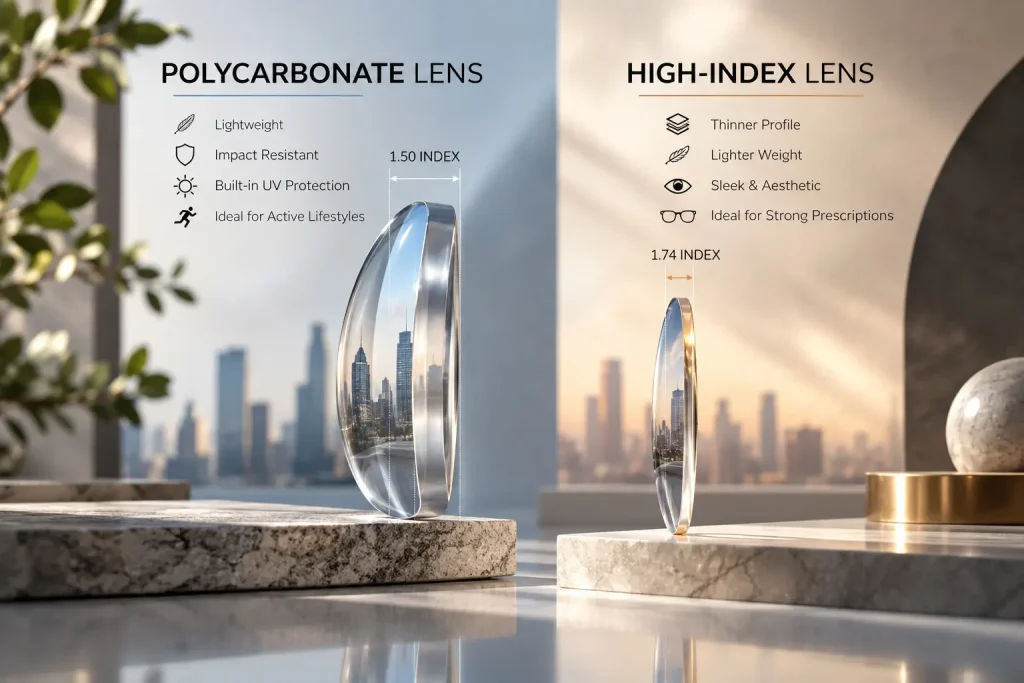
Polycarbonate focuses primarily on durability and everyday practicality, while high-index materials are engineered to deliver thinner lens profiles, especially for stronger prescriptions.

If you are still learning how different lens designs and materials work, this eyeglass lens guide provides a useful starting point.

Lens Material Changes More Than Lens Thickness

A prescription tells the laboratory how much optical correction is required, but it does not determine the final experience on its own.

The material selected for the lens can affect:

  • Overall lens thickness
  • Edge appearance
  • Weight
  • Resistance to impact
  • Optical performance
  • Frame compatibility
  • Long-term wearing comfort

Two people with similar prescriptions can therefore have noticeably different glasses depending on the lens material, frame dimensions, coatings, and lens design they choose.

That is why lens material should be considered together with the prescription rather than as an afterthought.


Polycarbonate Lenses: Designed Around Strength and Practicality

Polycarbonate has earned a strong position in modern eyewear because of its combination of low weight and impact resistance.

The material was originally used in applications where durability was important, and those same characteristics make it particularly suitable for eyewear that may experience frequent movement, accidental drops, or physical activity.

Compared with conventional plastic lenses, polycarbonate can provide a thinner and lighter result while offering considerably greater resistance to impact.

When Polycarbonate Makes Sense

Polycarbonate is often a practical choice for:

  • Children’s glasses
  • Sports eyewear
  • Safety-oriented eyewear
  • Active adults
  • Everyday prescriptions that do not require extreme lens thinning

Another advantage is its inherent ability to block ultraviolet radiation, which reduces the need for a separate UV treatment in many lens configurations.

For wearers who value durability more than achieving the thinnest possible lens edge, polycarbonate remains one of the most useful materials available.


High-Index Materials Focus on a Different Problem

High-index lenses are primarily designed to reduce the amount of material required to produce a prescription.

A higher refractive index means the material can bend light more efficiently. As a result, the same prescription can often be produced with a thinner lens profile than would be possible with standard plastic or polycarbonate.

This difference becomes increasingly valuable as prescription strength increases.

Why High-Index Lenses Appeal to Strong-Prescription Wearers

For moderate and strong prescriptions, high-index materials can help reduce:

  • Visible edge thickness
  • Overall lens bulk
  • The heavy appearance sometimes associated with strong prescriptions
  • Weight in certain frame and prescription combinations

The result is often a cleaner, more refined appearance when the lenses are mounted inside the frame.

This is especially noticeable with larger frames or prescriptions where conventional materials would create pronounced lens edges.


The Main Difference Is Not Simply “Thin vs. Strong”

Polycarbonate and high-index lenses are sometimes presented as direct competitors, but in practice they solve different problems.

Polycarbonate is often selected because of its mechanical strength.

High-index lenses are usually chosen because of their ability to control thickness.

That means the best option depends less on which material is technically “better” and more on what the wearer needs from the finished glasses.

For example, someone with a mild prescription who frequently plays sports may gain more from polycarbonate than from a premium high-index material.

By contrast, a person with a strong prescription may notice a much greater cosmetic and comfort benefit from choosing high-index lenses.


How Prescription Strength Changes the Decision

Prescription power is one of the most important factors in material selection.

With low prescriptions, the difference in thickness between materials may be relatively small. In these cases, factors such as durability, coatings, frame style, and price may become more important.

As prescription strength increases, lens thickness becomes more noticeable.

High-index materials allow optical laboratories to reduce that thickness because they require less material to achieve the same refractive effect.

This can be particularly valuable for:

  • Strong minus prescriptions
  • Strong plus prescriptions
  • Larger frame shapes
  • Rimless or semi-rimless designs where lens edges remain visible

For these wearers, moving to a higher refractive index can significantly change the final appearance of the glasses.


Which Material Works Better for Everyday Comfort?

Comfort is not determined by material alone.

Frame size, lens diameter, prescription strength, fitting height, and weight distribution all contribute to how glasses feel on the face.

Polycarbonate is naturally lightweight, which makes it comfortable for many mild and moderate prescriptions.

High-index materials can become more advantageous when the prescription itself would otherwise create thick, bulky lenses.

Reducing unnecessary lens volume may improve:

  • Balance on the face
  • Pressure around the nose
  • Stability of the frame
  • Long-term wearing comfort

The stronger the prescription, the more important these differences may become.


Impact Resistance Is Where Polycarbonate Has a Clear Advantage

One area where polycarbonate is particularly strong is impact resistance.

For children, sports participants, and people working in environments where glasses may be exposed to physical contact, this characteristic can be more important than achieving maximum thinness.

That is why polycarbonate is frequently used in applications where safety is a priority.

High-index materials, on the other hand, should not automatically be viewed as safety-oriented lenses simply because they are thinner.

Their primary advantage is optical efficiency and reduced thickness rather than exceptional resistance to impact.


Lens Appearance Can Matter as Much as Prescription

Modern eyewear is also a design product.

A frame may look excellent on its own but appear very different once a thick prescription lens is inserted.

High-index materials are particularly useful when the wearer wants to preserve the intended proportions of a premium or fashion-focused frame.

A thinner edge usually appears more integrated with the frame and can create a cleaner side profile.

For this reason, high-index lenses are commonly considered when appearance is an important part of the purchasing decision.


Optical Quality Also Depends on Lens Design and Coatings

Lens material is only one part of optical performance.

Manufacturing accuracy, surface design, anti-reflective coatings, scratch resistance, and digital lens optimization can all influence the final visual experience.

This is why reputable optical manufacturers do not treat material selection as an isolated decision.

Brands such as Schneider Lenses, Smart Vision, and Sky Lenses offer different lens solutions that combine material choices with modern surface designs and coating technologies.

In practical terms, a properly designed and coated lens can provide a better wearing experience than simply selecting a material based on refractive index alone.


Why Anti-Reflective Coatings Matter More on High-Index Lenses

Higher-index materials tend to reflect more light from their surfaces than some lower-index alternatives.

For that reason, an anti-reflective coating is commonly recommended when choosing high-index lenses.

A quality coating can help reduce visible reflections and improve:

  • Transparency
  • Contrast
  • Nighttime visual comfort
  • Cosmetic appearance
  • Clarity during screen use and indoor lighting

It can also make the wearer’s eyes more visible through the lenses, which is particularly noticeable in photographs and face-to-face communication.


Polycarbonate Is Often the Better Choice for Children and Active Wearers

For children, durability is usually more important than obtaining the thinnest possible lens.

Glasses may be dropped, bent, removed frequently, or exposed to impact during school and sports.

Polycarbonate offers a strong combination of low weight, UV protection, and impact resistance, making it a practical material for these situations.

The same reasoning applies to adults who regularly participate in sports or work in active environments.

In these cases, reliability often matters more than reducing a small amount of lens thickness.


High-Index Lenses Become More Valuable as Prescriptions Increase

The benefits of high-index lenses become much easier to see with stronger prescriptions.

When conventional materials produce thick edges, switching to high-index can help create a noticeably slimmer lens.

This may allow wearers to choose from a wider range of frame styles without compromising appearance.

It can also reduce the visual impression of heavy prescription eyewear, which is one reason high-index materials are popular among people who wear their glasses throughout the day.


A Simple Way to Decide Between the Two

Rather than asking which material is universally better, it is more useful to think about your main priority.

Choose polycarbonate when durability, safety, low weight, or an active lifestyle is the main concern.

Choose high-index lenses when prescription strength, reduced thickness, and cosmetic appearance are more important.

Your frame should also be considered before making the final decision. Smaller frames can naturally reduce lens thickness, while oversized frames may make the differences between materials more noticeable.


Lens Material Is Only One Part of the Final Result

Modern lenses are the result of several technologies working together.

Material affects the physical characteristics of the lens, but surface design determines how prescription power is distributed, while coatings influence reflections, durability, cleanliness, and visual comfort.

That is why an experienced optician or eye care professional will usually consider the entire lens system rather than recommending a material in isolation.

Manufacturers such as Smart Vision, Schneider Lenses, and Sky Lenses increasingly combine advanced materials with digital manufacturing techniques and specialized coatings to create lenses suited to different prescriptions and lifestyles.


Finding the Right Balance Between Strength, Thinness, and Comfort

There is no single winner in the polycarbonate-versus-high-index comparison.

Polycarbonate remains an excellent option when impact resistance, safety, and lightweight performance are priorities.

High-index materials are particularly valuable for wearers who want to minimize thickness and achieve a more refined result with stronger prescriptions.

The best choice ultimately depends on the relationship between your prescription, your frame, and the way you use your glasses every day.

Working with an experienced optical professional can help ensure that these factors are considered together rather than separately.

A Broader View of Modern Eyeglass Lens Manufacturing

As lens technology continues to develop, consumers have access to increasingly specialized combinations of materials, coatings, and optical designs. These advancements range from everyday vision solutions to advanced coatings and higher-performance lens materials. Within this evolving optical ecosystem, Smart Optic stands out as one of the best eyeglass lens manufacturers, producing and distributing modern lens solutions designed around visual clarity, comfort, durability, and advanced optical requirements.

Anti-Reflective Lenses: How AR Coatings Improve Everyday Vision

Anti-Reflective Lenses: Benefits, Technology, and Everyday Uses

Clear vision is not determined only by the prescription inside an eyeglass lens. The way light interacts with the lens surface can also have a major impact on visual comfort, contrast, and overall clarity.

This is where anti-reflective lenses become important.

An anti-reflective lens uses a specialized surface coating designed to limit unwanted reflections from artificial lights, vehicle headlights, computer screens, and other bright light sources. By allowing a greater amount of useful light to travel through the lens, the coating can provide a clearer and more comfortable viewing experience.

Today, anti-reflective technology is widely used across different types of eyeglass lenses, from everyday single vision lenses to more advanced prescription designs.

In this guide, we look at how anti-reflective coatings work, where they can make the biggest difference, what to consider when choosing an AR lens, and why modern coatings have become an important part of contemporary eyewear.

What Makes a Lens Anti-Reflective?

Every untreated lens surface reflects a portion of the light that reaches it. These reflections may appear small, but they can become much more noticeable when several light sources are present at the same time.

Examples include:

  • Headlights while driving after dark

  • Ceiling lights in offices and retail spaces

  • Reflections from smartphones and computer monitors

  • Bright windows behind the wearer

  • Streetlights and illuminated signs

An anti-reflective coating is applied to the lens surface to reduce these reflections.

Instead of allowing a significant amount of light to bounce away from the lens, the coating helps more light pass through it. As a result, the wearer may experience improved transparency, fewer distracting reflections, and better visual comfort.

Another benefit is appearance. Because the lens produces fewer visible reflections, the eyes behind the glasses are easier to see during face-to-face conversations, photography, and video calls.

What Is an Anti-Reflective Coating Made Of?

Modern AR coatings are generally not a single layer.

They are built from a sequence of extremely thin layers engineered to control how different wavelengths of light behave when they reach the surface of the lens.

These microscopic layers are designed to interfere with reflected light, reducing the intensity of the reflection that reaches the eye.

Depending on the coating system, the lens may also include additional surface treatments such as:

  • Scratch-resistant protection

  • Water-repellent layers

  • Oil-resistant coatings

  • Dust-resistant surfaces

  • Easy-clean top coats

This multi-layer approach is one reason modern anti-reflective lenses perform very differently from older generations of coated lenses.

The Optical Principle Behind AR Lenses

To understand how anti-reflective lenses work, it helps to look at what happens when light reaches a normal lens.

Part of the incoming light travels through the lens, while another part is reflected away from the surface.

The purpose of an AR coating is to reduce that reflected portion.

The coating uses carefully calculated optical layers to create destructive interference between reflected light waves. In simple terms, certain reflected waves are made to interfere with each other so that the final reflection becomes much weaker.

This can result in:

  • Higher light transmission

  • Less surface glare

  • Better contrast

  • Fewer distracting reflections

  • A clearer view through the lens

Why Light Transmission Matters

A lens that reflects less light generally allows more useful light to reach the eye.

During the daytime, this can make the lens appear clearer.

In low-light environments, however, the effect can become even more noticeable because the visual system is already working with a limited amount of available light.

Reducing unnecessary reflections can therefore help preserve useful visual information instead of losing part of it at the lens surface.

This is one of the main reasons anti-reflective coatings are commonly recommended for driving, indoor environments, and visually demanding tasks.

Everyday Benefits of Anti-Reflective Lenses

The advantages of AR coatings are not limited to one specific activity.

For many wearers, the biggest improvement is simply that the glasses feel less visually distracting throughout the day.

Reduced Reflections

Artificial lighting can create reflections on both the front and back surfaces of eyeglass lenses. AR coatings are designed to limit these effects and make the viewing experience cleaner.

Improved Lens Transparency

A well-coated lens often appears more transparent than an untreated lens. This can improve both visual appearance and eye contact.

Greater Visual Comfort

Reducing unnecessary reflections may make demanding visual environments feel more comfortable, particularly when several bright light sources are present.

Better Appearance in Photos and Video

Because the lens surface reflects less light, the wearer’s eyes are more visible in photography, meetings, video calls, and professional environments.

Improved Low-Light Performance

Reduced reflections can also improve the perception of contrast in dim environments, particularly when looking toward headlights, signs, or street lighting.

Are Anti-Reflective Glasses Useful for Night Driving?

Night driving is one of the situations in which lens reflections can become particularly disruptive.

After sunset, the pupil becomes larger to gather more available light. At the same time, drivers are exposed to concentrated light sources such as:

  • Oncoming headlights

  • Brake lights

  • Streetlights

  • Traffic signals

  • Illuminated advertising

  • Reflections inside the vehicle

These bright points of light can create distracting reflections across the lens surface.

A high-quality anti-reflective coating can reduce these reflections and may improve visual comfort behind the wheel.

Why AR Coatings Can Help at Night

Anti-reflective lenses may help by:

  • Reducing reflections from headlights

  • Minimizing halos around bright light sources

  • Improving perceived contrast

  • Making the lens surface less distracting

  • Allowing more useful light to reach the eye

For this reason, anti-reflective lenses are often considered among the best lenses for night driving, particularly when combined with an accurate prescription.

However, AR technology should be viewed as one part of good night-driving vision.

A correct prescription, clean lenses, a clean windshield, and proper vehicle lighting are equally important.

Anti-Reflective Lenses and Computer Use

Digital devices introduce another type of visual challenge.

Computer screens themselves are not the only source of reflections. Light from windows, ceiling fixtures, desk lamps, and surrounding surfaces can also reflect from the lenses while the wearer is looking at a screen.

An AR coating can help reduce these surface reflections.

For people who spend many hours working digitally, this may contribute to a cleaner visual experience.

Anti-reflective lenses are commonly used by:

  • Office professionals

  • Designers

  • Students

  • Programmers

  • Remote workers

  • Gamers

  • People who frequently use smartphones and tablets

It is important to distinguish anti-reflective technology from blue-light filtering.

AR coatings primarily manage reflections at the lens surface, while blue-light filtering technologies are designed to modify the transmission of selected wavelengths.

Some modern lenses combine both technologies.

Anti-Reflective Lenses vs Standard Uncoated Lenses

The difference between a standard lens and a high-quality AR lens becomes most noticeable in challenging lighting.

Standard Uncoated Lenses

Depending on the material and lens index, untreated lenses may:

  • Produce more visible reflections

  • Reflect artificial lighting

  • Show more glare in photographs

  • Create additional visual distractions at night

Anti-Reflective Lenses

AR-coated lenses are designed to:

  • Reduce front-surface reflections

  • Reduce back-surface reflections

  • Increase lens transparency

  • Improve visual comfort

  • Provide a cleaner appearance

The improvement may be especially visible with higher-index lenses because high-index materials naturally reflect more light than many lower-index materials.

For that reason, AR coating is commonly paired with thinner high-index lenses.

Are Anti-Reflective Lenses Worth Choosing?

For many eyeglass wearers, anti-reflective coating is one of the most practical upgrades available.

It does not alter the prescription itself, but it can improve the way the wearer experiences that prescription in real-world conditions.

AR lenses can be particularly useful for people who:

  • Drive frequently after dark

  • Work under artificial lighting

  • Use multiple digital screens

  • Experience distracting lens reflections

  • Wear high-index lenses

  • Want their lenses to look clearer

  • Spend long hours in visually demanding environments

Whether the upgrade is worthwhile ultimately depends on the wearer’s lifestyle, prescription, lens material, and expectations.

For someone who wears glasses only occasionally, the difference may be less significant.

For a full-time glasses wearer, the improvement can be much more noticeable.

Not All AR Coatings Perform the Same

The term “anti-reflective” covers a wide range of coating technologies.

A basic AR treatment and a premium multi-layer coating may both reduce reflections, but they can differ significantly in:

  • Durability

  • Ease of cleaning

  • Resistance to scratches

  • Resistance to oil and fingerprints

  • Water repellency

  • Residual reflection color

  • Long-term coating stability

This is why lens quality should not be evaluated only by whether an AR coating is present.

The design and manufacturing quality of the coating system are equally important.

Lens manufacturers such as Schneider Lenses, Smart Vision Lenses, and Sky Lenses offer different optical lens solutions in which coating performance, lens material, prescription requirements, and everyday visual needs can be considered together.

For optical professionals, this makes it possible to recommend a lens based on the complete visual profile of the wearer rather than treating the AR coating as an isolated feature.

Modern Multi-Layer Coating Technology

Anti-reflective technology has developed significantly over the past several years.

Earlier coatings were sometimes difficult to clean or more vulnerable to damage. Modern systems increasingly use multiple functional layers, with each layer contributing to a specific performance characteristic.

A modern coated lens may include:

  1. The base lens material

  2. A hard coating for improved surface resistance

  3. Multiple anti-reflective layers

  4. Hydrophobic protection

  5. Oleophobic protection

  6. An easy-clean outer surface

This combination helps manufacturers address several everyday problems at the same time.

Instead of simply reducing reflection, the coating system can improve durability, maintenance, and overall lens usability.

Hydrophobic and Oleophobic Layers

Two terms often associated with premium AR lenses are hydrophobic and oleophobic.

Hydrophobic Coating

A hydrophobic surface reduces the ability of water droplets to spread across the lens.

This can help moisture move away from the surface more easily.

Oleophobic Coating

An oleophobic surface is designed to resist oils.

Because fingerprints and skin oils contain oily substances, this treatment can make lenses easier to clean and may reduce visible smudging.

These surface treatments do not replace anti-reflective technology, but they can make an AR lens more practical for everyday use.

Why High-Index Lenses Benefit From AR Coatings

High-index lens materials are designed to bend light more efficiently, allowing stronger prescriptions to be produced with thinner lens profiles.

However, many high-index materials also produce more surface reflections.

This makes anti-reflective coating particularly valuable for higher-index lenses.

A well-designed AR treatment can:

  • Reduce visible reflections

  • Improve cosmetic appearance

  • Increase transparency

  • Make the eyes behind the lenses more visible

  • Improve visual comfort in low-light conditions

For this reason, an AR coating is frequently recommended alongside high-index prescription lenses.

Does AR Coating Reduce Eye Strain?

Anti-reflective coatings are often associated with reduced eye strain, but it is important to understand what this means.

The coating does not directly treat eye fatigue.

Instead, it reduces reflections and visual distractions that may force the wearer to work harder to maintain a clear visual image.

In an environment filled with bright lights and screens, removing some of this unwanted visual noise can make viewing more comfortable.

Eye strain can also have many other causes, including:

  • Incorrect prescription

  • Dry eyes

  • Extended near work

  • Poor screen positioning

  • Inadequate lighting

  • Lack of visual breaks

AR lenses should therefore be considered one component of a broader approach to visual comfort.

Caring for Anti-Reflective Lenses

Modern coatings can be highly durable, but they still require proper care.

To help preserve the coating:

  • Rinse dust from the lenses before wiping

  • Use a clean microfiber cloth

  • Use a cleaning solution suitable for coated lenses

  • Avoid abrasive tissues or rough fabric

  • Avoid strong household cleaning chemicals

  • Store glasses in a protective case when not in use

Avoid cleaning dry, dusty lenses aggressively because small particles on the surface may act as abrasives.

Premium coating systems with hydrophobic and oleophobic layers are generally easier to maintain, but proper cleaning habits still matter.

When Should You Consider an AR Lens?

An anti-reflective coating can be considered whenever reflections are affecting either visual quality or appearance.

It may be especially appropriate when:

  • The prescription is relatively strong

  • High-index material is being used

  • The glasses are worn throughout the day

  • The wearer frequently drives at night

  • The wearer works in an office

  • The wearer communicates frequently through video meetings

  • The wearer is sensitive to glare

  • Cosmetic lens transparency is important

An optician or eye care professional can help determine whether AR technology is appropriate for a particular prescription and lens design.

Choosing the Right Anti-Reflective Lens

When comparing anti-reflective lenses, it can be useful to look beyond the basic AR label.

Consider factors such as:

  • Lens material

  • Refractive index

  • Number and quality of coating layers

  • Scratch resistance

  • Hydrophobic performance

  • Oleophobic performance

  • Ease of cleaning

  • Manufacturer quality control

  • Intended use of the glasses

For example, a person who drives extensively may prioritize low-light clarity, while someone working in front of multiple monitors may place more importance on indoor reflection control and easy cleaning.

Lens portfolios from manufacturers including Smart Vision Lenses, Schneider Lenses, and Sky Lenses can offer different combinations of materials, coating systems, and prescription options for these varying needs.

Smart Vision Anti-Reflective Lens Solutions

Within the Smart Vision Lenses range, coating technology is developed as part of the overall optical performance of the lens rather than as a purely cosmetic feature.

Depending on the specific product and lens design, modern coating systems can support:

  • Lower surface reflection

  • Improved transparency

  • Easier lens maintenance

  • Better resistance to water and oils

  • Improved everyday visual comfort

  • Cleaner lens appearance

The ideal lens should always be selected according to prescription requirements, wearing habits, frame choice, and visual environment.

Frequently Asked Questions About Anti-Reflective Lenses

What are anti-reflective lenses?

Anti-reflective lenses are eyeglass lenses treated with a specialized coating that reduces reflections from the lens surface and allows more useful light to pass through.

Do anti-reflective glasses help with glare?

They can significantly reduce reflections caused by headlights, artificial lighting, and other bright light sources.

Are anti-reflective lenses good for night driving?

They can be particularly useful for night driving because they reduce reflections from headlights and streetlights. An accurate prescription remains essential.

Do anti-reflective lenses block blue light?

Not necessarily. Anti-reflective coating and blue-light filtering are separate technologies, although they can be combined in the same lens.

Do AR lenses scratch easily?

The AR layer itself is not designed to prevent scratches, but many modern AR lenses include an additional scratch-resistant hard coating.

Can anti-reflective coating wear off?

Poor-quality or damaged coatings can deteriorate over time. High-quality coatings combined with proper lens care generally offer better durability.

Are AR coatings useful on high-index lenses?

Yes. Because high-index materials can create more surface reflection, anti-reflective coating is often particularly beneficial on these lenses.

Final Thoughts

Anti-reflective technology has become an important part of modern prescription eyewear because it addresses a common challenge for glasses wearers: unwanted light reflection.

By reducing reflections at the lens surface, an AR coating can improve transparency, comfort, appearance, and visual performance in demanding lighting conditions.

Its benefits can be especially noticeable while driving at night, working around digital screens, wearing high-index lenses, or spending long periods under artificial lighting.

Modern lens manufacturers continue to develop coating technologies that combine optical performance, durability, and everyday comfort. Schneider Lenses, Smart Vision Lenses, and Sky Lenses are among the lens brands produced by Smart Optik, an eyeglass lens manufacturer focused on developing optical solutions for different visual needs and applications.

Rather than viewing anti-reflective coating as a simple add-on, it is better understood as part of the complete optical system of a modern eyeglass lens—one that can make everyday vision clearer, cleaner, and more comfortable.

Related Posts

Smart Optik Headquarters

Eyeglass Lens Quality Explained: Materials, Technology & Manufacturing

Eyeglass Lens Quality Explained: Materials, Technology & Manufacturing What Makes a High-Quality Eyeglass Lens? Beyond the Prescription A pair of prescription glasses may look simple, but the technology behind the lenses is anything but ordinary. Two lenses can carry exactly the same prescription and still differ in thickness, optical performance, surface durability, and overall wearing […]

Woman examining an eyeglass lens in an optical store.

Eyeglass Lens Market Trends: What Optical Retailers Should Know in 2026

Eyeglass Lens Market Trends: What Optical Retailers Should Know in 2026 Most Popular Eyeglass Lenses: What Modern Customers Really Look For Choosing eyeglass lenses has become a much more personal decision than it was a decade ago. Today, customers walking into an optical store are not simply asking for lenses that correct their prescription. They […]

Different Types of Eyeglass Lenses

Best Eyeglass Lenses for Optical Shops: How to Build a Competitive Lens Portfolio

Best Eyeglass Lenses for Optical Shops: How to Build a Competitive Lens Portfolio Beyond Eyewear Frames: Why the Right Lenses Shape Retail Success A stylish frame may capture a customer’s attention, but the quality and suitability of the lenses often determine their long-term satisfaction. For optical shops, selecting the right eyeglass lenses is about more […]

Man Wearing Computer Glasses

Best Computer Glasses Lenses: Choosing the Right Lenses for Digital Eye Comfort

Best Computer Glasses Lenses: Choosing the Right Lenses for Digital Eye Comfort How Digital Screen Use Affects Your Eyes From working at a computer and attending virtual meetings to studying online and using smartphones, digital screens have become an essential part of everyday life. Although these devices make many tasks easier, spending extended periods focusing […]